
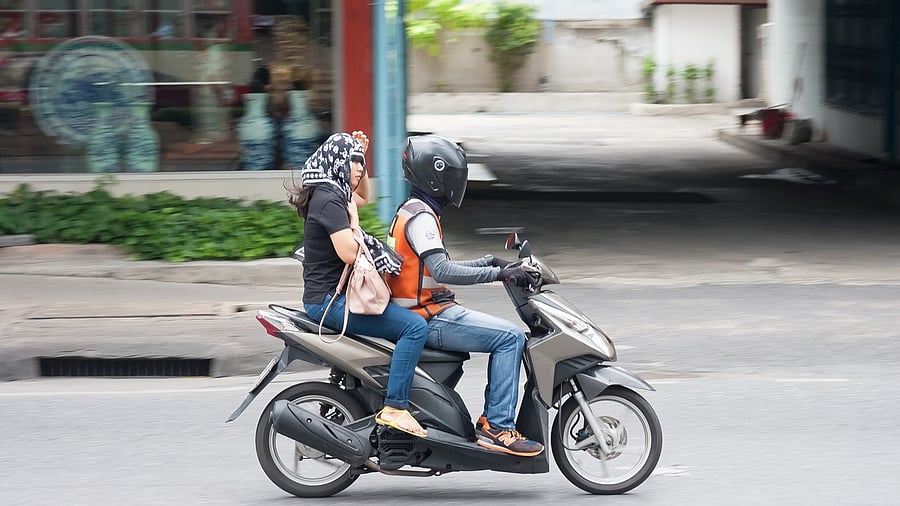
Image showing a bike taxi. For representational purposes.
Credit: iStock Photo
The Karnataka High Court’s order lifting the ban on bike taxis deserves to be welcomed because it restores a vital mobility option in Bengaluru – a city choking on traffic gridlock and public transport gaps – while safeguarding the livelihoods of drivers. The division bench held that motorcycles fall within the definition of transport vehicles under the Motor Vehicles Act, 1988, and ruled that a blanket ban amounted to a de facto prohibition on the constitutional right to practise a profession. The ban, earlier upheld by the single bench, threw lakhs of riders, mostly gig workers, into uncertainty. At the same time, commuters lost an affordable option for quick connectivity. With auto-rickshaws notoriously unreliable, bike taxis have emerged as a practical necessity, filling a glaring structural gap.
The background to the ban reveals a deeper governance failure. Although the state notified an Electric Bike Taxi Scheme in 2021 and the Centre later issued guidelines encouraging states to permit such services, Karnataka chose not to translate them into a regulatory framework. The government also failed to take a clear stand before the court, arguing that it had no policy on bike taxis and did not intend to frame one either. Now, with bike taxis back on the road, the policy paralysis has left a vacuum, forcing commuters to avail these services with no safety protocols in place.
The court order does not grant bike taxis or aggregators immunity from the law, and the government must now frame a comprehensive regulatory framework without delay. This should include mandatory commercial registration, clear permit conditions, and insurance that explicitly covers pillion riders. Verified rider identification, police background checks, real-time digital tracking, and visible permit display must be non-negotiable. Equally important is institutionalised rider training. Structured programmes covering road safety, defensive riding, passenger etiquette, gender sensitisation, and basic first aid should be mandatory before permits are issued. Aggregators should be held accountable for compliance and grievance redressal, while the government must ensure a level-playing field through uniform rules that apply equally to bike taxis, autos, and cab operators. The High Court has cleared the legal roadblock. It is now for the state to prove that it can regulate a modern mobility solution that its overstretched cities urgently need. What the state needs now is not obstructionist policy or bureaucratic red tape, but a vision that recognises bike taxis as a vital component of an integrated urban transport ecosystem rather than a threat to outdated monopolies.