
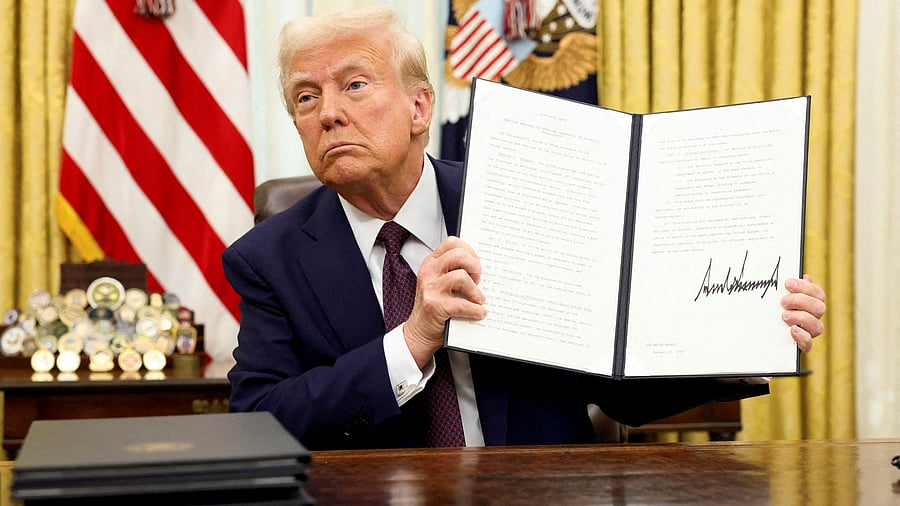
US President Donald Trump holds a signed executive order.
Credit: Reuters Photo
The blitz of executive orders signed by Donald Trump, the 47th President of the United States, is a dramatic foretaste of the Trumpian vision of American triumphalism, about the radical and subversive contours of which there is little doubt.
The orders included the ones entailing the nation’s withdrawal from the World Health Organisation, declaring drug cartels as ‘foreign terrorist organisations’, requiring federal workers return to the office full-time, revoking birthright citizenship, and pulling the United States out of the Paris climate agreement.
American presidents have used executive orders to legislate in ways that overhang far beyond administrative activity – that is, they have used these tools to achieve policy goals – especially those they know they are unlikely to accomplish with the help of Congress.
The list of impactful executive orders – from George Washington’s ‘Neutrality Proclamation’ to the executive orders issued by Woodrow Wilson in World War I to Dwight D. Eisenhower’s numerous national security directives to John F. Kennedy’s order to control racial violence in Alabama to Harry Truman’s desegregation of the armed forces to Ronald Reagan’s seizures of regulatory control – is long.
President Trump has begun his pledge to give America a MAGA makeover and now, a wary world awaits how his vision unfolds. Trump took aim at the Biden administration’s federal procurement targets for clean power, electric vehicles and other energy goals, and revoked a 2021 Biden executive order that set a goal for 50% of US vehicle sales to be electric by 2030.
Attorneys general from 22 states filed a lawsuit to block Trump’s executive order ending birthright citizenship, a century-old practice granting citizenship to US-born children regardless of their parents’ status which they viewed as violative of the 14th Amendment. But if Trump has his way in revoking the automatic citizenship granted to children born to parents who are on temporary work visas (like H-1B) or those awaiting green cards, it would surely impact nationals of countries with high levels of immigration to the US, including India and China.
That the President signed pardons for 1,500 of his supporters who were part of the January 6, 2021 attack on the US Capitol trying to overturn the 2020 election might be a clue to the depth of polarisation of American politics.
His decision to repeal various executive orders promoting diversity programmes and LGBTQ equality – the diktat to the US government is to only recognise “two genders, male and female” – also has the incendiary potential to unleash a new gender war.