
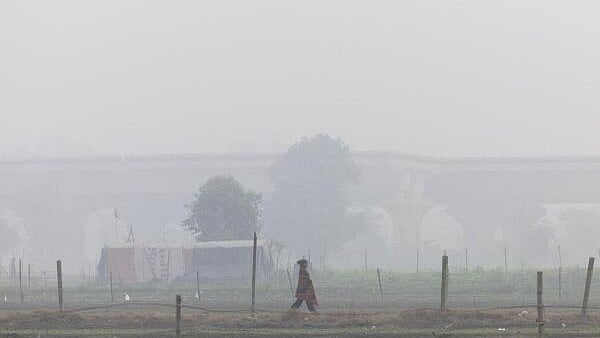
Air pollution in Delhi.
Credit: Reuters Photo
As air pollution rises in Delhi and the National Capital Region (NCR), the continuing and almost normalised absence of effective counter-action is pushing residents to see the public health emergency as an everyday reality. The air quality levels have varied between ‘very poor’ and ‘severe’, with no sign of relief. While the Supreme Court has delivered admonitions, advice, and directions to the government on petitions filed by citizens and civic organisations, it appears to have realised that the matter goes beyond court-decreed action. Calling measures taken so far a “total failure”, the Court has told the Commission for Air Quality Management (CAQM) to prepare a comprehensive long-term strategy, focusing on issues such as urban mobility, industrial processes, energy use, and stubble burning. It said ad hoc and short-term responses cannot deliver any meaningful reduction in pollution levels.
The overall AQI value in Delhi on many recent days was over 400, more than four times the acceptable level. Between November and December, Delhi had 41 days with AQI levels above 300, in the ‘very poor’ category, and eight days when the index crossed 400. Poor air quality and dense fog disrupt road transport, train services, and flights almost every day. Many schools and offices have gone online. The wintry conditions prevent the dispersal of pollutants, aggravating the problem. Visibility has been reduced to just a few metres in many places. Children, senior citizens, and sick persons are particularly affected. The government has tried multiple measures, including cloud-seeding, deployment of anti-smog guns, and mist sprayers. Restrictions were imposed on the entry of vehicles, and enforcement measures were strengthened, with no significant results.
Protests were held to draw the authorities’ attention to the crisis and demand stronger mitigation measures. Public protests on the issue of pollution are not common in the country. Some of them have become unruly, leading to the detention of the protesters. The Supreme Court is set to hear the matter next week when the CAQM is expected to place its revised roadmap on record. But that is only the long-term plan. The problem is also immediate. Unfortunately, the government continues to be in denial mode and, at times, takes negative positions. It has even made statements questioning the impact of air pollution on health and the applicability of the World Health Organisation (WHO) standards on pollution to India. Without acknowledgement of the problem, there cannot be a solution. But the suffering of the people is real, and it calls for informed and immediate steps towards lasting solutions.