
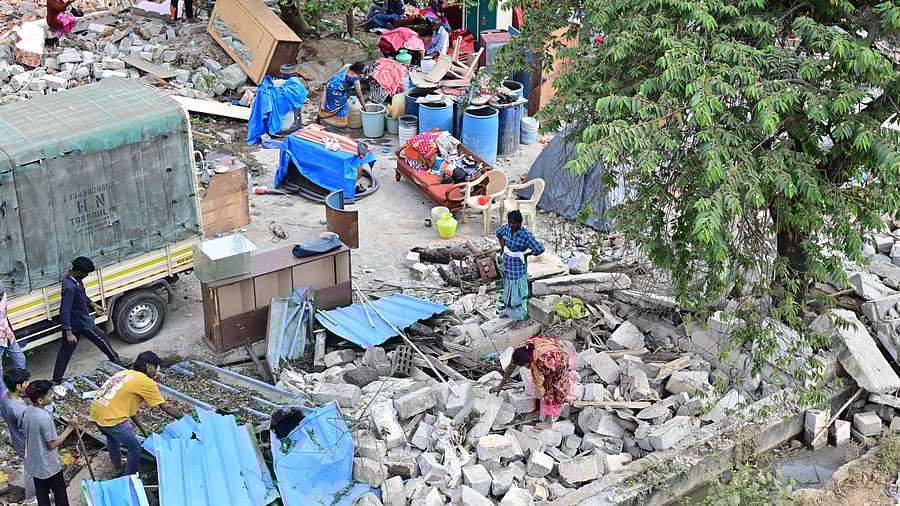
Residents salvage household items amid debris on the second day of the BDA’s encroachment removal drive at Thanisandra on Friday.
Credit: DH Photo/BK Janardhan
After Kogilu, it is now Thanisandra. In Kogilu, the Bengaluru Solid Waste Management Ltd reclaimed encroached land; in Thanisandra, the Bangalore Development Authority (BDA) did the same. The government’s renewed resolve to recover public land is welcome and long overdue in a city plagued by illegal settlements on lake beds, drains, and civic amenity sites. However, the manner in which this is executed raises troubling questions about empathy, equity and intent. Learning partially from the Kogilu backlash, the BDA provided temporary shelters and food to those displaced in Thanisandra. Even so, residents say they were evicted without notice and “treated like dogs”. Such humiliation stings. Urban governance cannot rely solely on force; it must also acknowledge that the poorest are often the most visible, but not the most powerful, participants in land encroachment.
That points to a deeper malaise Bengaluru refuses to confront. The city’s slums are not merely accidental clusters of poverty; many are products of a well-oiled informal land market where the underworld, local musclemen, politicians and corrupt officials operate in close cahoots. Encroachments rarely happen spontaneously. Land is identified, occupied overnight, and quickly populated to create a vote bank. Informal rents are collected and ‘protection’ promised in return. The most disturbing question is this: how is land that does not belong to the seller sold, and sometimes even registered? How do sub-registrars accept documents for government land, lake beds or stormwater drains? These transactions do not occur without official connivance. History offers uncomfortable reminders. Bengaluru has seen figures such as Slum Bharat, an underworld don shot dead in a police encounter. His power flowed directly from controlling slum settlements. In the 1990s, a Congress leader famously carried a ‘slum’ prefix to his name, and went on to become a minister. The nexus between slums, muscle power and electoral politics is neither new nor accidental.
Equally glaring is the state’s selective amnesia over the A T Ramaswamy report. Submitted in 2007, it exposed how tens of thousands of acres of government land were grabbed, often by the rich and influential, with active official collusion. While the poor face bulldozers, many of those named or implicated in that report continue to enjoy immunity. The Karnataka Land Grabbing Prohibition Act exists precisely to address this ecosystem. Used honestly, it can target not just the occupant of a shed but also the financier, instigator and protector behind the encroachment. Demolishing slums may make for strong visuals. Dismantling the mafia behind them, and the official corruption that sustains it, is the real test of political will. Until then, bulldozers will remain symbols of power, not justice.