
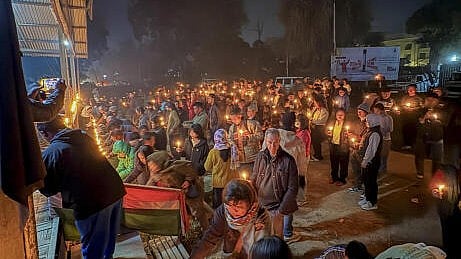
People gather for a candlelight vigil demanding justice for a Kuki woman from Manipur.
Credit: PTI Photo
It will soon be three years since Manipur plunged into a state of conflict and turmoil, and there is still no credible sign of a return to normalcy. More than 260 killings and large-scale displacement of people have been reported during this period, marked by intense distrust between the Meiteis and the Kukis, the state’s two dominant communities. The killing of a Meitei man, Rishikant Singh, who was visiting his wife, a Kuki, in the Kuki-dominated Churachandpur district, is a comment both on the past and the present of Manipur. Their marriage is a reminder of the state’s past, when the two communities could live together. But his killing, followed by the circulation of a video showing the act, sends out a chilling message on the deadly turn the estrangement has taken.
The video footage of the killing was circulated along with a message: No peace, no popular government. The question of whether peace or popular government should come first has been debated for a long time in the state. It was a popular government under Chief Minister N Biren Singh, a Meitei who identified himself with the community, that mishandled the situation, aggravated it, and made peace more difficult to achieve. Before the crisis, relationships involving people from the two communities did not lead to violence. Now, it is difficult to imagine such relationships after an extended period of strife and bloodshed. The first step towards enduring peace will be to eliminate the lack of trust among the communities. Only a popular government that can reach out to both camps with a credible intent for peace can make a difference. The President’s Rule, which was imposed in February last year, has not provided an administration that the people could trust. Over the 11 months, events in the state have shown that the interim arrangement has failed, while efforts to establish a representative, popular government have not made headway either.
Legislators belonging to the two communities met in Delhi last month, but there was no agreement. The meeting, however, signals progress which should be built on. The President’s Rule will certainly have to be extended, but its continuance should not hinder efforts to arrive at a political consensus that will, eventually, shape a popular government. The killing of Singh calls for greater caution from the administration – it should not be allowed to ignite a fresh phase of unrest in the state. Vigil must be intensified to prevent retaliatory action that risks extending the crisis and derailing efforts towards a political resolution.