
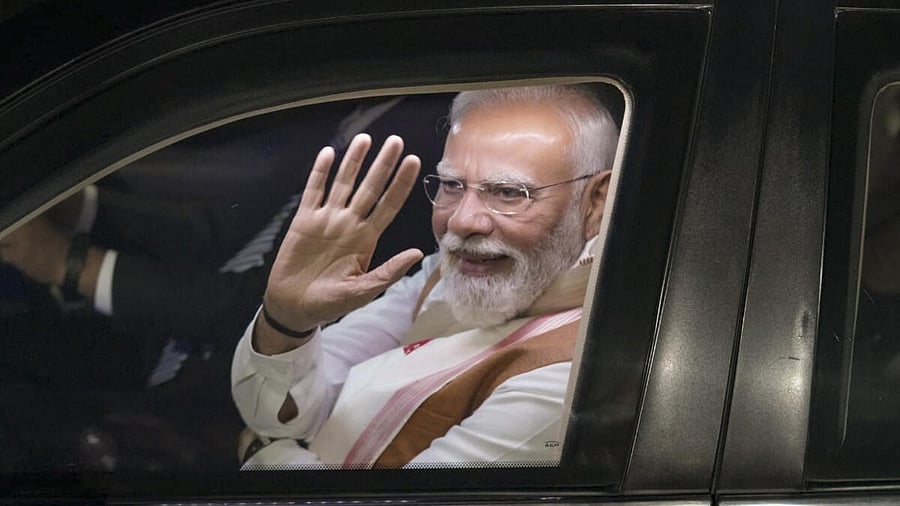
Prime Minister Narendra Modi.
Credit: PTI
Prime Minister Narendra Modi’s three-nation tour of Jordan, Ethiopia, and Oman was intended to strengthen India’s relations with countries in a strategically important region. Relations with the Middle East have assumed greater importance because of the recent geopolitical shifts in the region resulting from US President Donald Trump’s outreach.
The US now has stronger relations with Pakistan. Trump’s tariff war has prompted countries in the region to recalibrate mutual ties. India has traditionally had good relations in the region traced to political and economic reasons. The Narendra Modi government has taken these ties forward, with the attention going beyond the oil-producing nations. India’s relations with Jordan and Ethiopia have to be seen in that context.
During Modi’s visit to Ethiopia, his first to that country, both countries decided to upgrade their relations to a strategic partnership and envisaged improvement in trade, investment, and defence cooperation. They have found common ground in strengthening the African Union and promoting the interests of the Global South. Ethiopia has emerged from a civil war and is now focused on an international outreach. India has offered support to the African nation, which has recently been alienated from the US. It is also a member of the BRICS; India will host the grouping’s 2026 meet under its chairship.
Modi’s visit to Jordan was the first bilateral visit by an Indian Prime Minister to that country in 37 years, and it coincided with the 75th anniversary of the establishment of diplomatic relations between the two countries. India is Jordan’s fourth-largest trading partner, and the two countries have strong economic ties. During the visit, multiple agreements were signed to enhance cooperation across sectors and to improve the existing relationship.
The most important outcome of the Prime Minister’s tour was the signing of a Comprehensive Economic Partnership Agreement (CEPA) with Oman, which will boost trade, jobs, and investment between the two countries. This is the second trade deal with a Gulf Cooperation Council (GCC) country, after the agreement with the UAE, and it will help boost the efforts to expand India’s access to the West Asian market.
Under the agreement, Oman will provide India duty-free access to 98% of its tariff lines. India will give Oman concessions on 77.79% of its tariff lines. The agreement may enable Indian manufacturers to reroute goods to Africa and parts of Europe. It should also be seen as part of India’s broader strategy to widen export destinations to reduce the impact of higher US tariffs.