
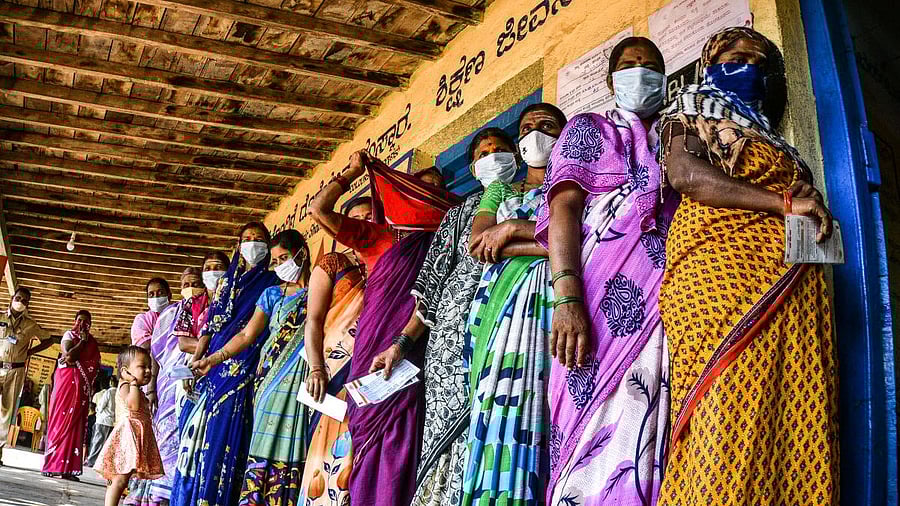
Voters queue up to cast their votes in the 2021 Gram Panchayat elections in Umchagi, Hubballi taluk. (Image for representation)
Credit: DH Photo
Mahatma Gandhi’s vision of gram swaraj was unambiguous: villages governing themselves, politically empowered and financially independent, forming the foundation of Indian democracy. Decades later, that ideal rings hollow as gram panchayats across Karnataka enter the new year starved of funds. The 73rd Constitutional Amendment Act, which came into force in 1993, sought to institutionalise Panchayati Raj and strengthen local self-governance by devolving power, responsibility, and resources to elected village bodies. Karnataka, in fact, was ahead of its time. As early as 1983, under Chief Minister Ramakrishna Hegde, the state adopted decentralisation with the promise that power would flow from halli (village) to Delhi. Today, the flow has reversed – Delhi controls the purse strings, while panchayats wait helplessly.
Karnataka’s 6,000-odd gram panchayats are yet to receive a single rupee from the Centre under the 15th Finance Commission for the current financial year. Of the Rs 2,100 crore due, the first instalment of Rs 1,092 crore has not been released, despite the state fulfilling all stipulated conditions, including submission of gram panchayat development plans. That other states such as Kerala, Tamil Nadu, and West Bengal – often at loggerheads with the Centre – have received their grants only deepens the suspicion of discriminatory treatment. The consequences are devastating. Development works have stalled, payments remain frozen, and some panchayats lack funds even for drinking water supply. Technical glitches following the merger of regional rural banks and IFSC remapping issues have further compounded the problem. As a result, over 800 panchayats are unable to access even existing funds. These are bureaucratic failures for which villagers are paying the price.
The state government, however, cannot wash its hands of responsibility. Elections to taluk and district panchayats have not been held since 2022. With the term of gram panchayat members set to end this month, the absence of elected bodies provides the Centre a convenient pretext to withhold funds. Under the Finance Commission guidelines, grants can be released only to panchayats with elected bodies. Successive state governments have delayed local body elections, often because MLAs prefer development funds and decision-making to remain concentrated in their hands. Together, the Centre’s financial strangulation and the state’s political procrastination have hit at the very foundation of local self-governance. Panchayats today exist mostly on paper, stripped of authority, resources, and dignity. When villages are denied power and money, democracy stands weakened. Gram swaraj cannot survive on slogans alone; it requires timely elections, assured funds, and genuine political will. Until then, local governance will remain a constitutional promise deliberately betrayed.