
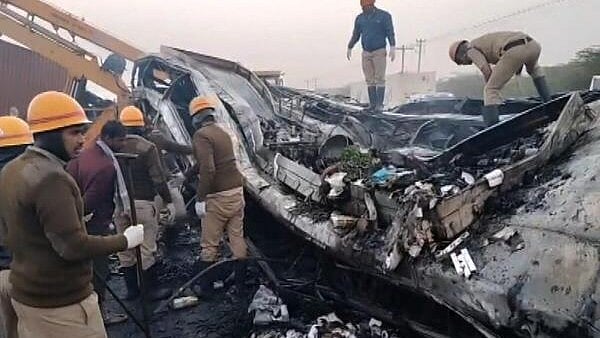
The toll from the tragic collision in Chitradurga rose to seven.
Credit: PTI File Photo
The devastating bus fire on National Highway 48 near Chitradurga on December 25 is not just another accident; it is the predictable outcome of a transport system that treats safety as optional. A private sleeper coach was hit head-on by a container truck that reportedly jumped the median near Gorlathu Cross in Hiriyur taluk, and was gutted within minutes. Seven people were killed and several others seriously injured, most of them trapped in their sleep as the vehicle turned into a furnace. Investigations have since revealed that the bus was carrying inflammable oil cans, which may have intensified the blaze and hastened its spread. This underscores how little has changed since the Kurnool tragedy barely two months ago, where nearly 20 lives were lost after illegally transported smartphones triggered lithium-ion battery explosions. That disaster was supposed to be a turning point. Instead, the Chitradurga incident shows that lessons remain unlearnt.
Uncomfortable questions persist: are buses designed and operated with passenger safety in mind? What are they permitted to carry in their luggage holds? And why are violations repeatedly discovered only after lives are lost? It has emerged that this particular bus had undergone surprise inspections, with its documents, fitness certificate, and even emergency exits found to be in order. That, however, offers little comfort. Compliance in one instance does not absolve a system where many sleeper buses continue to operate with blocked exits, flammable interiors, and unauthorised structural modifications. The standard response after such disasters follows a tired script: blame overspeeding, fatigue or driver negligence. While these factors matter, they obscure a larger truth. Highway design itself can be a silent killer. The Bengaluru-Mysuru highway is a textbook example. It has seen over 200 deaths and more than 1,500 accidents since opening. Unscientific entry and exit points, weak medians, poorly marked black spots, and water stagnation causing hydroplaning are common features on highways, which often slice through villages without safe crossings, creating conditions where one mistake can become fatal.
The solutions are obvious. Strict enforcement of the Centre’s fire detection and suppression rules for sleeper buses must become non-negotiable. Rigorous physical inspections should be conducted, and illegal transport of hazardous materials in passenger vehicles must attract severe penalties. Dangerous highway stretches must be audited and redesigned instead of merely being plastered with speed-limit signs. Above all, the government must act before, not after, another tragedy. Chitradurga is not an aberration. It is a warning, and ignoring it yet again would amount to wilful negligence.