
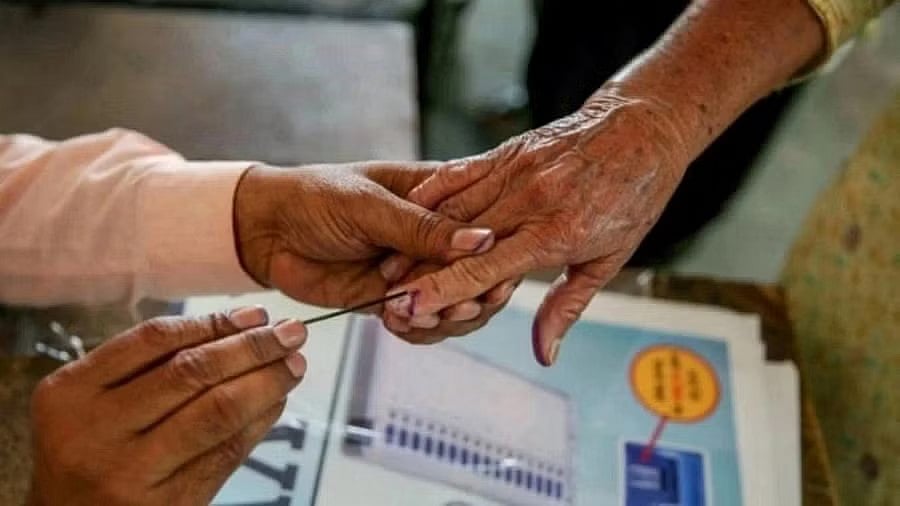
A representative image of a person casting vote.
Credit: PTI File Photo
With the Election Commission of India (ECI) seeking to correct “logical discrepancies” in the names and family backgrounds of voters in West Bengal, as part of the Special Intensive Revision (SIR) of electoral rolls, fresh concerns have been raised about the exercise. The Supreme Court has taken note of the “stress and strain” caused to millions of ordinary people. About 1.36 crore people have received notices from the Commission to explain what it calls discrepancies in the voters’ list. These include six or more voters identified as progeny of one person, a 15-year age gap between children and parents, a less-than-40-year age gap between grandparents and grandchildren, and mismatches in the spellings of common names and surnames. The Court has made strong observations on the matter and issued directions to ease the processes for people who are struggling to respond to the ECI’s questions, so that they remain on the rolls.
A directive from the Court requires the ECI to display the names of voters marked under the “logical discrepancies” category at the gram panchayat bhavans and block offices in rural areas, and ward offices in urban areas. The Court has asked the ECI to allow people likely to be affected by the exercise to submit their documents in these offices, to accept the Class X board examination admit card as a valid document for verification, and to extend the deadline for submitting the documents. These directions were issued after it became evident that the verification process was cumbersome, pushing millions to search for the right documents that prove their identities as voters. These documents are not always easy to procure and the window for submission is narrow. It has been pointed out that only 500 venues are scheduled to host the hearing of 1.36 crore people.
Many of the discrepancies the Commission claims to have found are not relevant to the exercise it has undertaken. The Court asked the Commission how a 15-year age gap between a parent and a child would be illogical in a country where child marriages are not uncommon. From the beginning, the Commission’s efforts in states where SIR was held appear removed from the idea of inclusion – instead of aiming for maximum entries of voters, it seems to follow a model of exclusion. It is to be noted that many “discrepancies” have been traced to the errors in the Commission’s 2002 list, for which voters should not be held responsible. Hopefully, the Court’s intervention will help to contain the damage and ensure that genuine voters are not disenfranchised.