
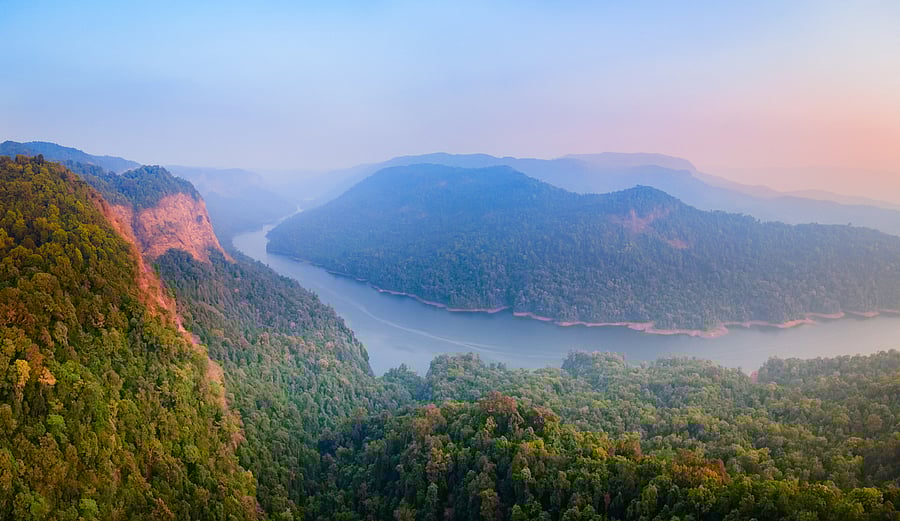
Sharavathi river valley.
Credit; iStock
The Sharavathi Valley in Shivamogga district, home to lush forests, wildlife, and the world-famous Jog Falls, has once again become the epicentre of a development-versus-conservatio n battle. The Karnataka Power Corporation Limited (KPCL) has proposed the Sharavathi Pumped Storage Project (PSP), a 2,000-MW hydroelectric scheme that promises clean energy and grid stability for the state.
The project will use solar or wind power during the day to pump water from Gerusoppa reservoir to the upstream Talakalale reservoir, releasing it through turbines to generate electricity during peak evening demand. On paper, the project seems attractive. It leverages existing infrastructure, relies on renewable hydropower, and promises to strengthen the state’s energy security without burning fossil fuels.
However, beneath this promise lie concerns too grave to ignore. The project site lies within the Sharavathi Valley Lion-Tailed Macaque Sanctuary, part of the fragile Western Ghats, a UNESCO World Heritage Site. Environmentalists warn that blasting, tunnelling, and the felling of more than 16,000 trees will fragment habitats and threaten biodiversity.
Landslides in this geologically sensitive region pose another threat. Critics also point out that the Environmental Impact Assessment is flawed and opaque, failing to account for cumulative ecological and social costs. The project also reopens old wounds. Many families in Henne, Maratha Keri, and neighbouring villages face displacement for the second time.
Their parents and grandparents were uprooted in the 1960s when the Linganamakki dam was built. Promises of land titles, fair compensation, and infrastructure support have remained unfulfilled. Now, the same communities are being asked to sacrifice again, with little confidence that past mistakes will not be repeated. Their anger is not just about losing land but about broken trust.
What, then, is the way forward? Some environmentalists suggest abandoning the project entirely in favour of alternatives such as battery energy storage systems (BESS), rooftop solar, and micro-hydel projects. These technologies are evolving rapidly and offer solutions with far less ecological disruption. If the state insists on pursuing the project, it must begin with a fresh, independent environmental assessment, a transparent consultative process, and a commitment to protecting biodiversity hotspots.
Most importantly, any rehabilitation must ensure compensation under the Right to Fair Compensation and Transparency in Land Acquisition, Rehabilitation and Resettlement Act, 2013, or provide land-for-land compensation, legal titles, and livelihood support for affected families. Karnataka needs clean energy, but not at the cost of priceless natural heritage and the dignity of its people. The Sharavathi project, in its current form, risks repeating the mistakes of the past. Development cannot be brought in through displacement and ecological ruin.