
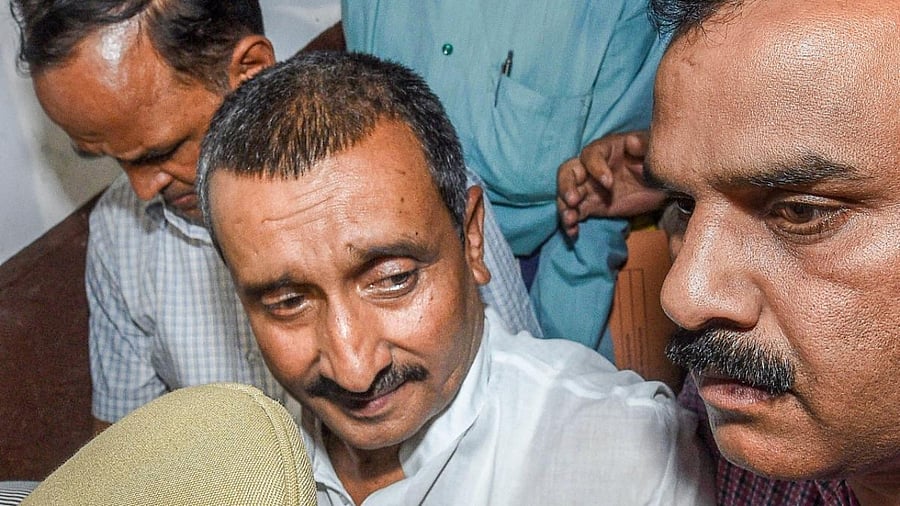
Kuldeep Singh Sengar.
Credit: PTI file photo
By initiating corrective action on important judicial rulings, the Supreme Court has reinstated justice in two diverse cases with underlying common themes of State, society, and public scrutiny. One involved its own order that accepted a new definition of the Aravalli range, which would have exposed large sections of the hills to mining and commercial exploitation. The other action was in response to the Delhi High Court’s order suspending the prison sentence of Kuldeep Singh Sengar, a former BJP MLA from Uttar Pradesh, in the Unnao rape case, and granting him bail. The public had an emotional stake in both cases, as seen in the protests organised against the rulings by activists and civil society.
In the Aravalli case, the Court revisited, suo motu, its ruling of November 20 on the definition of hills in the range, and placed the order in abeyance. It has decided to constitute an expert committee to assess concerns over the elevation-based definition of the range, the ecological continuity, and permissible mining in view of the environmental importance of the hills. The redefinition of the hills based on their height had triggered a controversy, as it excluded most parts of the range from its scope. It also varied from a slope-based definition approved by a committee the Court had appointed earlier. The apex court has done well to bring the matter to a pause and put it to further scrutiny. This is an important intervention, considering that the government appeared to be in a hurry and less persuaded by the environmental implications than by other considerations. It must now stop all construction and mining in the Aravalli region, pending closure of the matter by the Court.
On the High Court’s order in the Unnao rape case, the Court stayed the ruling which would have enabled the former legislator, found guilty in multiple cases, including a criminal sexual offence, to roam free and ultimately, undermine the ends of justice. The High Court’s decision was based on a narrow and technical interpretation of the term “public servant”. Sengar’s benefiting from this textual interpretation was widely seen as a subversion of justice, especially because he had wielded his power and authority in committing a heinous sexual crime, harassing and persecuting the survivor, and even conspiring to kill her father. Justice prevails when its miscarriage is prevented, too. Both judgments are remarkable because they are in line with public sensitivities on the issues involved. Here, judicial thinking also responded, rightly, to popular concerns.