
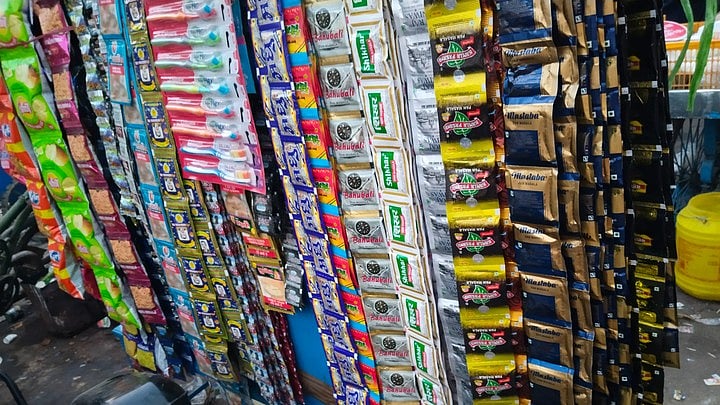
Representative image of gutka packets.
Credit: iStock Photo
The Karnataka government deserves commendation for acting swiftly when citizens raised a legitimate concern about gutka advertisements wrapped around state-run buses. Transport Minister Ramalinga Reddy’s directive to remove all direct and surrogate tobacco advertisements from public buses and bus stations is precisely how a responsive government should function. It acknowledges public sentiment, respects the law and, importantly, places public health above commercial considerations.
What makes this episode significant is that the trigger did not come from a court order or an opposition outcry, but from ordinary citizens, who refused to look away. The movement began modestly in North Karnataka, where young people removed the gutka advertisements on public buses. It soon spread to other parts of the state, including Bengaluru. The message was clear: government-owned spaces cannot be used to normalise social evils. This was not an isolated incident. Some time ago, a viral video showed a young commuter stopping a man from consuming gutka inside a Metro train. Such acts of public vigilance underline a deeper truth: when enforcement fails, citizens step in to defend shared civic spaces.
Gutka, an addictive smokeless tobacco product, is a mixture of crushed areca nut, tobacco, slaked lime, and flavouring agents. Though banned under food safety laws in Karnataka, manufacturers routinely bypass the prohibition by disguising the product as mouth fresheners. The health consequences are devastating. India has one of the world’s highest rates of oral cancer, overwhelmingly linked to smokeless tobacco. The civic damage is equally visible: red-stained walls, buses, and stations bear silent testimony to poor enforcement.
This failure is equally evident in the weak implementation of the Cigarettes and Other Tobacco Products Act (COTPA). While fines for public smoking have been increased to Rs 1,000, enforcement remains lax. Bars and pubs routinely permit smoking despite the law clearly stating that it is prohibited wherever food and beverages are served. This casual disregard erodes the credibility of regulation. One wonders if the government is abdicating its responsibility, waiting for public vigilantism to plug these gaps as well.
Advertising on buses is a revenue stream for transport corporations, but the social cost far outweighs the earnings. A few lakh rupees earned from a bus wrap cannot justify the long-term public health burden. The government has responded decisively when public interest demanded it. This episode is also a reminder of the power of the common citizen. When people act collectively, governments listen. That, ultimately, is democracy functioning as it should.