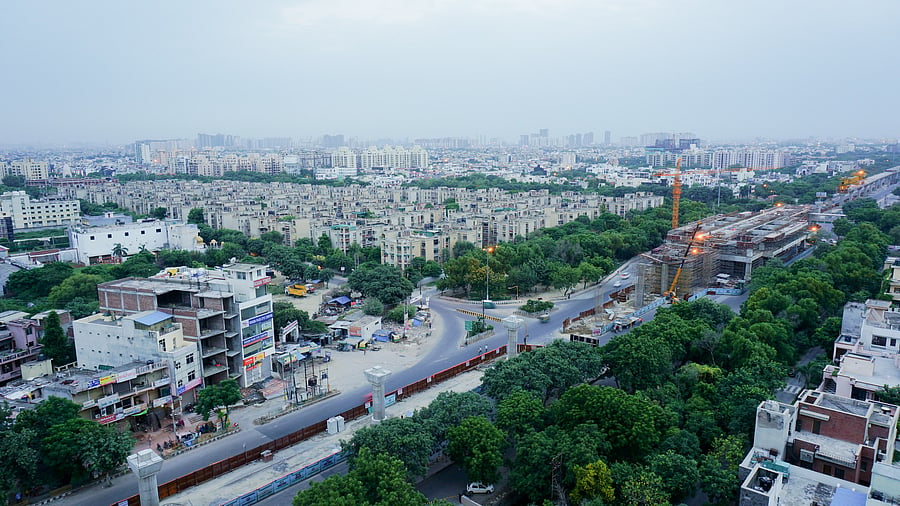
Representative image of Noida.
Credit: iStock
‘Naveda, Naveda, Naveda,’ bellowed conductors soliciting passengers to the ‘killer’ Red Line private buses that operated between Noida and Delhi’s Connaught Place. Infamous for mowing down pedestrians with an uncanny regularity, the buses were phased out as connectivity between Delhi and its satellite towns improved, with the Delhi Metro spreading its tentacles far and wide over the last two decades.
Improved connectivity and a burgeoning population made housing, especially affordable housing, a promising proposition in Gurugram, Faridabad and Noida. While the first prospered due to its proximity to the Delhi airport, Faridabad, spread on either side of the Delhi-Mumbai railway line, evolved as an industrial town.
Noida (acronym for New Okhla Industrial Development Authority), a brainchild of the last Congress chief minister of Uttar Pradesh, Narain Dutt Tiwari, prospered (paradoxically to its name) as a residential township on the western outpost of the state, contiguous to Delhi.
For migrants pouring into the national capital for jobs and livelihood, Noida offered a viable residential option. You could live in Noida and commute to Delhi for work. Soon, Dilli-walas, who once considered all residential suburbs in Jamuna-paar (across the Yamuna) as infra-dig, too crossed the bridge. If it took just 40 minutes to reach your shop in crammed Chandni Chowk, it made sense to shift to a gated condominium and take the Metro to the workstation.
For bureaucrats from UP and adjoining states looking for a second home their children could use while pursuing higher studies in Delhi, investing in a Noida property made sense as well.
Ergo, a development authority was set up to plan a new township. Sectors were demarcated, bungalows were propped up on floodplains, and infrastructure was laid out in neat grids.
The authority acquired more land from farmers in adjoining villages for low-rise residential complexes. Initially, only the Noida Development Authority constructed and sold residential units through a lottery system.
A boom in the housing industry, propelled by easy access and the lowering of interest rates on housing loans, brought private players into the fray. And they came in droves.
Property dealers became real estate magnates overnight. The UP government lowered the entry threshold for builders by offering land with an initial payment of just 30% of the estimated cost. In 2009, the Mayawati government made further amendments to the rules to allow allocation with a mere 10%.
The dream run continued as the builders sold not just homes but dreams. Dreams of having your own address in the Rajdhani. A three-side open house for Mr Khosla. A pool-facing 3BHK for Mrs Arora. A duplex for Mr Banerjee. If you had a customer, the builders had a property.
People invested. They took loans, stayed in rented accommodation and paid EMIs in the hope of living under their own roof one day. Some got it; some continued waiting.
When the courts stepped in to question some of the largesse doled out by the UP government to the real estate sector operating in Noida, the markets collapsed. Builders had acquired large tracts of land by paying a nominal price, but projects remained pending on paper despite having mopped up crores of rupees in pre-launch bookings.
In one of the cases, that of Amrapali builders, the Supreme Court of India intervened to hand over the project to NBCC (India) Limited. But there are a dozen others that remain pending.
In some cases, buyers have been handed possession of properties without the signing of a registered deed, which is a tripartite agreement between the buyer, the seller and the Noida authority. Since dues to the Noida Development Authority have not been cleared, the authority would not sign it.
The Noida landscape is dotted with many incomplete projects where land
was acquired or dug up for the construction years ago.
The recent death of a techie who drowned in a swamp generated by one such 40-foot-deep pit dug up in 2021 for the construction of a multi-storeyed complex in Noida is symptomatic of erratic and haphazard urban town planning in India. The deceased was an engineer in his mid-twenties, returning home post-midnight after a long day at work when his car fell into the waterbody. In zero visibility induced by heavy fog and near-zero temperatures, he kept shouting for help for over an hour atop the roof of his car before the vehicle went under.
Interestingly, Noida does not have a civic body. Or an elected municipality that could be held accountable by its residents. It is a unique arrangement where the development authority, helmed by a CEO, manages everything from horticulture and roads to garbage collection and development of new projects.
It is a city administered by three bureaucrats—the Gautam Budh Nagar district magistrate, the Noida Authority CEO and the police commissioner.
For many decades, the myth of losing power in Lucknow upon setting foot in Noida kept many chief ministers away from the richest city in UP. It finally took a politician-monk in Yogi Adityanath to break this superstition.
Noida, unlike Gurugram, has wide roads lined with trees, an effective drainage system and a decent green cover. Perhaps among the best residential suburbs in the National Capital Territory today.
With a little more conscientious planning, it could have been far better.