
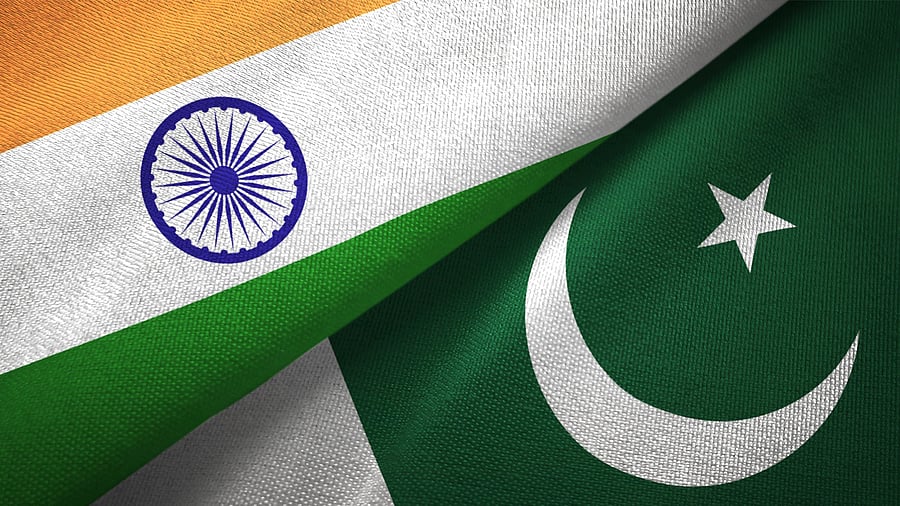
India and Pakistan flags.
Credit: iStock Photo
India and Pakistan have been significant players in the United States’ China policy. While India is seen as a major force in deterring China, Pakistan’s role has been to bridge the US’ gap with China. Pakistan’s stakes in the recent rapprochement between the US and China cannot be ignored. There are important takeaways from the October 30 meeting between Donald Trump and Xi Jinping, which the former referred to as a G-2 summit, and the US’ post-Pahalgam heel turn and Donald Trump’s invitation to Asim Munir.
Historically, the road to collusion between the US and China has gone through Pakistan. The romance between the US and Pakistani military generals is not new; it has its roots in the Cold War days. In July 1961, US President John F. Kennedy invited Pakistan’s President Mohammad Ayub Khan, a former military general, to the State dinner at Mount Vernon. The visit was diplomatic and geostrategic, a part of the US’ containment of the communist states, viz. Soviet Union and China. The US invitation to Pakistan arrived when India was geared to a non-aligned approach, a setback in Washington’s communist containment policy. However, Pakistan grabbed the opportunity to prove its loyalty and became a reliable frontline ally of the US.
In July 1971, US President Richard Nixon sent Henry Kissinger, his national security advisor and secretary of state, on a secret trip to China via Pakistan. The Pakistani diplomatic and military agency, primarily led by Khawaja Muhammad Kaiser, arranged the covert visit to China as a mediator between the US and China. Muhammad Kaiser, Pakistan’s ambassador to China between 1969 and 1972, was pivotal in convincing the Chinese counterparts to meet Kissinger. This subsequently facilitated Nixon’s visit to China in 1972. It was a direct rapprochement between a democracy and a communist state, facilitated by a military authoritarian regime. Nixon’s visit aimed to utilise the rift between China and the Soviet Union, the US’ superpower competitor during the Cold War years. Later, Zia-ul-Haq and Pervez Musharraf visited the US as part of their alliance strategy.
However, after years of healthy relations between the US and India, mainly since the 2000s, Trump has struck a contrasting note. Following the Pahalgam incident, the US’ turnaround towards Pakistan could be part of a strategy with echoes from history.
Pakistan has already proved its loyalty towards both the US and China. Besides the Bridging-China strategy, Pakistan has been viewed by the US as a tool in fighting terrorism, receiving millions of dollars of funding for years. On the other hand, during Operation Sindoor, China provided Pakistan’s armed forces with satellite and intelligence inputs, in addition to arms and weapons systems. China’s all-weather support for Pakistan is undeniable. The current US administration’s affinity towards Pakistan could be a repeat of 1971, i.e. unifying Pakistan, at the cost of India, to negotiate with Beijing directly.
A volatile neighbourhood
Pakistan’s role as a catalyst for G-2 could put it in a more favourable position. In the economic domain, China is a major stakeholder in several development initiatives in Pakistan, including the Gwadar port and CPEC projects. Recently, Trump also mentioned the prospects of mineral trade in Pakistan. Moreover, strong relations with the two economic giants could not only attract further investment and economic aid but also facilitate the flow of development loans and grants from the International Monetary Fund and other global institutions.
On the strategic front, Pakistan could streamline assistance in arms and technology from both the US and China. It is noteworthy that Pakistan’s current arsenal includes arms and equipment from the US, China, and Russia. Pakistan’s relationship with the G-2 could bring technological prowess and add capability to joint production. Recently, Pakistan, which is already using Chinese JF-17 fighter jets, was awarded a $686-million package by the US for the upgrade of its F-16 fighter jets.
Over the decades, India has been able to predict Chinese positions and strategic considerations. The US, however, has maintained a trial-and-error policy with India and Pakistan. Unless it abandons this approach, it may compromise its reliability in India, much like it did during the Cold War. Given that the G-2 countries are crucial for India’s peace and security and economic prosperity, India should be cautious of Pakistan’s moves in its backyard. While balancing its relationship with both the US and China, India must continue to focus on deterring Pakistan’s influence in the region.
(The writer is a research associate at the Indian Council of World Affairs, New Delhi)