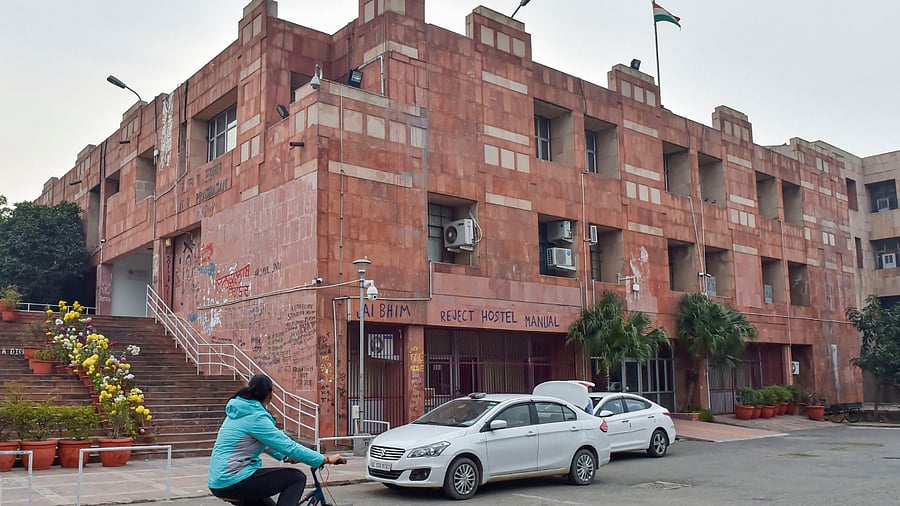
A view of the admin block of JNU.
Credit: PTI File Photo
By organising a path sanchalan composed of a couple of hundred men marching with their lathis in the Jawaharlal Nehru University (JNU), the RSS publicly declared its ‘victory’ stake on Vijayadashami earlier this week. For long, JNU and its well-respected intellectual traditions, its robust student activism, and its carefully nurtured culture of debate and discussion have been targeted by the BJP, its student wing the ABVP, and, of course, the RSS.
A real opportunity to ‘conquer’ what was/is seen as India’s most important (intellectual) Marxist redoubt presented itself with the appointment of Prof Jagadesh Kumar Mamidala as the university’s vice chancellor in February 2016. What was at first a democratic competition for students’ hearts and minds soon became a war by the administration against those who were increasingly labelled as ‘anti-national’ or ‘urban naxal’ for daring to question and challenge the government.
The rest, as we know, is history. Faculty and students in the university pushed back, with great creativity and verve, against the onslaught on JNU’s culture of teaching and learning. Its reputation was severely maligned and damaged, and its faculty and student body were brought under many forms of scrutiny and surveillance. Faculty and students alike were targeted with cases and enquiries that dragged on for years, humiliating and punishing them even though the university administration entertained no hope of winning. The process is the punishment in Naya Bharat.
Neo-nationalism reached a feverish pitch: JNU became the first central university to install a wall of (war) martyrs. Visits and talks by retired and serving military personnel became frequent, and the vice chancellor, in 2017, even requested a tank to be stationed on campus, to ‘instil’ nationalism and to remind the students of sacrifices made by the soldiers. No tank rolled in, but the shape of the university began to change quite literally with the establishment of courses in engineering and management.
A change of character
The RSS engaged in a form of institutional capture, since it possessed neither the credentials nor the breadth of vision to establish a ‘right’ wing version of JNU, though that may have been its original goal. The sight of men solemnly marching to a brassy band, while being showered with petals by supporters on the campus, has served as a powerful sign of the legacy reversal that is being pursued as the RSS exerts more power and control over the university’s intellectual assets.
Since its inception, JNU has been a residential university with a difference. Partly since its student body enjoyed a larger-than-usual role in determining institutional life, a true alternative to some aspects of life outside the university was imagined and has been sustained over the last half a century.
Two significant achievements speak of the truly alternative values the university has managed to sustain and protect over the decades. The first is the resetting of gender hierarchies, rare and even unimaginable in a society that has been deeply scarred by misogyny, violence against women, and harassment of women in daily and academic life. The JNU campus has enabled female students to feel relatively freer in their daily lives and academic transactions, within and beyond the classroom, in hostels and in public spaces. JNU has paid a price for this freedom, since it has long had to live with the backlash against this achievement, in earning the reputation of being too ‘permissive’.
Like many campuses across India, caste/class/regional and ethnic differences are dissolved, as women enjoy forms of respect that are rarely accorded to them outside. Universities such as JNU and the University of Delhi have formulated policies and constituted mechanisms to prevent and redress complaints of sexual harassment.
The unusually high-level participation of the student body in the conduct of student elections through a widely acclaimed constitutional process has kept JNU relatively free of the kinds of violent, money-driven election processes that have become the norm in most universities in the city of Delhi, as well as the country. A rare degree of democratic civility marks student life on the campus, where discussion and debate, even if it is sometimes tediously long, rather than violence in word or deed, govern student interactions.
All this stands to change, even be reversed, as forms of hyper masculinity, so familiar to us in all other aspects of Indian public life, appear to assert themselves, as in the RSS path sanchalan.
(The writer is a retired professor, Jawaharlal Nehru University)
(Disclaimer: The views expressed above are the author's own. They do not necessarily reflect the views of DH.)
Read more at: https://www.deccanherald.com/opinion/no-handshake-can-hide-hostility-indians-face-on-britains-streets-3755319