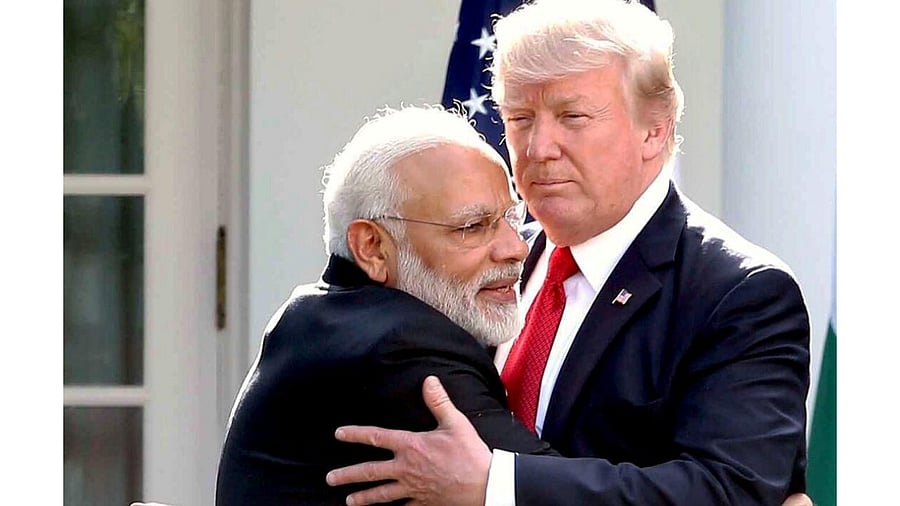
Prime Minister Narendra Modi and US President Donald Trump
Credit: PTI Photo
An editorial in The Economist began with the comment that the Donald Trump administration’s National Security Strategy (NSS) left Europe’s policymakers ‘in a panic’. Europe has reasons to reject the NSS. Whereas New Delhi’s calm reaction is to be seen in terms of the document’s benign neglect of India. There’s no angst, no fury, no despondency. In the past few months, India's outlook on the relationship with the United States, which was hailed as one of the most consequential partnerships of the 21st century, has changed fundamentally.
The Western perception of ‘mass migration’ as the leitmotif of the NSS is irrelevant to India, while the document’s silence on the ‘Russian threat’ to the Western world is a vindication of independent India’s contrarian experience of Russia being a ‘time-tested friend’.
Nonetheless, isn’t it interesting that despite all the intra-differences within the transatlantic system, the one thing that brought the Trump administration and European allies together is its pressure on India’s ‘Russia connection’? When it comes to self-interests, the US would still have uses for European allies.
Trump is consistent in his belief that European allies are free-riders, and can at best be a selective partner for the pursuit of the ‘America First’ doctrine. According to The Economist, the Beltway is swirling with rumours that those insiders most supportive of America’s allies within Trump’s team 'will be out in the coming year or so — among them, Marco Rubio, the secretary of state.’
Broadly, the rift between the US and Europe over Ukraine is widening. Europeans are clearly aiming to delay a settlement in Ukraine. Trump truly understands the motivations of current European leaders, and is distancing them from the settlement process. In a recent interview with Politico, he called Europe a ‘decaying’ alliance of countries with ‘weak leaders’, and accused European leaders of ‘talking a lot but achieving nothing’ on the Ukrainian issue. He also reminded Kyiv that Russia's negotiating position is stronger than Ukraine's, and that it's time for Volodymyr Zelenskyy to pull himself together and start agreeing to the US proposals. According to Trump, Ukraine is using the conflict to avoid holding elections.
All this raises the question of how much longer, bravado apart, Europe can hold out. Europeans are caught in a pincer — on one side, the Russian military pressure and on the other side Trump’s political pressure. The EU lacks the resources or capability to withstand such pressure. Almost all EU member states are already burdened with debt.
In sum, the spectre that is haunting Europe is of a divided, militarised, and economically weak continent with hollowed out supra-national institutions. Europe is doomed to settle for a subaltern role in Washington’s orbit, with its influence and autonomy on global processes dramatically declining in the near term.
What engages India’s attention most in the NSS will be the encouraging response from Moscow and Beijing to Trump’s vision of ‘flexible realism’. The Kremlin paid fulsome praise to the NSS, saying ‘the adjustments that we see correspond in many ways to our vision.’ Such effusive public agreement between Moscow and Washington concerning the tectonic plates of global politics is indeed rare.
Trump’s strategy largely accords to Moscow’s view — principally, Washington jettisoning its demonisation of Russia as ‘evil empire’; NSS’ pledge to end ‘the perception, and preventing the reality, of the Nato military alliance as a perpetually expanding alliance’; NSS’ call for co-operation with Moscow on strategic stability issues; and the real, painful, shocking wake-up call for Europe, etc.
The good part is, New Delhi does not need to worry about its proximity to Moscow, which would give India more strategic room to manage its Russia relationship on its own terms in the short term.
Equally, China’s positive reaction to the NSS is attributable to the ideological and substantive shift in US foreign policy. The NSS is deeply pragmatic by underscoring that the democracy agenda is over; it explicitly declares that the US preference is non-interference in other nations’ affairs, and about respecting states’ sovereignty; and it’s signalling that US foreign policy choices will be made based on what makes America more powerful and prosperous, etc.
China sees that the massive investible surplus of capital in its diplomatic toolbox could lubricate the US economy as Trump crankshafts America First. Indeed, the NSS reframes the relationship with China in terms of economic competition and eschews the previous rhetoric of an imminent military threat. Basically, the strategy seeks to leverage an economically competitive and interdependent world with an accent on domestic renewal, American job protection and restoration of industrial strength, and for ‘rebalancing America’s economic relationship’.
The new transactional and mutually beneficial US-China relationship and the document’s idea of shared responsibility are a far cry from the earlier notions of India being a ‘counterweight’ to China in the Indo-Pacific. Suffice to say, the Narendra Modi government’s calculus to position India at the forefront of the anti-China front through the Quad was an exercise in futility.
There isn’t a single mention in the entire NSS document of great power competition with China. In fact, NSS views China on its list of security priorities for the first time on page 19 of the 33-page document, and occupying just one section in a report that also covers Europe, Africa, West Asia, and other regions.
The Economist wrote: ‘Official thinking today seems to be guided by commerce and a desire to preserve a planned April summit between Mr. Trump and Xi Jinping… News that America will allow Nvidia to sell one of its more advanced chips in China suggests that the administration is ready to sacrifice some of its technological edge over China in exchange for goodwill… The fear among America’s allies is that the administration may indeed be moving in the direction the NSS lays out.’
The Indian foreign and security policy establishment is putting a brave face on its Himalayan blunder of waging an anti-China crusade, which ultimately only diminished the country’s regional influence, compromised its ‘strategic autonomy’ by aligning too closely with US strategic interests, and annoyed Beijing needlessly. Trump’s MAGA-oriented America First visualises India as a cog in the wheel of the US’ broader strategic priorities, such as helping cement positions in the Western hemisphere or with regard to critical minerals in Africa.
This is a far cry from the Modi-Trump joint statement of February 2020 titled Vision and Principles for India-US Comprehensive Global Strategic Partnership, issued after the US president’s State visit to India in February 2020. ‘O, what a fall was there, my countrymen!’ — to borrow the famous line by Mark Antony in Shakespeare’s Julius Caesar lamenting Rome’s stability.
M K Bhadrakumar is a former diplomat.
(Disclaimer: The views expressed above are the author's own. They do not necessarily reflect the views of DH)