
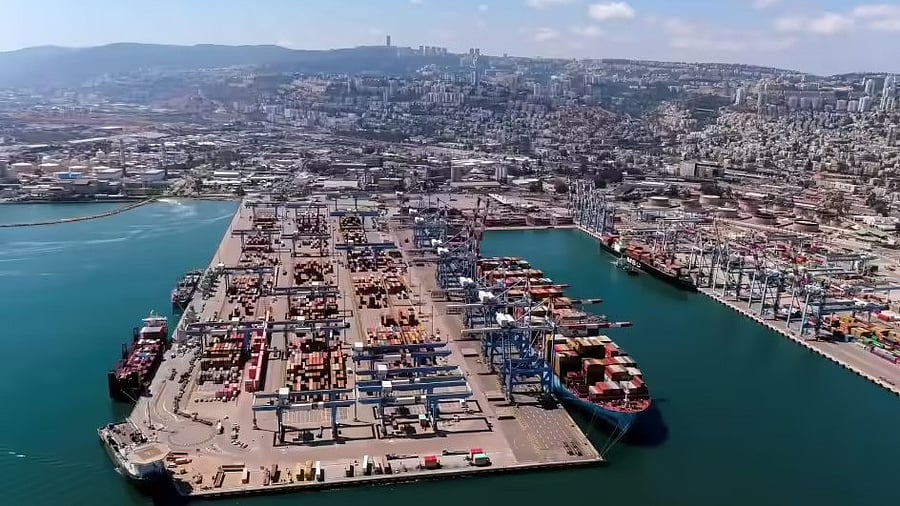
The Chabahar Port
Credit: X/@TheReal_RX
The strategic bet India placed on Chabahar is facing its strongest test in recent times. Donald Trump’s recent threat to impose a 25% tariff on countries trading with Iran amid the ongoing volatility in the country and Washington’s push to further isolate the Islamic Republic has ruffled feathers in New Delhi’s strategic circles. Compounding this, the six-month US sanctions waiver shielding India’s operations at Chabahar is set to expire in April 2026, deepening uncertainty around one of India’s most critical projects. With reports of India’s possible pullback from the port circulating widely, officials in New Delhi have indicated cautious engagement with Washington to manage the fallout.
Located on Iran’s southern coast along the Gulf of Oman, Chabahar offers India a rare strategic corridor that bypasses Pakistan and opens direct access to Central Asia and Afghanistan. Its position outside the Strait of Hormuz shields it from maritime choke point risks; its deep-water capacity allows it to handle large vessels while its status as a free economic zone simplifies customs and taxation procedures – factors that boost its commercial viability.
More critically, Chabahar underwrites India’s access to Central Asia, a region of renewed geopolitical attention, and a rich source of uranium, rare earths, and critical minerals vital for India’s semiconductor self-reliance, defence indigenisation, telecom expansion, and green transition. New Delhi has been steadily seeking to anchor itself in the region through the Connect Central Asia policy (2012) and the India-Central Asia dialogues. Trade with Central Asian economies has steadily grown from $500 million in 2014 to nearly $2 billion in 2025, with estimates suggesting an additional $2 billion in untapped potential.
Chabahar also underpins the tentative reset in ties between India and Taliban-ruled Afghanistan by serving the interests of both sides. Since Kabul fell to the Taliban, India has used Chabahar to send 2.5 million tonnes of wheat and 2,000 tonnes of pulses, keeping its humanitarian and development outreach intact.
Besides these, the port anchors the broader connectivity initiatives such as the 700-km Chabahar-Zahedan railway and the International North–South Transport Corridor (INSTC), a 7,200-km multimodal network linking India to Russia and Europe via Iran. Its proximity – 170 km west of Pakistan’s China-backed Gwadar port – significantly elevates its geopolitical significance, offering India a counterweight to China’s expanding maritime and continental footprint.
Thus, India’s long-term involvement in Chabahar reflects a multifaceted strategic logic. Its commitments reflect a confidence in Chabahar as a long-term strategic asset. However, evolving geopolitical pressures now cast uncertainty over these investments.
Fallout and damage control
Trump’s renewed sanction threat confronts New Delhi with a delicate balancing act. Scaling down operations would mean relinquishing a key geopolitical asset at a moment when India’s Central Asia ambitions, re-engagement with Afghanistan, and regional connectivity through INSTC depend on Chabahar’s viability. Any retreat could weaken India’s credibility as a reliable long-term partner, potentially ceding greater strategic space to Beijing.
Conversely, openly defying US sanctions carries high long-term costs, particularly at a time when India is already under US sanctions for its continued purchase of Russian crude and souring tensions following India’s Operation Sindoor and New Delhi’s rejection of Trump’s claim of brokering an India-Pakistan ceasefire. Further friction risks undermining India’s broader relationship with Washington – spanning from the Mineral Security Partnership, India-US Defence Acceleration Ecosystem, Transforming the Relationship Utilising Strategic Technology, and the Quad – platforms that are central to India’s global positioning.
More importantly, Trump’s increasingly fluid and transactional approach towards Pakistan pushes India to tread carefully since any further deterioration in India-US relations could allow Islamabad a greater room to align itself more closely with Washington’s shifting priorities.
As pressure mounts on India’s strategic hinge at Chabahar, New Delhi has been compelled to reassess multiple options. Discussions within the Ministry of External Affairs on reallocating the committed $120 million or creating a separate operating entity to limit direct governmental exposure signal this recalibration. Yet tactical adjustments alone will not suffice. India must intensify diplomatic engagement with Washington to seek workable alternatives, while simultaneously preparing contingency pathways that preserve Chabahar’s operational continuity without breaching US sanctions.
The Chabahar episode captures a classic foreign policy dilemma for India: how to safeguard a vital geostrategic asset while preserving sufficient diplomatic elbow-room to manage inevitable political and strategic fallout. The port thus stands as a strategic tightrope where every step demands balance, and every misstep carries significant trade-offs.
(Mahesh is a teaching assistant and research fellow at IIT-Bombay and Raza is a researcher at the Indian Council of World Affairs, New Delhi)