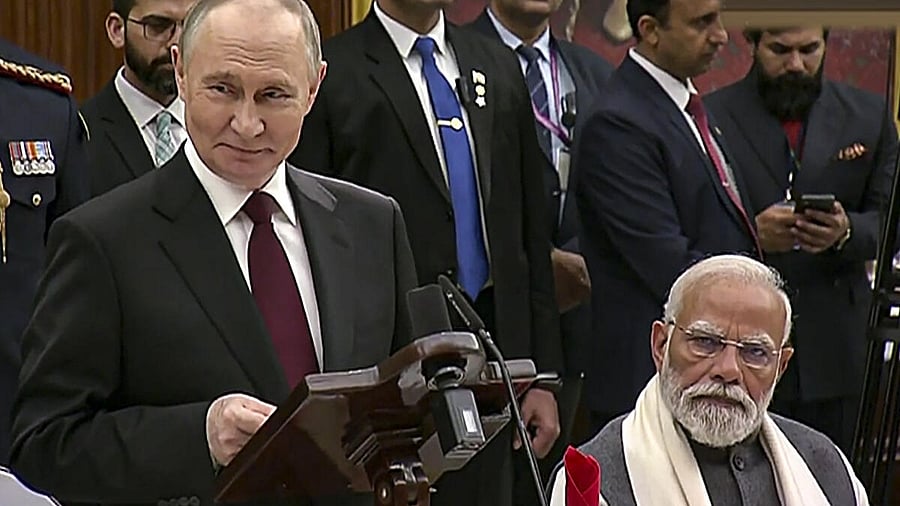
Prime Minister Narendra Modi with Russian President Vladimir Putin
Credit: PTI Photo
By Mihir Sharma
Russian President Vladimir Putin’s visit to New Delhi last week was his first since the invasion of Ukraine in 2022. Bilateral summits used to be held annually, but until now the Indian side has seemed to find reasons to avoid them. This time, however, the Russian president was greeted with ostentatious bonhomie. Prime Minister Narendra Modi met him as he landed, and the two leaders hugged. The readout afterward praised the two countries’ “special and privileged strategic partnership.”
But, as is often the case with Indian diplomacy, the uplifting tone concealed more than it revealed. For all the warmth on display, relations between India and Russia are plateauing.
That’s because they actually don’t have a great deal to offer each other — except perhaps as a hedge against their other friends. Look behind the headlines, and it’s clear that plans for economic integration and a $100-billion trade target are purely aspirational.
Consider the biggest bit of news: That India will lease a nuclear-powered submarine from Russia for $2 billion over 10 years. That doesn’t mean the military relationship has suddenly grown closer. The boat will be used only to train the navy, which will have it for just a decade. Plus, the lease has been in the works for years; it’s delays on the Russian side that have now been resolved.
If anything, this serves as a reminder of why New Delhi has soured on purchases from a country that was once its main defense supplier. Contracts aren’t fulfilled on time, spare parts are tough to come by, and prices tend to balloon.
Trust has broken down. The army is still waiting on two S-400 missile systems; it bought five for $5.4 billion in 2018, but only three arrived. The Russian military-industrial complex is so overcommitted that Indian planners aren’t sure when the rest will turn up — even though this summer’s conflict with Pakistan reminded them of the importance of solid air defense.
Even issues such as migration have become fraught. Moscow may want to attract more skilled Indians, but New Delhi is concerned about reports that its young men are being promised jobs but wind up on the frontlines in Ukraine.
And crude purchases, the backbone of the bilateral relationship, are beginning to be more trouble than they’re worth. The Russians don’t seem interested in buying anything from India in return. Which means they must be paid in dollars, not rupees — but sanctions have tightened and such payments are getting harder each day.
A ballooning trade deficit and a set of accounts that nobody can settle have pushed New Delhi into badgering Moscow to lower its non-tariff barriers on Indian farm goods and to send more tourists. But these are imperfect and insufficient attempts to repair a trade relationship that is structurally unsound.
So why the warmth? And why meet now? It’s obvious why Russia is interested. India’s friendship allows Putin to claim to his people that the majority of the world is still on his side.
More importantly, he can tell China that. The Kremlin is deeply uncomfortable with its subordinate role in that “no limits” relationship, and thinks visits like this signal it can rally support on its own accord, that it is no mere vassal. There are still some domains — nuclear technology, traditional energy resources, ties with the Global South — where Moscow genuinely has more expertise than China.
India has its own motives, including for the timing of this visit. New Delhi has long believed that the war in Ukraine will end with some messy, unsatisfying freezing of the current front line. It looks like US President Donald Trump will turn those expectations into reality — and so India should demonstrate continuity in this relationship now, before some deal in Washington resets Russia’s global posture. It’s also helpful to remind Europe and the US that they need to work harder to keep New Delhi on their side.
But India’s biggest motive is straightforward and transparent. It was even put into writing, in the “international issues” section of the post-summit joint statement — which, incidentally, mentioned Gaza but not Ukraine.
Both sides, the leaders said, would aim for a multipolar world as well as “a multipolar Asia.” That’s as clear as diplomat-speak ever gets: Neither Russia or India will give China uncontested control in their shared neighborhood.
Some relationships are less about the two in them than they are about other people. This is one of them. Neither country can supply what the other most needs; India doesn’t have the resources to support Russia’s shrinking economy, which in turn doesn’t have the supply chains that could fulfil our manufacturing dreams. But even if nothing is left in the relationship except for pride and pageantry, that’s still enough to make a point to China and the West.
A plateau, however festooned it might be with red carpets and welcome banners, is still a plateau. And both Delhi and Moscow must know that they are nearing the edge of what their “special and privileged” partnership can actually provide.