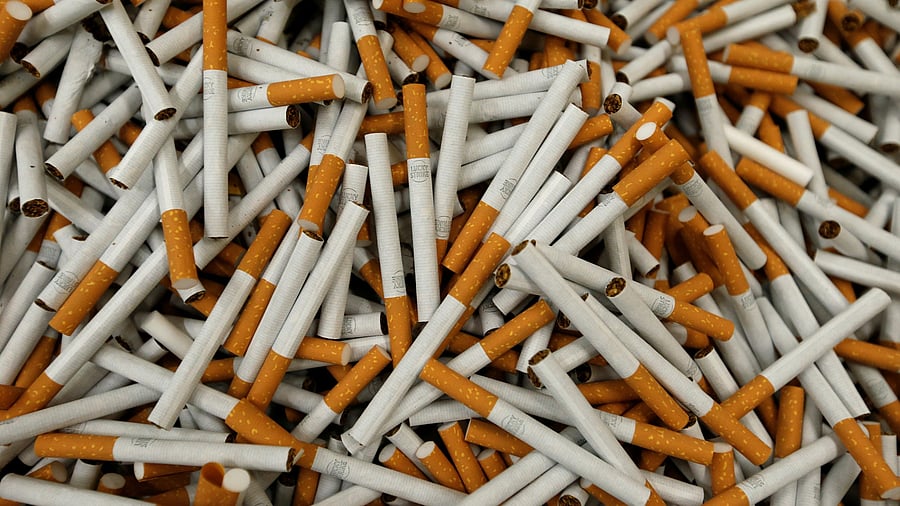
File photo for representational purpose.
Credit: Reuters Photo
The Union home ministry’s recent notification modifying tobacco taxation — effective from February 1 — marks an inflection point in India’s approach to taxing harmful products.
The Centre seeks to correct long-standing distortions in tobacco pricing through the restructured GST rate, the gradual removal of the GST compensation cess, and a new valuation system for smokeless tobacco based on retail prices. The intervention is not a moral stance on consumption, but an economic rectification to a tax system that had lost its purpose.
Policy situation and rationale
In 2017, the GST regime restructured tobacco taxation into two major slabs (5 per cent and 18 per cent), along with a special 40 per cent rate for luxury and sin goods. With GST rates and a compensation cess, the old excise duty system — once the primary tool for deterring tobacco use — was effectively dismantled.
The finance ministry itself admitted that excise duty on cigarettes had been reduced to a nominal ‘fraction of a paisa’ per stick. Notably, the compensation cess on tobacco products has remained unchanged for nearly eight years.
This stagnation coincided with steady income growth and inflation, making tobacco cheaper in real terms. The ministry’s FAQ acknowledges that cigarette affordability has either remained constant or increased over the past decade. This reflects a clear policy failure in tax design: levies on harmful goods lose their corrective effect when they are not adjusted at least proportionally to rising incomes.
Policy variable of affordability
In public health economics, affordability — not price — is the key variable influencing consumption. A fixed tax rate of a growing economy functions like a tax cut in real terms, and India’s tobacco taxation clearly illustrates this.
The Global Adult Tobacco Survey (GATS-2) estimates that 42 per cent of men and 14 per cent of women in India smoke tobacco, with the country accounting for ~70 per cent of global smokeless tobacco users.
Smoked tobacco is largely consumed through bidis, especially among lower-income and rural populations, whereas smokeless tobacco products (gutkha, khaini, and pan masala) remain widely accessible. Against this backdrop, a tax regime that allows affordability to rise is not neutral — it actively undermines public health goals.
Pigouvian policy of tobacco taxation
The most suitable analytical model to explain the Centre’s move is Pigouvian taxation. Tobacco consumption creates negative externalities not reflected in market prices: higher public spending on healthcare, lost productivity, morbidity, premature death, and broader social costs. When consumers pay prices that exclude these costs, consumption exceeds the socially optimal level.
A Pigouvian tax aims to internalise these externalities by raising prices to reflect the true social cost. This reasoning is not moralistic; it does not judge personal preferences, but corrects a market failure.
The ministry’s emphasis on affordability, real prices, and external standards suggests such economic arguments which underpin the reform.
The objective is welfare maximisation. Consumers retain choice, but prices signal social costs. Unlike prohibition, taxation does not eliminate choice; it corrects harmful behaviour without unintended consequences.
The broader meaning lies in how the reform is framed. If seen as moral policing or mere revenue generation, it risks political opposition and policy instability. Interpreted as Pigouvian correction, it represents an effort to make markets work more honestly.
As India confronts rising healthcare burden and tobacco-related deaths, the reform’s success will depend less on immediate revenue gains than on whether it establishes an evidence-based framework for taxing harmful consumption. In that sense, February 1 is not an endpoint, but a test of future policy coherence.
The writers are students at the National University of Study and Research in Law, Ranchi.
(Disclaimer: The views expressed above are the author's own. They do not necessarily reflect the views of DH.)