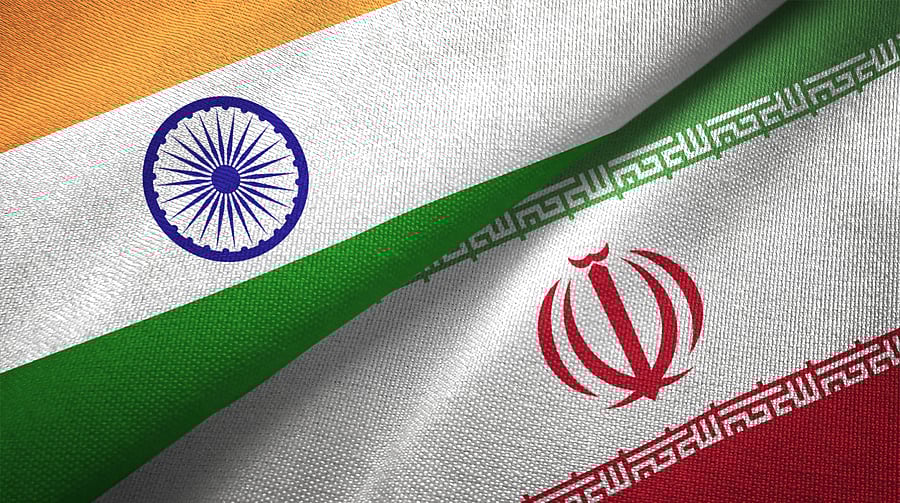
India and Iran flags
Credit: iStock Photo
The wave of protests across Iran marks one of the most serious internal challenges the Islamic Republic has faced in recent years. What began as demonstrations against currency collapse and economic mismanagement has rapidly escalated into a political crisis, with protesters openly demanding regime change. The scale, intensity, and persistence of the unrest, combined with growing international scrutiny, place Iran at a precarious juncture. For India, this crisis is not a distant internal upheaval; it has direct implications for its strategic, economic, and geopolitical interests in West and Central Asia.
Iran’s economic crisis has been building for years, driven by structural weaknesses, corruption, sanctions, and policy failures. The sharp fall of the rial, rising food prices, and widespread unemployment triggered protests in Tehran in late December, before spreading nationwide. What distinguishes this protest cycle from earlier ones is its swift evolution from economic grievances into overtly political demands. Slogans targeting the clerical establishment and Supreme Leader Ayatollah Ali Khamenei reflect a deepening crisis of legitimacy that the regime is struggling to contain.
The State’s response has been uncompromising. Iranian authorities have launched a securitised crackdown involving mass arrests, intimidation, and lethal force. Human rights organisations report dozens of deaths, including those of minors, though exact figures remain difficult to verify due to repeated nationwide internet shutdowns. The judiciary has issued stark warnings, with Iran’s Attorney General declaring that protesters could be treated as “enemies of God”, a charge that carries the death penalty. The army and the Islamic Revolutionary Guards Corps have described security as a “red line”, vowing to protect strategic infrastructure and warning citizens against alleged foreign-backed plots.
Yet, beneath this show of force, there are visible divisions within the Iranian leadership. President Masoud Pezeshkian has called for restraint, while the judiciary, security forces, and the Supreme Leader have adopted a hardline stance. This lack of internal consensus weakens the regime’s ability to manage the crisis and risks further alienating an already disillusioned population. The imposition of repeated internet blackouts reflects the leadership’s anxiety about losing control of both the narrative and the streets.
The protests have also acquired symbolic and organisational dimensions that heighten the regime’s unease. Demonstrators have waved Shah-era flags bearing the lion and sun and displayed images of Reza Pahlavi, the son of the deposed monarch. The symbolism of monarchy in the protests signals a rejection of the Islamic Republic’s ideological foundations rather than a call for limited reform.
International reactions have complicated Tehran’s calculations, with the US adopting sharp rhetoric; European countries, Australia, and Canada condemning repression; and Iran blaming the US and Israel for fomenting unrest. While direct military intervention remains unlikely, the convergence of internal protests, diplomatic pressure, and economic vulnerability has placed Iran in one of its most fragile positions in years, developments that merit close attention from India, given its stakes in Iran’s stability.
A measured distance
India’s foremost concern is the Chabahar Port project, in which it has invested nearly $500 million as a strategic gateway to Afghanistan, Central Asia, Russia, and Europe, bypassing Pakistan. Prolonged instability in Iran threatens the project’s timelines and strategic value, particularly the Chabahar-Zahedan railway, with labour disruptions, internet shutdowns, and supply-chain interruptions already highlighting its vulnerability. Sustained unrest could also allow China to expand its influence, weakening India’s regional and maritime posture. Beyond connectivity, India’s energy interests are also at stake, as the political turmoil in Iran could disrupt regional energy dynamics and constrain future cooperation.
Against this backdrop, New Delhi’s diplomatic approach has been cautious and pragmatic. India has maintained engagement with Iran’s political leadership, seeking to insulate strategic cooperation from short-term turbulence.
As chair of BRICS in 2026 and a prominent voice of the Global South, India occupies a unique position. It enjoys working relations with Iran, the US, and key regional players, enabling it to act as an interlocutor rather than a partisan actor at a time of heightened tensions.
Ultimately, Iran’s crisis underscores the long-term strategic costs of economic mismanagement and political rigidity. Economic collapse, mass protests, and international pressure have together created a volatile situation with uncertain outcomes. For India, the challenge lies in safeguarding its strategic interests without becoming entangled in Iran’s internal conflict or great-power rivalries. Sustained engagement, strategic patience, and contingency planning will be essential as New Delhi navigates the fallout from one of the most consequential political moments Iran has faced in recent years.
(The writer is an associate fellow at the Manohar Parrikar Institute for Defence Studies and Analyses)
Disclaimer: The views expressed above are the author's own. They do not necessarily reflect the views of DH.