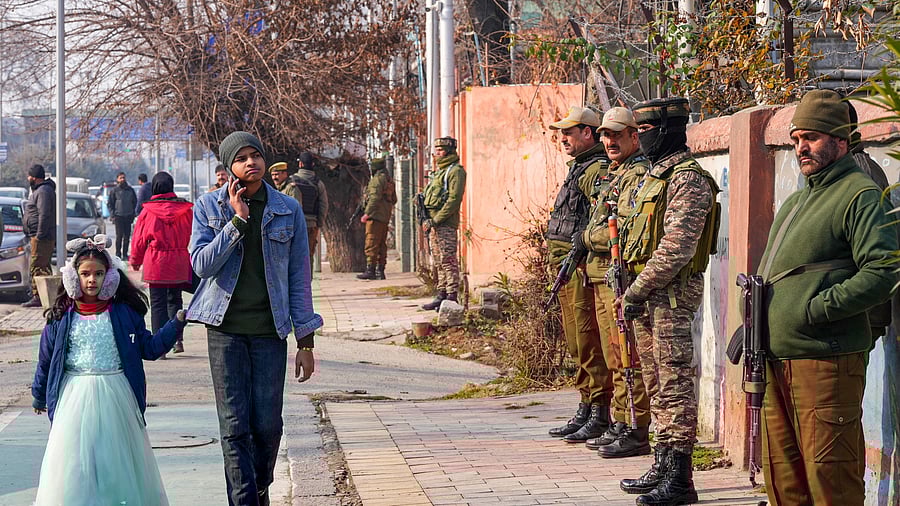
People pass by as security personnel stand guard.
Credit: PTI photo
Over the past few years, journalists working in the Valley have noticed a quiet but profound shift: people increasingly refuse to speak—not just on record, not just anonymously, but even off the record. Conversations stop midway, voices drop instinctively, and questions are met with polite deflection. “Please don’t quote me” has quietly evolved into “Please don’t ask.”
This is not dramatic censorship through shuttered newspapers or banned websites. It is a subtler, more insidious form of silencing that comes from multiple directions—State institutions, social pressures, and lingering fear of militant groups. The result is a collapse of the line between public speech and private conversation, making even off-the-record exchanges feel risky.
For decades, Kashmiris spoke to journalists despite extraordinary danger. During the peaks of insurgency, when violence and crackdowns were frequent, people still shared their grief, anger and experience. They understood the risks but believed context mattered—that journalists could preserve nuance and act as intermediaries between lived reality and the outside world. That confidence has faded.
Today, ordinary people fear misquotation and inference. In a fragmented media ecosystem, a sentence can travel far from its setting—flattened into a headline, amplified on social media, or repackaged for debates. A cautious observation can appear categorical; an analytical remark can seem provocative. In a region where identity and intent are constantly scrutinised, even unintended interpretations can be risky.
Fear of losing context compounds this. Kashmir resists binaries. A shopkeeper may resent economic disruptions yet reject violence; a student may criticise governance without supporting separatism; a family may desire stability while carrying unresolved political grief. But public discourse outside Kashmir often demands clarity where none exists, forcing words into rigid frames: pro-State or anti-State, normalcy or resistance, loyalty or dissent.
This anxiety is amplified by sharply polarised media. Speaking to the “wrong” platform can be read as taking sides. Ordinary people, who see themselves as neither activists nor ideologues, increasingly choose silence rather than risk being absorbed into a narrative not of their making.
Administrative aftershocks of speech add another layer. Routine interactions with the State—passport verification, government jobs, travel permissions—are widely perceived to involve scrutiny. Old social media posts, past associations, or reported remarks may resurface unpredictably. Whether anecdotal or systemic, these perceptions shape behaviour. Silence becomes a rational defence.
State pressures are mirrored by non-State ones. Social, political, and ideological scrutiny continues to influence expression. Being seen as “talking to the media” can invite suspicion or resentment. Residual fear of militant backlash, though reduced since the 1990s, persists psychologically. Memories of journalists targeted, sources exposed, and families harassed linger. In tightly knit communities, caution is adaptive.
The digital environment deepens this fear. A comment shared in confidence can be screenshot, forwarded, and circulated without consent. Many worry less about the journalist present than about unseen audiences who may later encounter stripped-down, misinterpreted versions of their words.
Even government officials, once relatively accessible, now increasingly decline comment. Calls go unanswered, messages unread. Where bureaucrats earlier offered off-the-record clarifications, they now issue only formally cleared statements. This mirrors the broader withdrawal of citizens, leaving journalists dependent on press releases and authorised narratives.
For journalism, the consequences are profound. Reporting thrives on ordinary voices—on testimony, contradiction, and dissent. When those voices retreat, coverage becomes cleaner and safer but thinner, reflecting administration rather than society. The lived reality of Kashmir—the hesitations, quiet negotiations, and doubts—fades from view. Silence risks being mistaken for consensus.
Journalists themselves are not blameless. Competitive pressures, sensational headlines, and careless handling of sources have sometimes reinforced public mistrust. In a high-stakes environment, one instance of misrepresentation can linger long enough to discourage future conversations. Trust, once broken, is hard to restore.
Yet this is not a media problem alone. Journalism does not operate in a vacuum. When legal frameworks are broad, enforcement unpredictable, and accountability opaque, self-censorship becomes rational, not cowardly.
The implications for democracy are serious. Democratic accountability depends not only on elections but on continuous dialogue between the governed and the governing. Journalism is supposed to mediate that dialogue—to surface grievances before they harden into alienation, to document successes alongside failures, and to reflect society honestly to power. When both citizens and officials withdraw from this exchange, governance risks becoming insulated, hearing only what is formally conveyed.
Silence also distorts feedback loops. Policies may succeed on paper while generating quiet distress on the ground. Without candid reporting, course correction becomes difficult. Absence of visible dissent should not be mistaken for genuine consent.
Kashmir is not unique in experiencing shrinking civic space, polarised media, and guarded speech. Across India and globally, similar trends exist. But Kashmir, shaped by decades of conflict, identity scrutiny, and layered vulnerabilities, experiences this chilling effect more intensely.
The challenge is not simply to urge Kashmiris to speak but to rebuild conditions where speech feels safe, meaningful, and worthwhile. That requires restraint from state institutions, space for dissent without suspicion, accountability among non-state actors, and journalism that prioritises context over speed.
Until then, the quiet will endure. And in that quiet, journalism loses not just stories but also its most essential resource—trust.