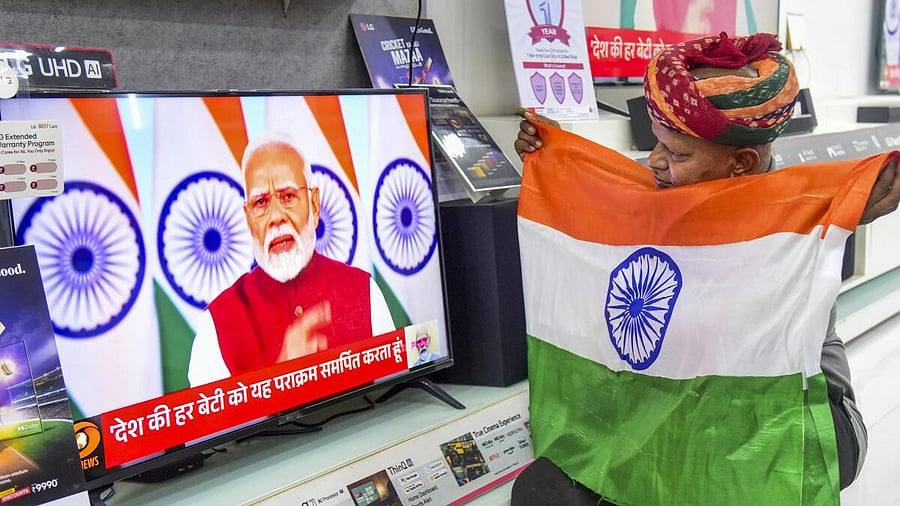
A man holds the national flag as he watches the live telecast of Prime Minister Narendra Modi's address to the Nation, in Bikaner, Monday, May 12, 2025.
Credit: PTI Photo
Prime Minister Narendra Modi’s stirring victory speech, setting India’s new war doctrine, delivered a strong message on terrorism to Pakistan. Perhaps its belligerence also tried to assuage the faithful that the ceasefire with Pakistan was not a retreat.
The government’s political rhetoric had convinced many that India would not only crush Pakistan in any war that ensued but that the annexation of Pakistan-occupied Kashmir (PoK) would follow. For that audience, the ceasefire following Operation Sindoor was a damp squib.
Modi’s pre-recorded television address departed from the usual ease and confidence with which he addresses the masses. It was punctuated throughout by obviously orchestrated moves like the contrived hand gestures of clasping his palms to signify unity and the repeated raising of a pointed index finger. Another dramatically extravagant gesture was the salute with a hand trembling with emotion.
Perhaps such a passionate performance was demanded not only when declaring victory over Pakistan, but was also a necessary message to the Hindutva ecosystem urging it to keep the faith.
Many within it had expressed frustration and disappointment after the declaration of a ceasefire. After Foreign Secretary Vikram Misri announced the ceasefire with Pakistan, it was not only his family that was trolled by the Right-wing, but also the Modi government itself.
Hindutva activists, pro-government media personalities, and some Bharatiya Janata Party (BJP) leaders took to social media to contemplate whether India had surrendered from a position of strength. Some wondered why India had not ‘annexed PoK’. Others declared, ‘As long as these terrorists are alive, a ceasefire makes no sense’.
Those baying for Pakistani blood after the Pahalgam terrorist strike, also relentlessly trolled Himanshi Narwal, wife of slain Navy officer Lieutenant Vinay Narwal, after her appeal to not spread hate against Muslims or Kashmiris. She said that she wanted justice, not communal violence. Narwal was accused of dishonouring her husband’s sacrifice. Wild accusations were made against her and of her links with the terrorist attack itself.
Those who could not tolerate even a call for communal amity cannot have been expected to support the ceasefire with Pakistan.
The other issue that enraged the Right-wing ecosystem was the United States’ claim, by no less than its President Donald Trump, that there would have been no ceasefire without its help. Even after India’s repeated claims that it was a defeated Pakistan that had sued for peace, Trump kept reiterating that he had a role in engineering the ceasefire.
Modi needed to appease his Right-wing support base because without them his political narrative cannot be disseminated. They are the ones who operationalise campaigns against targets identified through labelling and well-recognised dog-whistles. Only when the hardcore elements become the avant-garde, do the moderates and the middle classes follow them.
Modi’s address to the nation then had to carry the bellicose message that “Terror and talks cannot go together… Terror and trade cannot go together…. Water and blood cannot flow together” and “if there are talks with Pakistan, it will be only on terrorism; and if there are talks with Pakistan, it will be only on PoK”.
He trusts his supporters to not dissect his new doctrine too finely. They are not expected to think about the contradictions set up by such familiar clichés.
Pakistan may quite readily agree that talks be only about terrorism. But it will surely bring terrorism in Balochistan into the discussion, for which it publicly blames India. It accuses India of fanning terrorism and suicide attacks in Balochistan and its adjoining province of Khyber Pakhtunkhwa by using the Balochistan Liberation Army and the Tehreek-e-Taliban Pakistan. India has denied these allegations.
Again, if India wants to discuss the return of PoK, Pakistan cannot be prevented from talking about its claim on Kashmir. In fact, they might even be happy that India is bringing a discussion on Kashmir to the table. The only new issue added by Modi is the threat of holding back the waters of the Indus system by putting the Indus Waters Treaty in abeyance.
What India has done successfully is to put pressure on Pakistan to agree to restart talks on the treaty. That is a strategic victory in itself.
But can India realistically mobilise the Indus waters to fight Pakistan’s sponsorship of terrorism? Of its proposed three-stage plan of dam construction, water diversion, and data cut off, only the last seems feasible. India currently lacks the massive dams and diversion canals required to deny Indus waters to Pakistan. They will take years to build, and Pakistan has already declared that it will consider water denial an act of war.
Not that Right-wing trolls are expected to think through these contradictions in the new strategic doctrine unveiled by Modi. But they have acquired an unusual weight in Indian politics in recent years. The oppositional space in India has moved from Parliament and the streets to social media, which has become a far more effective tool of mass political mobilisation.
It was the trenchant questions on the Pahalgam terrorist strike asked of the Modi regime by three women on social media that drew the ire of the State on their heads. Not the Congress and the rest of the political opposition, who felt scared to criticise the government’s failures in Pahalgam lest they alienate ‘mass sentiment’ and be dubbed ‘anti-national’. The street marches or ‘Jai Hind Sabhas’ now being organised by the Congress to celebrate India’s victory and question the mediatory role of the US may be both confusing as well as politically too late.
Modi instead is directly addressing his core constituency recognising vulnerabilities his leadership may face after the ceasefire, US claims of mediation, and the possibility of talks with Pakistan. The extreme Right-wing of Hindutva was nurtured under his regime. He knows that he must keep riding that tiger to survive. Hence, the aggressive and orchestrated public display of belligerence to keep the flock together.
(Bharat Bhushan is a New Delhi-based journalist.)
Disclaimer: The views expressed above are the author's own. They do not necessarily reflect the views of DH.