
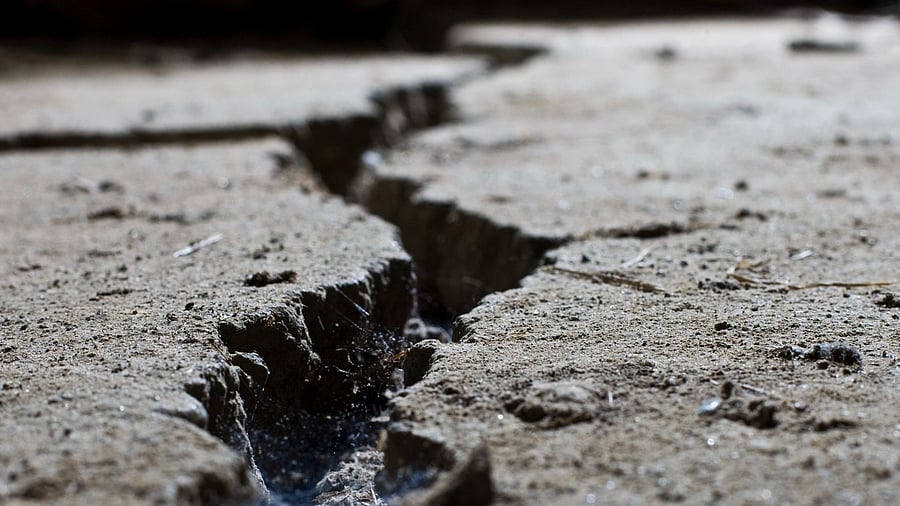
Earthquake. Representative image
Credit: iStock Photo
The first night after I landed in Gujarat, a day after the Kutch earthquake twenty-five years ago, I could not sleep. The killer quake had flattened a large part of Ahmedabad. High-rise buildings had sunk into the ground with their occupants inside, and one could still hear their screams. I heard desperate cries for help from someone trapped inside a four-storey building buried underground. People were on edge as aftershocks—some of them quite strong—continued rocking the city every few minutes.
The earthquake occurred at 8.46 am on January 26, 2001. Its magnitude was 7.7 MW (6.9 on the Richter scale), and it lasted for about two minutes. The epicentre was at Chaubari village, located to the north of Bhachau in Kutch district, 65 km east of Bhuj and about 250 km west of Ahmedabad. Among other things, it is also remembered for the sheer number of aftershocks it generated. In the first fortnight after the earthquake, there were two major aftershocks of magnitudes of 5.9 and 5.3. There were 953 aftershocks in 2001, followed by 149 in 2002 and 53 in 2003.
By the time I returned to the hotel for the night’s sleep—urgently needed as I was to travel to Bhuj the next day—Ahmedabad had experienced close to 200 aftershocks. The rocking continued throughout the night. Every few minutes, the hotel building would tremble, and I would sit upright, ready to jump out of the room at the first sign of a crack on the wall. After an hour or so, I gave up and came down to the ground floor near the reception, prepared to spend the rest of the night on a sofa.
The reception clerk on night duty understood my predicament. He offered me a bunk meant for hotel workers. Since it was on the ground floor and there were other staff members in the hall, I finally managed to sleep, hoping that if a big one came, at least a few minutes would be available to run to the street.
Fortunately, nothing untoward happened. The next morning I left for Bhuj. For the next two days, I slept in the backseat of the car—the driver slept in the front—and survived on a few packets of biscuits and water as I travelled to some of the worst-hit areas, such as Bhuj, Anjar, Bhachau, Rapar and nearby villages. While travelling I picked up relief material from aid workers and distributed it to people who had received little support till then. I also worked as an interpreter for locals seeking help from foreign rescue teams.
At Anjar, a town known for vegetable dyes, knives and bandhni textiles, there was a peculiar sight. A few shops were open, and they were selling nothing but cheap perfumes and deodorants. The air was so heavy with the smell of rotting bodies lying by the roadside that it was impossible to walk around unless the nose was wrapped in a handkerchief almost soaked in perfume. Corpses covered in cloth lay along the road. Anjar was also the place where a Republic Day procession of
300 children and their teachers was buried under debris when buildings on both sides of a lane collapsed on them. The majority died.
How many were killed in the Kutch quake? Initial numbers cited by the authorities were very high. A Union minister even claimed that over 100,000 people might have died. Figures released by government agencies in the first week of February were around 16,000, which later rose to over 20,000, based on police and hospital records. A subsequent verification process revealed many overlaps and duplication of figures. The final death count was fixed at 13,805, of which 12,221 were from Kutch district.
Bhuj was completely devastated. The air inside the walled city, which was once filled with the sounds of goldsmiths and jewellery workers, stank of rotting corpses on the road. The 281-bed district civil hospital collapsed, killing 11 staff members and 182 patients.
The military hospital provided emergency care. By afternoon, a tent was set up at Jubilee Ground, suturing material was gathered from another hospital, anaesthetists were made available, and surgeries began, which continued over the next four days.
By the following day, more doctors from other cities reached Bhuj, ready to offer their services. In the initial days, there were problems with the availability of medicines, but things improved gradually. More temporary hospitals were set up on the ground, and a prefabricated hospital was created. I spent the night at Jubilee Ground inside the car, which continued rocking throughout the night.
The temblor brought down electricity and telephone lines. It led to a rise in crime, and people struggled to communicate their well-being to their relatives in other cities. I met two brothers
who travelled over 200 km in 12 hours just to make a single STD call to their family in Mumbai.
The quake also damaged many historical monuments. Morbi’s famous Darbargarh Palace, Mani Mandir, Nagar Darwaja, Wagamel and Green Tower—built by or associated with the royal family of Maharaja Waghji Thakur—were damaged substantially. So were the Shaking Minarets in Ahmedabad’s Gomtipur. Bhuj’s Kutch Museum, which showcased the region’s craft and culture, was badly damaged.
According to an estimate by INTACH, at least 10,000 historically important sites, including palaces, old havelis, wells, chhattries, places of religious significance, clock towers, gateways, and pavilions, located across 250 towns and numerous villages, were affected by the earthquake.
Lack of coordination among officials in the wake of such a devastating tragedy was visible almost everywhere in the initial days, though things improved later. Communities came together to help each other.
The experience of the Bhuj quake was instrumental in conceptualising the National Disaster Management Authority and the raising of the National Disaster Management Force, along with the enactment of the Disaster Management Act, 2005, to provide legal backing to the two bodies. Gen N C Vij, who as Southern Army Commander played an instrumental role in the relief and rehabilitation work, was tasked with creating a dedicated authority to deal with all types of disasters.
Unhappy with the relief and rehabilitation work by the Keshubhai Patel government, the Atal Bihari Vajpayee government at the Centre dispatched a young leader by the name of Narendra Modi to oversee the operations on the ground. Modi met journalists in Ahmedabad and assured them of help and support while they travelled to Kutch. Within a year, he became the chief minister of Gujarat—and the rest, as they say, is history.