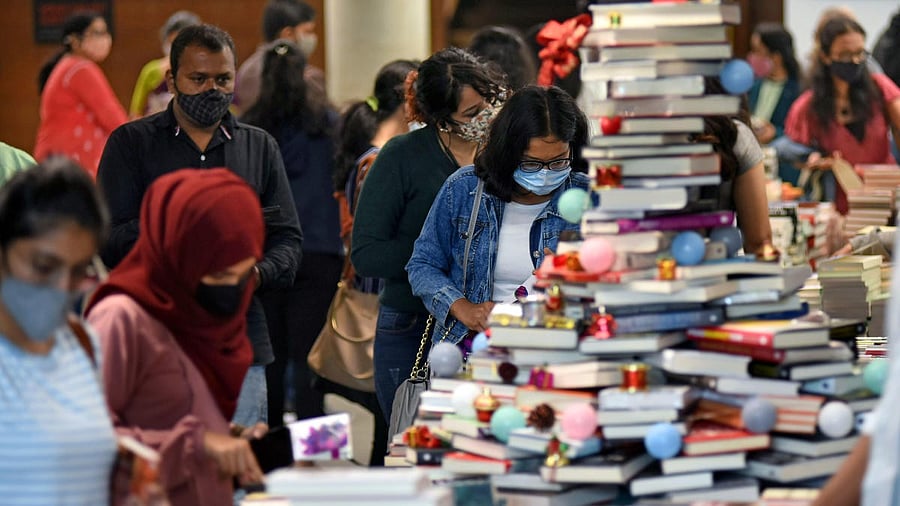
Representative image of a lit fest.
Credit: DH Photo
It is that time of the year again – the literature festival season. India celebrates the written word in every possible form by holding these events in many cities. The festivals shape a cultural trend, build public curiosity around books and ideas, and turn literature into a shared civic experience. In many ways, literature festivals now function like modern public squares – spaces where society gathers to listen, question, disagree, and reflect.
The festivals are enriching not merely because of the range of sessions they offer but because of the deeper questions they provoke about literature, representation, and democracy. They also reaffirm something we often forget: literature is far more than prose and poetry. It is an expansive universe that includes politics, journalism, economics, gender studies, cinema, sports, ecology, and the many disciplines that shape human life. Writing in any field that speaks to social realities is also literature. That is why festivals today host discussions not only on fiction and poetry, but also on public policy, climate change, migration, digital life, and the ethics of representation. Literature becomes a meeting point for ideas.
And this is where a troubling pattern emerges – whose voices are heard, whose voices are we celebrating, and whose voices are missing? When people speak admiringly of Gen Z as expressive, bold, and progressive in these literary gatherings, who exactly are they referring to? Not those children who are from the disadvantaged sections of society, not those in government schools, not young people living at society’s margins. Too often, a small slice of urban middle-class youth is presented as if it represents an entire generation. This selective visibility becomes sharper in mainstream English literary spaces, where participation often depends on cultural capital – education, accent, networks, and access to English.
Indian literature is not a single stream. It is multilingual, layered, and deeply shaped by social realities. Many Indian-language traditions, including Kannada, Malayalam, Tamil, Telugu, Bengali, and Marathi, have long histories of social critique and inclusion. They have produced writers who speak directly about caste, labour, gender, hunger, migration, and injustice. But English literature showcased at many festivals remains dominated by the middle and upper classes. Even when festivals speak of diversity, representation can become symbolic rather than structural.
The literature of the marginalised remains underrepresented in many mainstream festival line-ups. This absence is not because writings of the marginalised do not exist in English. Dalit texts exist in English translation, and Dalit authors write in English too. Yet they rarely receive sustained space on national literary platforms. The question is uncomfortable but necessary: are such voices excluded because they “have no voice”? Or because they do not fit the fluency norms and cultural codes of elite spaces?
A structural exclusion
If fluency becomes the gate, the failure lies not with the writers but with the education system that has historically withheld English from communities that need it most. This brings us to a crucial point that literature festivals must confront more directly: teaching English to the marginalised is not a luxury; it is a responsibility.
It is not enough to teach English as a subject. English must also become a medium through which Dalit, Adivasi, and disadvantaged students learn science, history, philosophy, politics, music, and economics. Only then can they write about these subjects in English and enter national forums, academic discourses, publishing networks, and literature festivals with confidence and authority.
For too long, English literature in India has been guarded – consciously or unconsciously – by elite and middle-class gatekeepers. Indian-language literatures are respected but often through polite admiration rather than equal platforming. Even when festivals invite writers from marginalised communities, they are sometimes positioned as “special sessions” rather than as central voices shaping the festival’s intellectual agenda.
We speak at festivals about gender, identity, climate, technology, popular culture, cinema, and global politics. Yet we often leave out the most transformative issue of all: education. If literature festivals aspire to be democratic cultural spaces, they must begin by asking: Where are the marginalised? Why do their stories not appear on our panels? Why are they not on our stages? Inclusion cannot be a decorative gesture. It must be structural.
And that inclusion begins long before the festival, inside classrooms, libraries, government schools, community reading spaces, and public universities. It begins with access, with English, with opportunity, and with voice. Only then will literature festivals truly represent the full spectrum of Indian life – not just everything and everyone, but also those who have long been left outside the gates.
(The writer is a professor and academic head at the Regional Institute of English South India, Jnanabharathi Campus, Bengaluru)
Disclaimer: The views expressed above are the author's own. They do not necessarily reflect the views of DH.