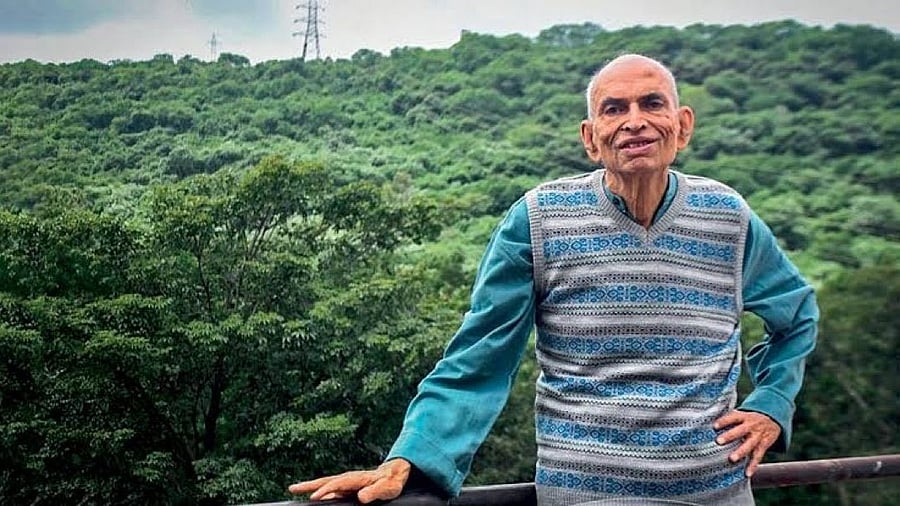
Madhav Gadgil
Credit: X/@Jairam_Ramesh
I am flooded with memories from my time as a research student of Prof Madhav Gadgil at the Indian Institute of Science (IISc). We used to see him--and his equally illustrious wife, Prof Sulochana Gadgil--regularly at the IISc swimming pool. IISc folklore has it that when the Institute wanted to recruit Prof Sulochana, a distinguished meteorologist from Harvard and MIT, it also solved the classic “two-body problem” by also recruiting Prof Madhav Gadgil from Harvard. He came from the lineage of the legendary mathematical biologist E O Wilson, renowned for his work on sociobiology, and was a legend in his own right.
At IISc, PhD students are required to clear an oral qualifier examination before proceeding with their thesis work. This examination board consists of experts from outside one’s own department and often even outside the Institute. I had the good fortune—or perhaps misfortune, depending on the outcome of the exam—of having Prof Madhav Gadgil as my examiner. After trying to ease my nerves by asking a few general questions about my thesis topic, he gently led me to the blackboard.
He began with an apparently innocent query about my knowledge of biomass. I pleaded complete ignorance. He then proceeded to walk me through the fundamentals of renewable natural resource concepts – from the general notion of the biomass of a fish population in a pond to the growth path of that biomass, which turned out to follow a logistic growth equation. Mathematically, it was a differential equation, which, upon solution, yielded the growth equation of biomass. This went on, patiently and methodically, for another two or three hours. By then, I had lost all sense of time. That episode probably explains what first-principle thinking truly means.
After all this was over, he generously invited me to give a few seminars on renewable resource economics at the Centre for Ecological Sciences (CES) at IISc. Superficially, this appeared to be a great honour. In reality, it was his subtle way of making me understand the importance of renewable resources and nudging me to acquire the necessary depth of knowledge in the subject.
Though I thought it was a distraction at that time, decades later—when I began working on climate change issues—all of this came in handy. It was a joy to see the German students fill my lectures on natural resource economics with keen interest in distant, ecologically diverse Bayreuth in Bavaria. When I went on a forest tour with the ecology faculty there, I could readily connect their experiments in Bavarian ‘managed’ forests with insights drawn from forestry models I had studied while preparing for my CES seminars.
It is therefore no surprise to me that Prof Gadgil is celebrated as one of India’s greatest ecologists, to whom we owe the first Biosphere Reserve tag for the Nilgiris and decades of principled policy work towards its preservation. What is perhaps less widely known is his association with the founding of the Centre for Theoretical Studies at IISc. The centre brought together scholars from across the world in disciplines such as anthropology and the philosophy of science. It was this centre that gave IISc a truly open and liberating academic culture, allowing students like us a glimpse into fields we would otherwise not have encountered in a predominantly science and engineering institution.
Such intellectual openness in him to other subjects is hardly surprising. He came from a social science family: his father, D R Gadgil, was Vice-Chairman of the Planning Commission and a dominant figure in Indian economics and the founding director of the Gokhale Institute of Politics and Economics at Pune. His joint work with historian Ramachandra Guha, who used to cycle around the IISc campus during those years of their collaboration on the use and abuse of nature, which resulted in two monographs, is another pointer to what I am alluding to.
My lasting memory is that of standing in the middle of a Bavarian forest full of tall beech trees, remembering the equally tall Professor Madhav Gadgil and all that I learnt through his gentle yet firmly guided learning process during a brief period of my life. One note reverberated through me: the gratitude owed to the great scholars of our country, which can only be repaid by passing it all on to the next generations.
(The writer is Vice-
Chancellor, Vidyashilp
University, Bengaluru)