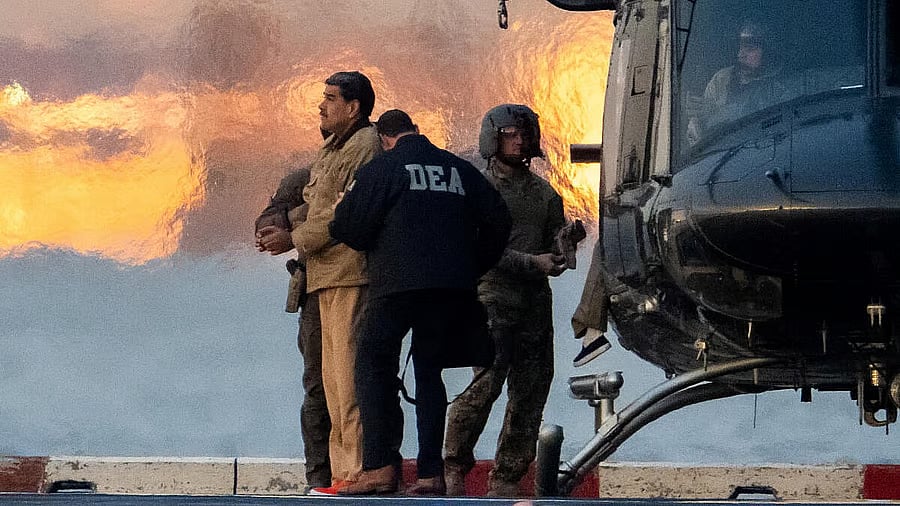
Venezuelan President Nicolas Maduro.
Credit: Reuters Photo
Regime change is back in fashion, and the target this time is the oil-rich Bolivarian Republic. A section of the US media had been growing hoarse, loudly moralising and repackaging the old narrative for weeks. On January 3, Caracas was bombed, approximately 40 people were killed, and Venezuelan President Nicolás Maduro was captured. Democracy exported, the American way.
Since the beginning of his second term, Donald Trump has repeatedly threatened coercive action against the Maduro administration. He cast the Venezuelan dictator as one of the world’s largest narcotraffickers and placed a $50-million bounty on his head. Apparently, Maduro’s Trump-style kinaesthetic expression did not endear him to the White House.
Another indication of an impending armed operation was the US National Security Strategy (NSS) released on December 4, 2025. Referred to as the Trump Corollary, it explicitly reaffirmed US dominance over the Western Hemisphere by invoking the Monroe Doctrine. The Pentagon had been steadily preparing the ground since August 2025, strengthening air and naval deployments in the Caribbean, including the arrival of a nuclear-powered submarine.
Historically, Venezuela’s resources have shaped both its alliances and its vulnerability. Before oil nationalisation in 1976, the petroleum sector was dominated by multinational corporations such as Texaco, Chevron and Exxon, making Venezuela a key US ally. Yet oil wealth entrenched extreme inequality. Hugo Chávez disrupted this order by redistributing resource rents through social programmes, fundamentally altering Venezuela’s political economy and its alignment with Washington. The geopolitical realignment that followed — including closer ties with China, Russia, Iran and Cuba — only deepened US hostility.
In this case, the joke, though tragic, is the Grand Old Party’s intellectual laziness on display — recycling the narrative once used to sell the Iraq invasion. Venezuelan boats allegedly carrying fentanyl were upgraded to Weapons of Mass Destruction. The bloody outcome when these word games were last rallied around by the Neo-Cons has not yet faded from collective memory. Then the objective was Iraq’s natural resources; this time it is Venezuela’s. The Bolivarian Republic holds one of the world’s largest reserves of heavy crude oil, along with rich deposits of gold and rare earths.
It was also the brazenness that was unnerving. POTUS declared after the attack that Venezuelan oil and land should be “returned” to American companies, and that the US would “run” Venezuela until a preferred administration assumed power. Even the pretence of a “civilising mission” was done away with. It’s a blatant attempt at establishing geopolitical supremacy for the exploitation of natural resources — a perfect blend of classical and neo-colonialism, the American way.
Years of economic warfare preceded Washington’s military operation Absolute Resolve. During Trump’s first term, sanctions on Caracas were escalated under the moral pretext of human rights and democratic erosion. From 2017 onwards, Venezuela’s access to US financial markets — including that of Petróleos de Venezuela, SA (PdVSA) — was choked, even as exemptions protected US interests.
John Bolton has stated with unusual candour that Washington does not seek democracy in Venezuela per se, but a political order aligned with US interests. This logic shaped US actions in 2019, when the Trump administration recognised Juan Guaidó as interim president — a move endorsed by nearly 60 states. When Maduro proved resilient, Washington tacitly welcomed Guaidó’s failed coup attempt.
Oil remains central to this political engineering. Following Russia’s invasion of Ukraine and Western sanctions on Russian energy, Caracas sought leverage through petroleum diplomacy. Washington, keen to stabilise prices ahead of the 2022 elections, briefly set aside decades of hostility to negotiate, revealing principle as contingent, not fixed.
What has drawn global attention — including from India — is Washington’s renewed emphasis on enforcing its sphere of influence in the Western Hemisphere. Trump’s Corollary brings back the imperial ways of the 19th century, when the sovereign sanctity of nations was repeatedly violated to fulfil the greed of the colonial empire. If such logic is mirrored by Russia in Ukraine or China in its periphery, the result may be a world of hardened spheres of influence, each policed through force. This is not reassuring for India, as it might easily find itself embedded in one such sphere.
The Caracas bombing further solidifies the claim that the rules-based order is completely up in flames, with international organisations effectively losing the negligible authority they had in the first place. The anarchical fabric of international politics once again has only one prominent element — brute power.
Despite Trump’s claims of taking over the Venezuelan state, Vice President Kelcy Rodriguez has been appointed the interim leader by the court of the land. The Venezuelan military also remains largely undisturbed. What is clear, however, is the message sent to Latin America: opposition to US interests will not be tolerated. Regime change, once again, appears to be Washington’s preferred instrument.
(The writer is Policy Research Associate, Pune International Centre)
Disclaimer: The views expressed above are the author's own. They do not necessarily reflect the views of DH.