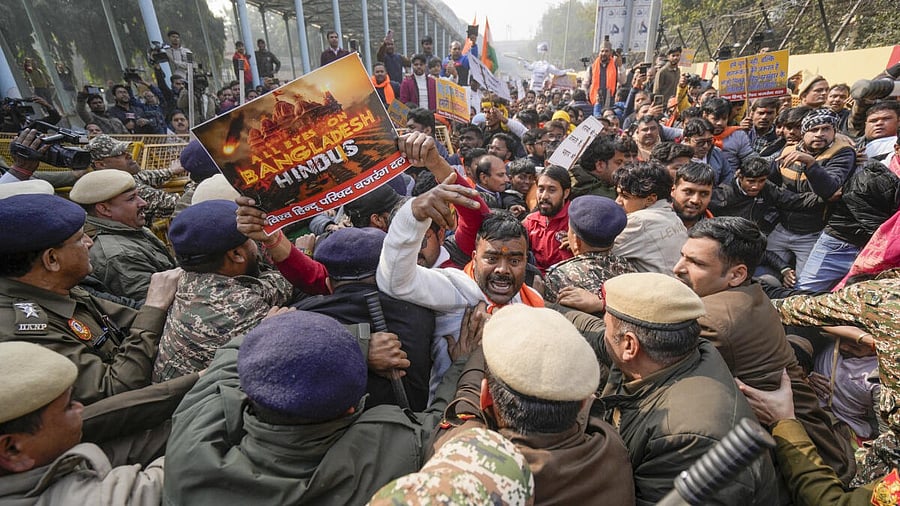
Protest over attacks on Hindus in Bangladesh
Credit: PTI File Photo
The recent protest outside the Bangladesh High Commission in New Delhi aimed to express moral outrage. Members of Hindutva organisations, waving saffron flags and shouting slogans, even attempted to storm the diplomatic mission to protest the killing of Dipu Chandra Das, a Hindu garment worker in Bangladesh who was lynched by a mob following allegations of blasphemy.
The brutality of the crime is undeniable. According to police and media, Das was beaten to death, and his body was later set on fire. The killing warrants unequivocal condemnation, and concern for minority safety anywhere is both legitimate and necessary.
In India, the outrage manifested in widespread protests. Supporters of the Vishva Hindu Parishad and the Bajrang Dal broke barricades and clashed with police near the Bangladesh High Commission in New Delhi. Demonstrations were also reported in Bhopal, Kolkata, Hyderabad, and Jammu and Kashmir, with slogans demanding “safety for Hindus in Bangladesh” and appeals to the prime minister to “bring Bangladeshi Hindus to India” or ensure their protection.
Yet the timing, tone and provenance of these protests render them deeply ironic and politically hollow.
In the same period that Hindutva groups claimed guardianship over Hindu minorities abroad, their own affiliates and supporters were implicated in a wave of intimidation and violence against Christians across India, particularly around Christmas. This contradiction exposes a credibility crisis in politics that claims to speak for vulnerable communities while presiding over, or enabling, harassment of minorities at home.
What lends the recent protests a performative quality is the domestic record of the protesters themselves. For years, Muslims—India’s largest minority—have borne the brunt of mob violence, lynchings and institutional discrimination at the hands of Hindutva groups, often with little accountability from authorities.
More recently, violence against Christians has surged, particularly during the Christmas season, signalling that the threat has widened to include other minorities. Once a broadly shared public festival in much of India, Christmas now routinely coincides with reports of church disruptions, prayer meetings halted, and mobs entering private homes alleging illegal conversions. In 2025 alone, monitoring groups such as the United Christian Forum reported over 700 incidents of such attacks on Christians by November.
In Madhya Pradesh’s Jabalpur, a Christmas feast organised for visually impaired children became the site of public assault. A BJP district vice president, Anju Bhargava, was filmed verbally abusing and striking a visually impaired woman, accusing organisers of conversion, even as a police officer looked on. Children present said the event involved only a meal.
In another Jabalpur church, men shouting “Jai Shri Ram” disrupted prayers with similar accusations. In Chhattisgarh, churches were burned and Christian homes destroyed following a dispute over the burial of a Hindu man whose son had converted to Christianity. In Rajasthan’s Dungarpur district, members of the RSS and Bajrang Dal disrupted a Sunday Mass at St Joseph’s Catholic Church, confronting clergy and worshippers with allegations of forced conversions.
In Odisha, vendors selling Santa costumes were threatened into closing their stalls, and delivery workers dressed as Santa Claus faced intimidation. In Bhubaneswar, a pastor and his pregnant wife were attacked inside their church and forced to trample on Bibles and chant the names of Hindu gods — an incident that went viral and sparked public outcry.
In Kerala’s Palakkad, an RSS-affiliated man reportedly attacked children performing carols, destroying their musical instruments. In Delhi’s Lajpat Nagar, women and children wearing Santa Claus hats were harassed in public by men allegedly linked to the Bajrang Dal. In Haridwar, Hindu organisations issued directives effectively banning Christmas celebrations in hotels and shops, prompting even a government-run hotel to cancel a planned event.
These incidents cannot be dismissed as spontaneous mob action. What connects them is organised ideological authority. They are emboldened by formal statements—including one from the VHP
urging Hindus not to celebrate Christmas—framed as cultural “awakening”. Shops and institutions are pressured
to shun a festival that, for many Indians regardless of faith, has been part of the social calendar.
Broadly, this is justified in the language of opposing “conversion”. India’s Constitution guarantees the right to propagate religion while prohibiting forced conversion. Several states have enacted laws criminalising conversion by inducement. In practice, these laws have increasingly become instruments of vigilantism.
Against this backdrop, the prime minister participated in a Christmas morning service at the Cathedral Church of the Redemption in New Delhi and shared greetings for peace and harmony on social media. But they lacked an explicit denunciation of the attacks that unfolded across the country in the preceding days—and, more importantly, there had been little evidence of sustained police action against those responsible. Recurring inaction can be read as tacit approval, undercutting official appeals for peace and harmony.
Moral authority in matters of minority rights is not established through protests outside foreign embassies. It is built through consistent conduct at home. When expressions of solidarity are extended only to those who share a particular faith, they risk shifting from a defence of human rights to an instrument of communal mobilisation.
Protesting violence against Hindus in Bangladesh while tolerating—or even encouraging—the intimidation of Muslims and Christians in India does little to advance the cause of minority protection. Instead, it undermines credibility, deepens distrust, and fuels a cycle of grievance and retaliation that further endangers minorities across the region.
(The writer is assistant professor at the Department of Professional Studies - School of Commerce, Finance and Accountancy, Christ Deemed to be University)
Disclaimer: The views expressed above are the author's own. They do not necessarily reflect the views of DH.