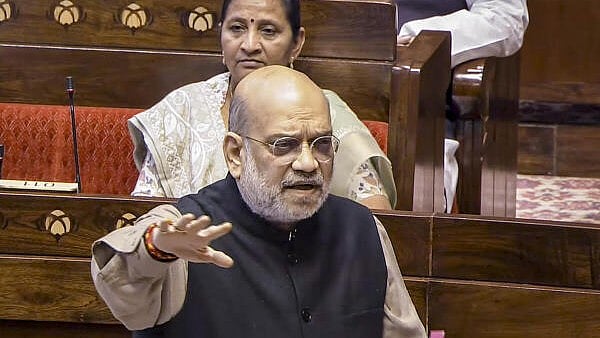
Union Home Minister Amit Shah speaks during a debate on Vande Mataram in the Rajya Sabha at the Winter session of Parliament, in New Delhi.
Credit: Sansad TV via PTI Photo
In the current controversy surrounding the National Song, there are two myths: One, that Muslims across the board have always objected to it. Two, that those who demand that it be recited are motivated by patriotism. Both myths are easily demolished.
The best evidence against the first myth is that the extremely popular 1997 song Maa Tujhe Salaam was composed by A R Rahman. Rahman was not an exception; he was just following in the footsteps of Muslim freedom fighters. Even those leading the Khilafat movement enthusiastically sang Vande Matram till the 1930s, when the Muslim League started objecting to it.
The late Asghar Ali Engineer used to laugh at those who raised religious objections to reciting Vande Mataram. As an internationally respected Islamic scholar, Engineer had a right to do so. He would point out that courtiers in the Mughal court had to perform sajda (bowing low, with one’s hand to one’s forehead) to Mughal emperors. No fatwa was issued; in fact, a Muslim scholar who dared to object to this practice as unIslamic was thrown into prison. Engineer often said he would defy any fatwa that forbade singing the National Song which, according to him, spoke of nothing more than bowing in respect to the motherland. At the same time, he would refuse to even utter the words ‘Vande Mataram’ if forced to do so.
In many Urdu schools, Allama Iqbal’s Naya Shivala is still recited every day, which has the words: ‘each speck of dust of the motherland is God to me.’ No one has yet cast aspersions on Iqbal’s Muslimness.
But trying to force Muslims to recite Vande Mataram is what Hindutvavadis have been doing for almost half a century, and never more so than today. ‘Is desh mein rehna hoga to Vande Mataram kehna hoga’ used to be heard only during riots; today, it’s being said by ministers, even in Parliament. Today, Hindutva groups have made Vande Mataram a battle cry against Muslims, and their motives have nothing to do with patriotism.
On Republic Day 2018 in Kasganj, Uttar Pradesh, Hindutvavadis drove into a Muslim neighbourhood on motorcycles, carrying saffron flags and the National Flag, demanding that Muslims who’d gathered there for flag hoisting, make way for them. Paying no heed to the Muslims’ request to join them in hoisting the flag, they started shouting: Is desh mein rehna hoga to Vande Mataram kehna hoga. In the clashes that ensued, one of them was killed. Ironically, these clashes would never have taken place had a year of living under the new Yogi Adityanath regime not forced the Muslims to display their patriotism in public. Until then, flag-hoisting was done indoors. This January, 28 Muslims were sentenced to life imprisonment for murder and for ‘showing disrespect to the flag’.
In 2017, the new BJP-nominated chairman of Delhi’s historic Dyal Singh College’s management committee decided to change its name to Vande Mataram Dyal Singh College. This unilateral decision drew protests not only from everyone associated with the college, but also from the Akalis, long-term BJP allies, as well as then Punjab Chief Minister Captain Amarinder Singh. No explanation was forthcoming for this decision. Was the BJP unaware of the reverence in which Sardar Dyal Singh Majithia, the founder of the college was held, or just indifferent to public sentiment? Ironically, in Lahore, the Pakistani government has left the name of the Dyal Singh college unchanged.
Gurgaon in 2018 saw a spate of attempts by Hindutva groups to stop Muslims offering Friday namaz on public grounds officially allotted to them for the purpose. When one such group was arrested, they expressed indignation that ‘patriotic youth’ shouting Vande Mataram and Jai Sri Ram could be treated as offenders.
This author was witness to similar indignation being expressed by the counsel representing the police, the Maharashtra government, and the Shiv Sena, when Justice B N Srikrishna, heading the Commission of Inquiry into the 1992-1993 Bombay riots, asked what action had been taken against rioters shouting Is desh mein rehna hoga to Vande Mataram kehna hoga. Even as the counsel protested that this was a “patriotic” slogan, the high court judge explained that laying down conditions of residence
on any citizen, let alone a community, by another group was not only communal, but also fascist.
There could not have been a better summing up of the Vande Mataram controversy.
(The writer is a senior journalist)