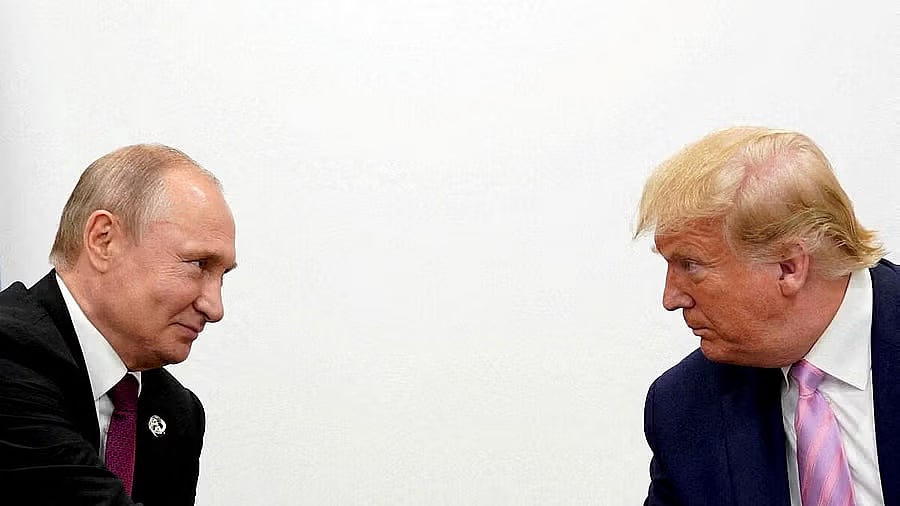
US President Donald Trump and Russian President Vladimir Putin
Credit: Reuters File Photo
Donald Trump is firmly in charge. When he first became President of the United States in 2017, Trump was unsure, and did not know how to get past the Washington establishment with entrenched interests at every turn. Four years in preparation for his new term have taught Trump how to overcome obstacles in his path, which are aplenty.
India, be warned! The 47th US president is not the same man who was the 45th president. More than most countries, India mollycoddled Trump in power from 2017 to 2021, sweet-talked its way and, most importantly, pandered to his ego.
The most obvious outcome of the summit phone call between Trump and Russian President Vladimir Putin on March 18 is that Trump emerged as a consummate diplomat. The other significant characteristic of their telephone conversation was the huge details which had been put in place before the two leaders were on the phone.
In his first term, most of Trump’s actions were without the necessary preparation. His reactions to events were often off-the-cuff. Like his suggestion to inject disinfectants to fight Covid-19, making him the butt of jokes worldwide. His weakness then was that Trump did not trust anyone. He knew that the deep state in the US was out to get him, and that many of those surrounding him were there for their share of the gravy train. But he could do very little about it except play musical chairs with his secretary of state, national security advisor, and others occupying high posts.
This time, he is placing his trusted people in positions, wherever he can, throwing rules out of the window. The jury is still out on whether he will succeed in such matters. The men and women in his inner circle now are those who have stood by Trump through thick and thin. Trump still dominated the news cycle during those four years. But it was for the wrong reasons — for being convicted as a felon or for his attempts to convert the Grand Old Republican Party into his family enterprise.
Instead of solutions like disinfectants for treating the pandemic, Trump went to Putin this week with a plan A, plan B, and plan C. That is why his dialogue with the Russian president did not descend into acrimony or collapse altogether. That is why the US president can claim honestly that he made progress on ending the war in Ukraine.
If Trump eventually succeeds in ending the Ukraine conflict — it is a big ‘if’ — India’s diplomats and policymakers in other ministries should imbibe valuable lessons from how the White House and the Kremlin succeeded in doing so. External Affairs Minister S Jaishankar is doing his best to change things, but his Ministry of External Affairs (MEA) still carries many vestiges of Soviet-style diplomacy like an albatross around its neck.
Indian diplomacy, even now, measures the success of most visits by Prime Minister Narendra Modi in terms of the agreements signed during those visits. During the Soviet era, the Kremlin and South Block — seat of the Prime Minister’s Office and the MEA — competed in putting on the summit table as many agreements to be signed as possible. If there were less than 12 agreements during one visit, neither side found it satisfactory.
A ‘list of outcomes’ released from South Block after every foreign visit by Modi is revealing. During Modi’s visit to Mauritius earlier in March, one of the ‘proud’ outcomes was a wordy ‘Memorandum of Understanding between the Ministry of Industry, SME and Cooperatives (SME division) of the Republic of Mauritius and the Ministry of Micro, Small and Medium Enterprises of the Republic of India on cooperation in the field of micro, small and medium enterprises’. What co-operation? Whatever for? When Modi visited Laos in October, an equally proud bilateral agreement was on a ‘Quality Improvement Programme (QIP) on Preservation of Shadow Puppet Theatre Performance in Champasak Province in Laos’. Is this something that requires the presence of India’s prime minister in Vientiane? But one more leather-bound agreement stacked up on the summit table is good for optics, the way South Block’s protocol people view visits.
Trump and Putin decided that their nations would resume playing ice hockey, suspended after the war in Ukraine began. This will prepare their people somewhat for plans between the two leaders to reset US-Russia relations. India should take a fresh look at what sport can do to enhance its soft diplomacy. But then Russia is a big powerhouse in sport, and it matters when Russians play ice hockey anywhere. India’s sports record is murky — allegations by women wrestlers against sports leaders is an example — and the country has a long way to incorporate sports into its diplomacy.
(K P Nayar has extensively covered West Asia and reported from Washington as a foreign correspondent for 15 years.)
Disclaimer: The views expressed above are the author's own. They do not necessarily reflect the views of DH.