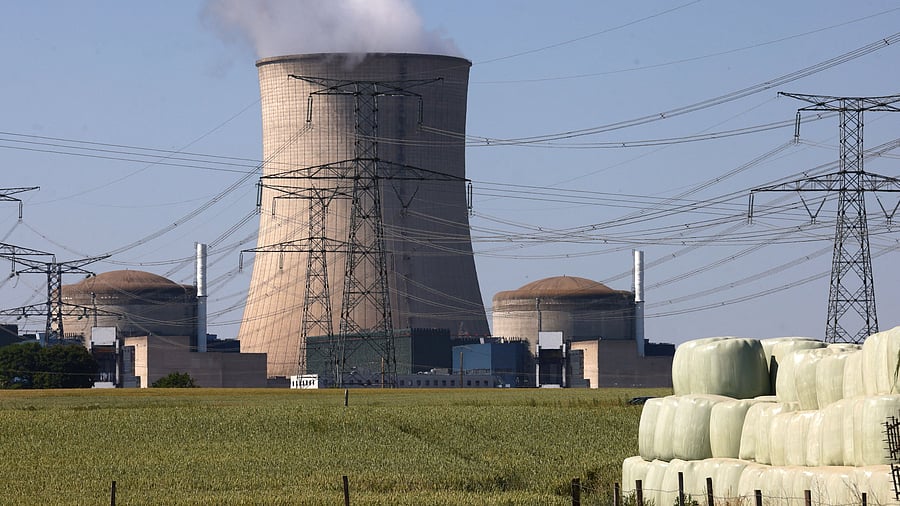
A general view shows the Electricite de France (EDF) nuclear power plant in Cattenom.
Credit: Reuters photo
Once a home of the Manhattan Project, the fields surrounded by forested valleys and rolling hills in Oak Ridge, Tennessee, could soon yield another nuclear first.
Concrete foundations and pilings are rising here for what is expected to be one of the first of a new generation of nuclear power plants, known as small modular reactors. The company behind it, Kairos Power, has been developing its technology for almost a decade and is now deep in the throes of construction.
Many companies are racing to build reactors that experts say could, over time, be cheaper than the kind of large nuclear power plants that have been in use for decades. To hear corporate executives and government officials tell it, the world is at the dawn of a new nuclear age that will provide cheap energy and satiate artificial intelligence technology’s staggering appetite for electricity.
At the centre of this promise is the idea of shrinking the vessels where nuclear reactions heat water to produce steam used to spin turbines. The components of these smaller reactors, the thinking goes, can be mass-produced and assembled more easily than conventional designs built by a small army of highly skilled workers.
The nuclear power industry has long struggled to complete projects. Almost all U.S. nuclear power plants in operation started generating power decades ago, most before Bill Clinton became president. In recent decades, steep costs and long delays, coupled with concerns about safety, have stymied nuclear energy.
“I think a lot of people recognise the value of what nuclear can bring but are still a little bit nervous about whether it can actually be done,” said Mike Laufer, co-founder and CEO of Kairos Power, which is based in the San Francisco Bay Area. “Credibility can be very hard to earn, but it can be lost very quickly.”
The US has more nuclear power reactors than any country, but it trails in building new ones. In the past decade China has built more than three dozen reactors while the United States completed just two. Those two, at the Alvin W Vogtle Electric Generating Plant near Augusta, Georgia, came years late and cost $35 billion — about three times the original estimates.
President Donald Trump wants new reactors to be a signature achievement of his term. His Energy Department has awarded $800 million for new reactor technologies and $1 billion in loan guarantees to restart the Three Mile Island power plant in Pennsylvania. The government is expected to offer billions more.
Some experts, however, contend the main problem is an industry that has repeatedly struggled to deliver. The hurdles facing advanced reactors are even bigger, the experts say, because they are novel and some require a new kind of uranium fuel that the industry has only limited experience with.
New reactors will also require significant financial investment and federal aid. That might not be a problem given the current bipartisan enthusiasm for nuclear energy, but that goodwill could evaporate if the industry again falters.
“Once again it’s the bright shiny object,” said Peter Bradford, a former commissioner on the NRC and a longtime critic of the high costs and delays that characterise new types of reactors. To be successful, a new design should be able to compete with other types of energy, he added. “Nuclear has just never been able to do that.”
The Race to Lower Costs
Nine years ago, the three founders of Kairos Power began developing their designs, pinning their hopes on a new approach. The three men all studied nuclear and mechanical engineering at the University of California, Berkeley, where J. Robert Oppenheimer, the leader of the Manhattan Project, once taught.
Kairos executives said they had opted to test each phase of the plant’s development as it progressed, rather than take the approach more common in this line of work: Design, construct and hope for the best.
Unlike conventional nuclear plants, Kairos’ reactor will not have large, domed buildings made of concrete and metal. And steam will not billow from huge water towers. Instead of water, the Kairos reactor will heat salt.
The reactor will rise a bit over about 32 feet. The full commercial design includes two reactor buildings and a turbine with an overall footprint of 60 acres.
The company, which has 540 full-time employees, designs and produces its own components. It makes many of the parts in Albuquerque, New Mexico, about 60 miles from Los Alamos, the ultimate headquarters of the Manhattan Project.
Nuclear projects have been hampered by high costs and the difficulty associated with building a first-of-its-kind project, Laufer said. “And the recent experiences have only reinforced that.”
NuScale, a company that was once expected to deliver the first small reactor, in November 2023 had to cancel a project in Idaho after utilities pulled out of agreements to buy electricity from it because costs had risen too much.
The company said its technology was now advancing through a partnership with ENTRA1 Energy, an owner and developer of power plants. In September, the two companies and the Tennessee Valley Authority, a federal government owned power company, announced plans to develop nuclear reactors. The first NuScale units will be built in Oak Ridge and could deliver power by 2030, the company said.
Other companies are pursuing similar projects. GE Vernova Hitachi Nuclear Energy has plans to build several smaller reactors starting in Ontario. TerraPower, a company backed by Bill Gates, is building a reactor in Wyoming.
Radiant, a startup, says it is set to build this year a portable, micro reactor that will produce enough electricity to power 1,000 homes. Such devices are for special uses like providing energy to data centres or the military. “If you don’t need a grid connection, we’re a great solution,” said Ray Wert, a company spokesperson.
Like Kairos, Radiant plans to manufacture its reactors in Oak Ridge, home to the Oak Ridge National Laboratory, one of the Energy Department’s 17 national laboratories.
Big Backers and a New Fuel
At its site in Oak Ridge, Kairos is working on a test reactor expected to be complete in 2028; a demonstration unit, capable of producing electricity, is aimed for 2030. The company has a contract to supply 500 megawatts of energy capacity — about half the capacity of the typical large-scale nuclear plant — to Google
by 2035.
Google’s involvement could make a huge difference. Technology companies investing in AI bring the kinds of money and interest that were missing in the early 2000s when delays and soaring costs last scuppered ambitions for a nuclear renaissance.
Reactors being built by Kairos and others will run on something called TRi-structural ISOtropic particle fuel, or TRISO, that was developed by the Department of Energy. The TRISO particles are enriched uranium kernels coated with multiple layers of carbon and ceramic.
Thousands of the poppy-seed-size particles are embedded in a graphite matrix to form pebbles the size of golf balls. The TRISO shell confines radioactive material from the uranium as it breaks down and produces heat. With the fuel’s built-in containment system and the molten salt coolant, the reactors won’t need the same costly reinforced containment buildings used in conventional plants, proponents say. But some scientists are not confident that this new fuel allays all safety concerns.