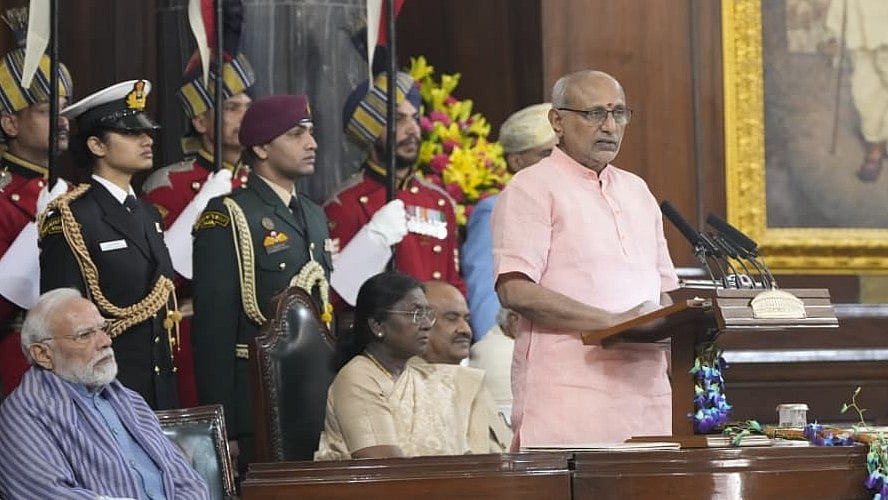
Vice President C P Radhakrishnan
Credit: X/@VPIndia
On December 1, the country will witness a new beginning when Vice President C P Radhakrishnan returns to Parliament in a new role as the ex-officio Chairman of the Rajya Sabha. The composition of Parliament underwent a change in the interim two-decade period Radhakrishnan ended his tenure as a member of the 13th Lok Sabha in 2004.
Having been a Member of Parliament (MP) in the era of coalition governments, he returns when the landscape has changed over the last decade. Since the advent of the Prime Minister Narendra Modi government in 2014, the Bharatiya Janata Party (BJP) has remained the single-largest party in Parliament, which allows the lead party in the coalition a greater say in setting the agenda, and dictating the pace of work.
The decade also saw a sharp uptick in the series of confrontations between the government and the Opposition, whose members’ presence shrank increasingly in both Houses of Parliament. In the first few years of the decade, the Rajya Sabha turned into a political battlefield for the Opposition to stall the moves of the Modi government on issues leading to the adoption of a negotiated settlement.
Since it acquired a comfortable majority in the Upper House too, the BJP-led National Democratic Alliance (NDA) coalition now breathes easy. However, the emergence of this situation also led to confrontation between the coalitions on either side of the aisle. The Opposition has since been complaining that it is not being granted space to raise issues in Parliament, while the government insists it is prepared to discuss any subject permissible under the rules of respective Houses.
Sharp decline
Parliamentary managers of the governing coalition often state that the Opposition is more interested in stalling the proceedings of the House instead of discussing issues concerning people and legislation. The Opposition takes exception, accusing those tasked with managing parliamentary affairs of avoiding discussion on contentious issues.
The Congress and other MPs in the Opposition point out that over the years, the Chair did not permit notices to discuss issues concerning people. Featuring among these were notices to discuss the Sino-Indian border clashes in Galwan or the subsequent face-off; security breach in Parliament last winter; functioning of the Election Commission of India, and a host of developments.
In fact, during the 2023 Winter Session, an unprecedented 146 Opposition MPs (100 from the Lok Sabha and 46 from the Rajya Sabha) were suspended from the proceedings of the House. The MPs were protesting and demanded a statement either from the Prime Minister or the Home Minister following the breach of security, by a visitor in the Lok Sabha gallery.
Parliament consists of both the government and the Opposition, and never before has a standoff between them been more serious. The combined Opposition had submitted motions for the removal of both the Chairman and the Deputy Chairman. Though these were rejected, they reflected the complete breakdown of relations.
Recently, Trinamool Congress MP Derek O’Brien argued why the government’s reluctance to discuss the working of the Election Commission of India was flawed. Several Opposition parties, he stated, had filed notices demanding a discussion related to the electoral practices being more transparent, yet these were not accepted.
Referral to committees
One major grouse of the Opposition has been that the government is reluctant to refer bills for greater scrutiny by the standing committees of Parliament. Statistics provided by PRS Legislative Research said that during the 17th Lok Sabha, of the 179 bills that were passed, 58% were passed within two weeks of introduction, and just 16% of these were referred to committees. This was lower than 39 of the 190 bills (21%) that went to the panels during the 16th Lok Sabha. This pales in comparison to the 15th Lok Sabha, when 157 of the 228 bills (69%) were sent to standing committees.
After the controversial three farm laws were withdrawn in 2021, the Opposition reminded that had these bills been subjected to scrutiny by the panel of jurisdiction, the laws framed would have faced little or no resistance. The workings in the committees allow them to invite experts and stakeholders to put across their points of view.
Controversy on the eve of the session
Now, the Congress, the principal party in the Opposition, pounced upon an entry in the Rajya Sabha Bulletin referring to Parliamentary Customs and Conventions to be followed by members in the House. Among them, the party stated that to maintain decorum and seriousness of the proceedings, there should be no ‘Thank You’, 'Jai Hind', ‘Vande Mataram’, or any other slogans raised in the House. Subsequently, the entry does not appear in it.
A seasoned politician who has held gubernatorial positions in various States before being elected Vice President, Radhakrishnan has been holding a series of meetings. Besides officials and Ministers, the new Chairman has also met leaders and MPs from across the political spectrum as part of the preparation for the new role in the Rajya Sabha. On him rests the onerous task of rebuilding trust between the government and the Opposition, both of whom constitute Parliament.
K V Prasad is a Delhi-based senior journalist.
(Disclaimer: The views expressed above are the author's own. They do not necessarily reflect the views of DH.)