
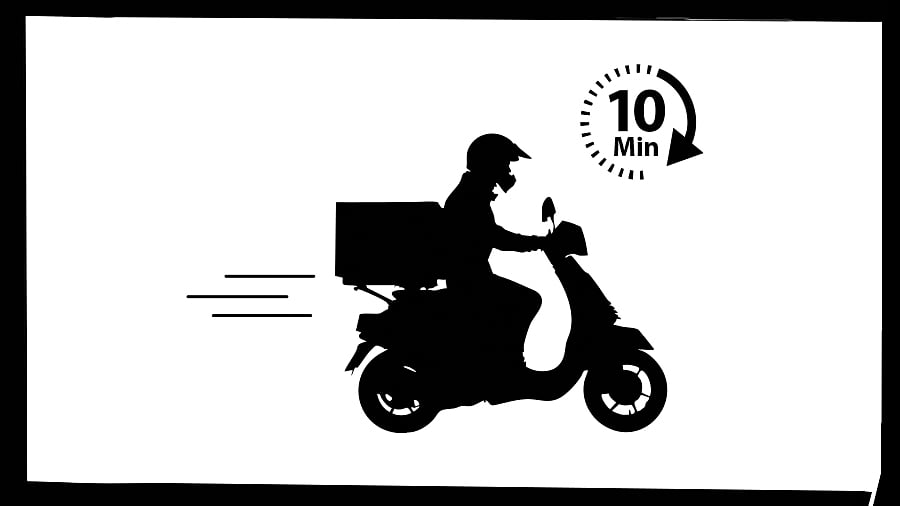
The skyline of the Indian metropolis is no longer defined just by its tech parks or traffic jams, but by a frantic, neon-vested blur. The Quick Commerce (QC) revolution has transitioned from a pandemic-era experiment into a breathless, multi-billion-dollar sprint. But as the delivery promises shrink to single-digit minutes, the economic and moral costs are expanding at an unsustainable rate. From the dizzying height of venture capital funding to the asphalt-level reality of the delivery worker, the industry is operating on a logic that feels more like a fever dream than a business model.
The sheer scale of capital being incinerated in the QC market today is breathtaking. We are witnessing a high-stakes poker game played by five giants – Blinkit, Swiggy Instamart, Zepto, Amazon, and Tata’s BigBasket. Each has deep pockets, collectively sitting on a war chest of nearly Rs 40,000 crore. Yet they continue to bleed cash quarter after quarter.
By competing on the razor-thin margins of groceries and the logistical nightmare of 10-minute delivery, quick commerce firms are essentially buying turnover. But groceries are far more essential and price-sensitive than a cab ride. While it’s okay to pay a premium for milk in a pinch, why would a rational consumer routinely pay extra for a weekly basket of staples? Today, affluent urbanites spend upwards of Rs 40,000 a month on instant deliveries and prepared food. This is “peak-cycle” behaviour. When the global economy eventually stalls – a likely scenario given the wobbling AI boom in the US – the repercussions in India will be substantial. As the funding winter turns into a permafrost, the middle class will inevitably tighten its belt. When that happens, the 10-minute convenience will be the first luxury to be pruned from the household budget.
The only reason quick commerce makes any operational sense is the availability of cheap, desperate labour. If you stand on a street corner in Bengaluru, Mumbai, or Delhi, you will notice a stark demographic reality: the people delivering your Rs-50 chocolate bar are almost exclusively migrants. The work is back-breaking, and the stress is dehumanising. These workers are trapped in an algorithmic vice. To earn Rs 800-1,000 a day, a delivery partner must complete 25 to 30 orders. Including dead time (waiting at dark stores) and navigating India’s chaotic traffic, this translates to 12-14-hour workdays.
They face stiff penalties for delays – a cruel irony given that they are risking their lives to shave seconds off a delivery for someone who likely doesn’t need that sourdough bread right now. We are seeing a surge in road rage and accidents involving delivery bikes. The industry is essentially subsidising its 10-minute promise with the safety and dignity of the most vulnerable sections of society. This reliance on a gig workforce with no social security net is a ticking social time bomb. It is a system built by the elite, for the middle class, on the backs of the poor. History tells us such structures do not have happy endings.
Even with an average order value (AOV) that has climbed to Rs 620 (up from Rs 450 in 2023), the math remains razor-thin. At 15% gross margin, you keep Rs 93. Deducting for delivery partner payout, dark store staffing and OpEx expense, wastage, shrinkage, and last-mile logistics expense, you get a contribution margin of -Rs 7 (yes, minus seven rupees). This is loss before corporate and marketing expenses. The money is being ‘lost’ as follows:
A dark store is a fixed-cost monster. You pay rent and staff 24/7, but the demand is peak-heavy (8 am-11 am and 6 pm-10 pm). During the “dead hours”, your cost per order can spike from Rs 60 to Rs 150. To keep customers coming back, stores must stock high-frequency items like milk and bread. These have the highest wastage rates (5-8%). As platforms move into electronics, they face a new demon: Returns – A Rs-100 grocery order is rarely returned. A Rs-60,000 phone has a 5-7% return/replacement risk. The cost of a delivery partner going back to pick up a high-value item often wipes out the margin of 50 grocery orders.
The perils of
unplanned purchase
A household that plans its weekly groceries is a household in control of its finances. Quick commerce, however, thrives on the opposite: the unplanned purchase. The industry wants to institutionalise impulse buying. While this works during a market boom when time is money, it fails the test of long-term economic logic.
The idea that we should never have to wait – that our every whim must be satisfied within 600 seconds – is creating a generation of impatient consumers who are decoupled from the reality of supply chains. Impulse buying is a feature of a surplus economy; planning is a feature of a stable one. When the market corrects, the thrill of the 10-minute delivery will be replaced by the cold reality of the delivery fee and platform fees.
The quick commerce bubble is currently inflated by a mixture of FOMO (Fear Of Missing Out) among investors and a temporary surge in urban disposable income. However, the fundamental math doesn’t hold. You cannot indefinitely deliver low-value items (like a single bunch of coriander) using high-cost logistics while paying a living wage to the worker.
Consolidation is inevitable – over 700 startups shut down in India in 2025. Quick commerce is essentially becoming a three-player war (Blinkit, Swiggy, Zepto). Eventually, one of two things will happen: either prices will rise to the point where only the top 1% use these services, or the companies will pivot to a more rational 1 or 2-hour or next-day delivery model to survive. The 10-minute mirage will fade, the neon vests will decrease in number, and we will likely return to a world where we plan our lives a little better.
(The writer is the co-founder and CEO of an on-demand driver service platform)
Disclaimer: The views expressed above are the author's own. They do not necessarily reflect the views of DH.