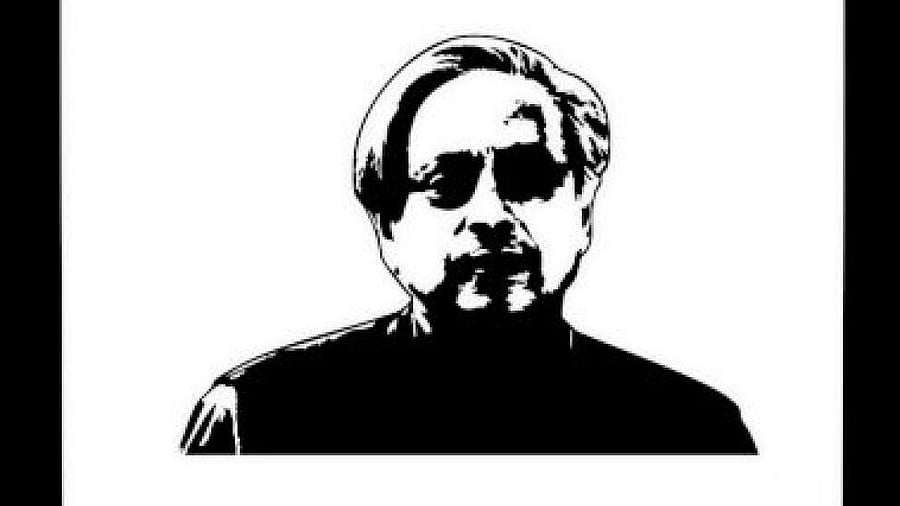
DH Illustration.
Congress leader Shashi Tharoor’s politics is inescapable from his narcissism — blending flamboyance, literary flourish, and diplomatic experience to underline his distinction against your run-of-the-mill Congressmen.
His individual stands are rationalised as loyalty to the nation over party discipline, but in reality, represent no more than personal ambition. The only other politician who comes close to him in overweening ambition is his intellectual polar opposite, Navjot Singh Sidhu. In both, personal ambition overshadows party discipline.
If Tharoor masks his nebulous ambition (there was a narrative of his being Kerala chief minister once) using intellectual subterfuge; Sidhu plays his cards openly — bluntly saying that he will return to the party only if he is offered the top job as Punjab’s chief minister. Most recently, Sidhu’s wife made a statement that her husband will return to politics if the Congress declares him its chief ministerial face in Punjab and that “Rs 500 crore is needed to become Punjab CM.” Both Tharoor’s and Sidhu’s outrageous behaviour is explained by their political ambition being frustrated.
Despite differences in style, Tharoor and Sidhu are similar — one reflects a cosmopolitan intellectual opportunism, the other a cruder populist bluntness. By prioritising their personal status over party unity and discipline, both undermine the Congress. Yet neither will gain anything from joining the Bharatiya Janata Party (BJP).
Perhaps understanding this dead-end, Tharoor has publicly refused to accept the newly-minted Veer Savarkar International Impact Award from a Right-wing NGO. He claimed to have learned about it from the media, and has accused the organisers of being irresponsible. However, the organisers have asserted to the media that he had agreed to accept the award in a personal meeting with them, and only later decided to back out.
Acceptance of the award would have been read as appeasement of the ruling BJP and betrayal of the Congress’ core ideological beliefs. Tharoor may have feared an irretrievable backlash from the party.
That Tharoor is in sackcloth and ashes today is also indicated by his absence from Parliament, claiming that he is “sacrificing” his attendance record in Parliament to campaign for the party in the local municipal body elections. Lest no one notice, he posted this on X, to emphasise his commitment to the Congress in Kerala.
Tharoor’s indiscretions have embarrassed the Congress on several occasions. They include references to economy class in air travel as “cattle class”, and allegations of misuse of office when he tried to get Rs 70 crore sweat equity for the late Sunanda Pushkar — then not yet his wife — to set up the Kochi IPL franchise. Nor has he spared the Gandhi family by criticising ‘dynastic politics’ (later he claimed misinterpretation by the media) despite the fact that it was Sonia Gandhi who gifted him his second career as a party MP after he retired from the United Nations.
He signed the G-23 rebels’ letter asking for party reforms — positioning himself above the party line — but also went out of his way to repeatedly compliment Prime Minister Narendra Modi and L K Advani to the chagrin of his party. He skipped a crucial Congress Working Committee meeting, citing personal reasons and accepted becoming a global emissary of the Modi government to sell its chest-thumping narrative of Operation Sindoor to the world. Most recently, he accepted the dinner invitation for a State banquet for Vladimir Putin when the Leaders of the Opposition in the two Houses of Parliament, Mallikarjun Kharge and Rahul Gandhi, were deliberately snubbed and not invited in violation of tradition.
Tharoor’s reputation does not rest only on his eloquence, his self-branding as a vocabulary bully, his literary output or his cosmopolitan image. All his actions — speeches, books, social media presence — are aimed at highlighting his exceptionalism as a leader who cannot be confined to being a mere party functionary. Pretending that his image puts him above party divides and allows him to participate in the global propaganda initiative of the Modi government, however, is mere skulduggery.
Tharoor may claim that his actions conform to democratic norms and rules. However, under Modi, India has ceased to be normal democracy. For more than a decade, the Opposition is being portrayed as the enemy of the government. His justifications for participating in events pretend that those lines drawn in the sand do not exist, and they distance him from the
Congress’ collective struggle against an increasingly authoritarian and Hindu-majoritarian government. His behaviour also blunts his party’s collective messaging and erodes the internal cohesion of the party.
He boasted nine months ago in a podcast that no one should assume that he had no “other options” if the Congress did not want him, but later claimed that his literary pursuits were misinterpreted as political exploration. He has always backpedalled after continuous provocation of the party that gave him a ‘soft landing’ as a paratrooper in 2009. Without the party’s backing, he would have been nothing more than a retired but eloquent UN diplomat with a literary reputation.
Perhaps he realises that he has no caste bloc, community network, or grassroots cadre which he can mobilise. His Lok Sabha victories in the highly competitive Thiruvananthapuram constituency have of late been won by narrow margins (only 16,077 votes in 2024), making him electorally vulnerable. He knows that he survives more on the organisational ability of the Congress and personal visibility than on mass mobilisation around his leadership or persona. His constituency is mostly urban, comprising educated, middle-class voters. It is now fragmented, with the BJP gaining ground in recent election cycles.
Therefore, Tharoor’s dilemma is that no matter how high profile his cosmopolitan image, without the Congress he is just an intellectual, a retired global diplomat, and a writer — not a mass leader. When he made a bid to take over the party by contesting for the president’s post, he realised he had meagre support within the party.
As of now, his political future is inseparable from the Congress. Outside the Congress, he can only position himself as a statesman, commentator, or a reformist. If the BJP courts him, it is only to needle the Congress leadership.
The BJP also does not see him as a mass leader. He is electorally irrelevant to the party. He brings nothing to the BJP’s table except offering himself as an instrument to embarrass the Congress.
Bharat Bhushan is a New Delhi-based journalist.
Disclaimer: The views expressed above are the author's own. They do not necessarily reflect the views of DH.