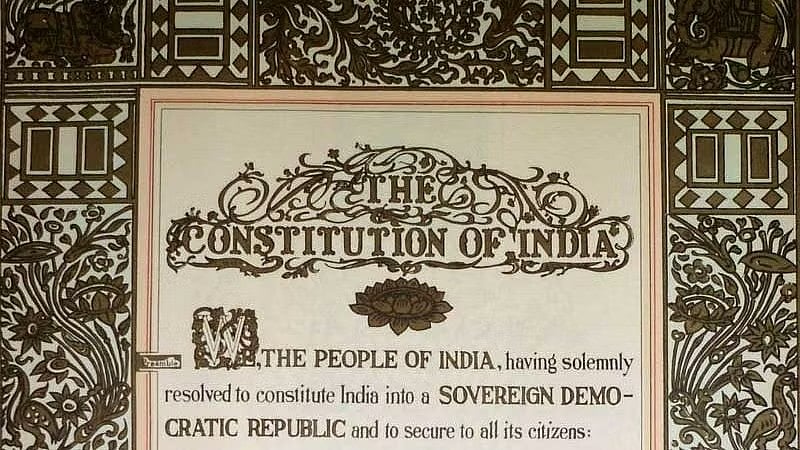
Constitution Day
Credit: X/@VPSecretariat
On India's 77th Republic Day, we will hear customary tributes to the Constitution. Yet, a pressing question remains: do we treat it as a finished monument of the past, or as a living democratic project that demands our continuous participation?
The answer lies not in how we commemorate January 26, but in how we inhabit the Constitution’s spirit every day. This requires revisiting a forgotten truth about its origins: it was not merely written by an elite body; it was assembled through widespread public participation — a work never meant to end.
Popular imagination views the Constitution as the product of a distinguished assembly in Delhi. However, legal historians Rohit De and Ornit Shani have reshaped this genesis story. In their provocative 'Assembling India’s Constitution', they show that from 1948 to 1950, the Constitution was “assembled” through a participatory, democratic process. Citizens’ groups, linguistic minorities, and communities deluged the Secretariat with letters and petitions, debating the draft nationwide. The document that emerged was thus built from below — a true “assemblage” of national aspirations. This is a little-known fact.
This history is vital because it defines the Constitution’s nature. It was designed, as De and Shani argue, to be pliable and dynamic — a framework for ongoing democratic argument, not a rigid monument. The authority of “We, the People” was therefore a factual description of its creation, not mere rhetoric.
If the Constitution was assembled by the people, its Preamble is the keystone. Yet, its ideals — Justice, Liberty, Equality, and Fraternity — are too often recited as a mantra and shelved as abstractions. They must instead be our national moral compass.
This compass points to a specific practice. Fraternity, as BR Ambedkar underscored, is the most neglected and vital ideal — the soul of the document. It is the social sentiment that breathes life into laws ensuring liberty and equality. Without this shared belonging, “We, the People” shatter into "us versus them".
Here, the historical “assemblage” meets a personal duty. The promise of fraternity is broken daily by structures of caste, inequality, and exclusion. Those of us with privilege — of education, caste, or capital — have a duty of trusteeship. Constitutional morality begins with Ambedkar’s rule of the self: vigilance over our prejudices and comforts, using our advantages to dismantle barriers. The Preamble thus becomes a guide for daily citizenship.
This understanding casts our present democratic moment in a troubling light. The plural assemblage that shaped the Constitution contrasts with a political culture favouring monologue over dialogue.
Today, a singular ‘people’s will’ often marginalises dissenting voices. Parliamentary scrutiny is bypassed, consultation truncated, and mediating institutions are under strain. Law-making becomes an act of imposition.
The consequence is a dangerous divergence. We venerate the Constitution as a sacred relic while hollowing out the participatory processes that give it life. The spirit of assemblage is suffocated, replaced by suspicion.
Reviving this spirit is the work of the people. This Republic Day, we must resolve to reassemble our democratic practice. First, reclaim the Preamble as a shared civic vocabulary. Move it from bronze plaques into living rooms and public squares. Community readings, workshops, and public discussions can restore it as a moral compass against which laws and policies are evaluated. Justice and fraternity must once again become benchmarks of public discourse.
Second, deepen deliberative democracy at the grassroots. Empowered Gram Sabhas and citizen assemblies at local and state levels, inspired by models like Kerala’s People’s Plan Campaign, can echo the Constitution’s original participatory spirit.
Third, strengthen legal empowerment. Supporting strategic litigation, constitutional literacy, and access to justice, especially for marginalised groups, remains a vital way for citizens to shape constitutional meaning.
Finally, practice fraternity as everyday politics. This personal reassembly requires listening, protecting the vulnerable, and making conscious choices that bridge social divides. This micro-politics of solidarity is where the national project is rebuilt, one relationship at a time.
This Republic Day, let us look beyond the parade. The tricolour is not just a symbol of freedom won, but a reminder of a democracy perpetually in the making. The Constitution was not a gift received on January 26, 1950. It was a project launched. Our honour for its founders lies not in ritual, but in labour — in the courageous, collective, and continuous work of reassembly.
(The writer is a reflective development practitioner based in Kozhikode)