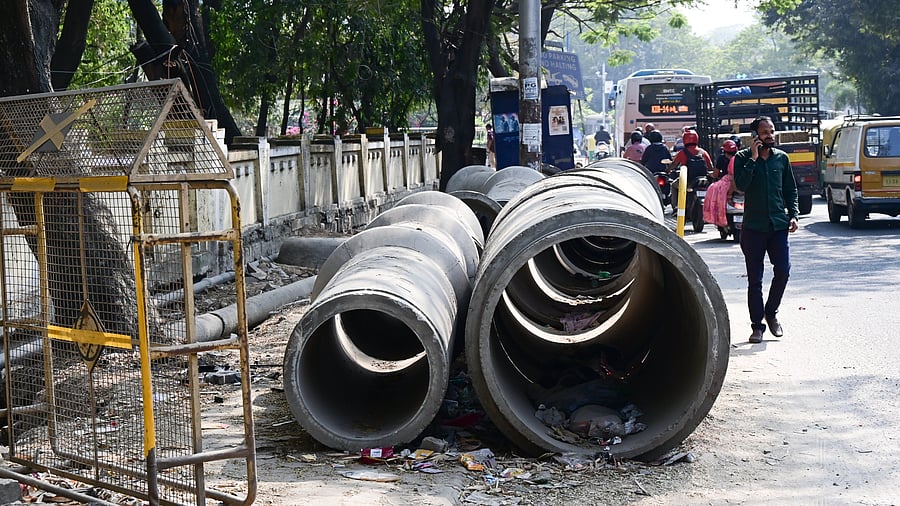
Footpaths broken, pedestrians step onto the road, putting themselves in harm’s way. DH Photo/BK Janardhan
The year 2026 began on a grim note for India’s cities. New Year celebrations were followed by unprecedented air pollution in Delhi and the National Capital Region. Soon after came the shocking death of 16 people due to water contamination in Indore, Madhya Pradesh—ironically ranked India’s “cleanest city” for eight consecutive years. In Chinnappanahalli near Marathahalli in Bengaluru, a building under construction collapsed, killing a four-year-old girl and injuring three others. Police reports pointed to the absence of basic safety measures.
Such incidents are not aberrations. Pedestrians struggling to walk on broken footpaths or cross roads is an everyday sight. Road accidents, injuries, and fatalities occur with regularity. Safety has thus emerged as a defining issue – perhaps the single most important concern--in urban India.
Consider Gandhinagar, the capital of Gujarat, which invested Rs 257 crore for a “24/7 water supply” project. Despite this, its civil hospital recently reported 70 cases of typhoid in a paediatric ward due to sewer mixing with drinking water—an act of utter negligence. In Uttar Pradesh’s Gorakhpur, children gasped for breath and turned blue because the hospital had not paid its oxygen supplier. In Surat, once a model for municipal services, young students were forced to jump from a burning building due to unchecked illegal construction, leading to multiple deaths. In Bengaluru, rampant building violations thrive on the connivance of municipal authorities.
This New Year calls for a renewed focus on five basic safety measures in the interest of citizens’ welfare:
1. Clean and safe air: Air pollution has become an alarming threat to public health. Beyond its well-known impact on the lungs and heart, it is now established that air pollution affects the brain and cognitive processes. Children are particularly vulnerable, as developing brains are more susceptible to neurotoxic pollutants, impairing learning and emotional health.
2. Safe water: According to Niti Ayog, nearly two lakh people die every year due to lack of access to safe water, with about 70% of water sources contaminated. The World Health Organisation links unsafe water to diseases such as cholera, typhoid, hepatitis and polio. Many Indian schools still lack basic facilities like safe water and sanitation, seriously affecting children’s health. The National Green Tribunal has described water contamination in Indore as a public health emergency, calling it a systemic failure. In truth, it is a national public health failure.
3. Road safety: In 2024, India recorded 4.73 lakh road accidents and 1.70 lakh deaths. Two-wheelers accounted for about 45% of fatalities, while pedestrians made up nearly 20%. City-wise data places Delhi at the top with 1,461 crash deaths, followed by Bengaluru with 772. Instead of enforcing traffic laws strictly, the Karnataka government has offered a 50% discount on unpaid traffic dues – effectively an amnesty that incentivises violations. Footpaths in most cities are unwalkable, while crossing roads is a hazardous exercise.
4. Safe waste management: Indian cities generate about 170,000 MTS of solid waste annually, including municipal waste, industrial hazardous waste, biomedical and electronic waste, as well as agricultural residue that is often burnt, especially around Delhi. Improper waste handling poses serious health and environmental risks. Epidemiological studies show that waste workers and communities living near dumping sites face high exposure to parasites and infections, leading to increased mortality. Added to this is the growing menace of stray dogs, now troubling municipalities.
5. Building safety: Recurrent collapses of buildings and bridges expose weak enforcement and poor maintenance. Between 2010 and 2014, over 13,000 people died in structural collapses, with residential buildings accounting for 40% of deaths. Recent incidents include collapses in Delhi’s Mustafabad, Mumbai’s Virar and a school roof in Rajasthan, all in 2025. The Morbi bridge collapse in 2022 killed 32 people, while the Kolkata bridge collapse in 2016 claimed 27 lives. Bengaluru still remembers the Gangaram building collapse in of 1983, which killed 123 people. The causes are well known: substandard materials, flawed foundation design and dilapidated buildings.
At the root of these failures lies a profound disregard for human life – among public authorities and, increasingly, among citizens themselves. Construction workers, slum dwellers and the urban poor bear the brunt. How else does one explain reckless driving, illegal constructions and the casual violations of safety norms that endanger neighbours and passers-by?
There is much to learn from China. Over a decade, Beijing halved its PM2.5 levels, while India’s average barely moved. Globally, nine of the 10 cities with the steepest PM2.5 declines between 2013 and 2022 were in China. The Chinese government acted decisively by shutting polluting factories, shifting to cleaner energy, restricting vehicle use and promoting public transport.
In India, the reluctance to regulate the explosive growth of private vehicles has worsened congestion, parking problems, and public health outcomes. Cities increasingly seem designed for cars rather than people, with little regard for safety.
There is also limited public awareness about risks such as indoor pollution from cooking fuels, asbestos, poor ventilation and dust. Informal food vendors often operate near open drains, while food safety norms are routinely ignored despite a rigorous Food Safety and Standards Act.
Safety is not an optional extra. It is fundamental to good governance. It instils confidence in people, including investors, and boosts productivity.
(The writer is a former chief secretary, Government of Karnataka)
Disclaimer: The views expressed above are the author's own. They do not necessarily reflect the views of DH.