
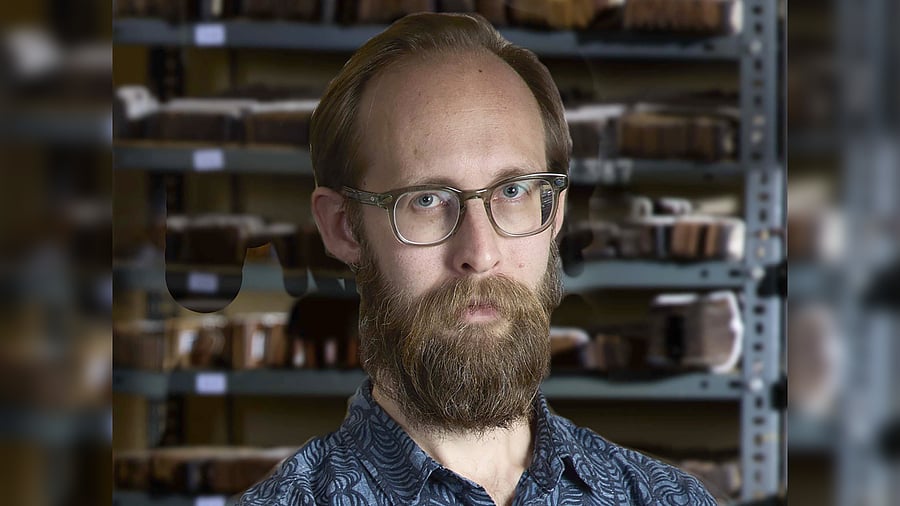
Andrew Ollett
Credit: Special arrangement
Andrew Ollet, scholar in Sanskrit, Prakrit, Pali, Apabhramsha, Kannada and Chinese, was in Bengaluru recently to receive the Infosys Prize for Humanities and Social Sciences for 2025. He teaches at the University of Chicago and is now working with Sarah Pierce Taylor on a new translation of Kavirajamarga, the 9th century Kannada treatise on poetics.
Excerpts from an interview:
How did you discover Prakrit? You couldn’t have heard it growing up (in the New York suburbs).
I started with Ancient Greek in college. My teacher mentioned Sanskrit forms, sparking my interest. Soon, I was studying Sanskrit—it was fascinating. My advisor, Sheldon Pollock, suggested comparing Greek literary dialects to Indian ones, like Prakrit with its lyric poetry in the Gathasaptasati. That’s how I entered Prakrit.
What led you to Kannada, which is Dravidian, unlike Prakrit, which is aligned with the north Indian languages?
I am interested in language interactions. Pollock showed Kannada’s close ties to Sanskrit, despite its being Dravidian. Early Kannada works engage with texts like Jinasena’s Adipurana and Dandin’s Kavyadarsha. After my PhD, I studied Kannada to explore regional-transregional negotiations.
How did you learn Kannada? Your university has a South Asian studies tradition.
I couldn’t take formal classes then. During a Harvard fellowship, I self-taught and joined reading groups on texts like Pampa Bharata and Karnataka Panchatantra. No formal training, which I regret. At University of Chicago, where I work, we honour A K Ramanujan’s legacy, though Kannada isn’t taught regularly now.
You are seen as a worthy successor to Ramanujan…
I’m unworthy, but honoured.
Congratulations on the Infosys Prize. What are your impressions of Bengaluru?
I like it—it is charming. I have come for manuscripts or talks, often on the way to Mysuru. Last time, it was a relief after Delhi’s December cold.
Your work focuses on pre-modern Kannada and Indian literature, and you have been working on Kavirajamarga and Alankara Dappana…
My recent book is an edition and translation of Alankara Dappana, closely related to Bhamaha’s Sanskrit Kavyalankara. I argue Alankara Dappana predates Bhamaha (pre-700 CE), perhaps 500-550 CE, making it earlier than Kavirajamarga.
Was Kavirajamarga inspired by it? What are the similarities and differences?
I will call Kavirajamarga’s author Sri Vijaya. He closely read Dandin and Bhamaha but not evidently Alankara Dappana. He adapts Sanskrit topics radically. For example, Dandin treats meaning ornaments (arthalankaras) first, then sound (shabdalankaras). Sri Vijaya reverses this, prioritising shabda as fundamental. He notes that faults in Sanskrit, like improper verse stops, are virtues in Kannada.
Is the three-line tripadi the oldest Kannada poetic form?
It appears in inscriptions but it is not used in Kavirajamarga, which mentions it. The earliest literary tripadis are in Pampa’s works of the 10th century.
So Kannada evolved its poetics in conversation with Sanskrit and Prakrit. How do you view this journey, which continues to this day? Our broadsheets are Sanskritic and formal while our tabloids lean towards more informal, spoken Kannada?
In Kavirajamarga, there’s “calibration” of Sanskrit use in Kannada—it is an obsession. It has rules on compounding and using certain Sanskrit words. Terms like samasamskritam evolve into tatsama and tadbhava in later grammars. This Sanskrit-Kannada negotiation persists.
You describe Prakrit as Sarpa Bhasha (language of the snakes). How did it get that name? And did Kannada influence Prakrit?
It comes from the 17th century text… Mirza Khan’s Tuhfat-ul-Hind, which describes Sanskrit as Devavani (gods’ language), Bhasha as Naravani (humans’ language), and Prakrit as Patalavani (language of snakes)… In Jaina tradition, we see Kannada comments on Prakrit, for example, in Vaddaradhane, and in Apabhramsha works from Karnataka. They have mutual influences and shared idioms. The word for ghee is tuppa in both languages….
About Prakrit: how do you explain the paradox of literature being written extensively in a language that isn’t spoken?
I’m not sure I have understood it, despite having worked on it for a long time… By 3rd-4th CE, Sanskrit was being used for certain genres (e.g., Buddhist north Indian texts), Prakrit for Jaina commentaries, lyric poetry. Both were trans-regional; Sanskrit spread wider.
What are the insights you have gained from translating Kavirajamarga?
It is a deep text, and it requires knowing Bhamaha and Dandin intimately. Sri Vijaya is inverting them, subverting them, doing his own thing, commenting upon them. And I have also learnt the history... my introduction to Kannada scholarship has been through the scholarship on Kavirajamarga and that has been enlightening and enriching. To get to know the works of people like T V Venkatachala Sastri has been amazing.
Recently, there was a furore when the well-known film star Kamal Haasan said Kannada came out of Tamil...
I follow Bhadriraju Krishnamurti, one of the great scholars of comparative Dravidian linguistics. Family trees are insufficient representations, they are simplifications of the relationships between languages, but in the Dravidian family tree we have North Dravidian and then several branches of South Dravidian languages. And then in the South Dravidian languages, we have Tamil, Malayalam, Kannada. And other languages, Kodava and so on. So on that model, they are clearly sisters. But again, that is a simplified representation of how languages have developed over time and their relations to each other. I think that from a linguistic point of view, there are features of Kannada grammar that you can’t explain by positing that Tamil was the language from which it developed.
So the question seems to be whether what some call Proto-Dravidian is what others call Tamil.
Yes. I mean people should take this controversy as an opportunity to inform themselves about comparative philology and the relations between languages, and the work of scholars like Krishnamurti.
With his evocative translations, Ramanujan was instrumental in taking the vachanas to the world. Are you exploring them, and more recent Kannada poetry?
Elaine Fisher’s new book covers 12th-13th century movements. I have read up to 11th century; it is outside my core but intriguing.
What are the University of Chicago’s projects that would interest people out here?
The university is in transition... We don’t teach Kannada regularly now—it is informal with Sarah Pierce Taylor. I hope this prize highlights our South Asian work, and attracts students.