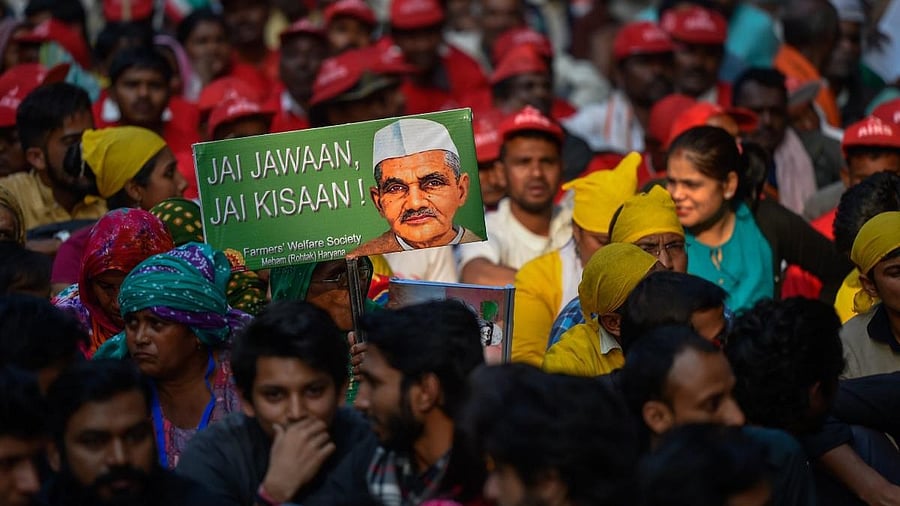
Image of farmers hold a poster carrying photo of former prime minister Lal Bahadur Shastri, who gave the slogan 'Jai Jawan, Jai Kisan' for representational purposes.
Credit: PTI Photo
History is not always a fair judge. It tends to remember those who disrupt the order more vividly than those who preserve it and those who provoke conflict more sharply than those who resolve it. As time passes, many who served society with integrity and restraint fade from public memory, while controversial or destructive figures continue to occupy centre stage.
The freedom movement was sustained not only by charismatic mass leaders but also by thousands who worked quietly, organising local networks, educating communities, raising funds, and enduring imprisonment without expectation of recognition. Over time, public memory narrowed itself to a few towering figures, while many others slipped into obscurity.
Lal Bahadur Shastri remains a telling example. As Prime Minister, he led the country through war and economic stress with humility and moral authority. His call of “Jai Jawan, Jai Kisan” reflected a deep understanding of India’s social and economic foundations. Yet his understated leadership is often overshadowed by louder and more polarising political legacies.
Sardar Vallabhbhai Patel’s contribution to integrating the princely states into the Indian Union was foundational to the country’s survival as a cohesive nation. The task demanded firmness, diplomacy, and extraordinary administrative skill. Without his efforts, India’s political map might have remained fragmented. Yet for decades, this achievement did not receive the attention it deserved in public discourse.
South India offers its own examples of such quiet builders. C. Rajagopalachari, independent India’s first Governor-General, combined intellectual depth with political restraint, often taking unpopular but principled positions. K. Kamaraj, remembered for his personal simplicity, reshaped Tamil Nadu by prioritising education and institution-building over political spectacle. Their legacies endure in systems strengthened rather than slogans coined.
Karnataka, too, has benefited from understated leadership. Sir M Visvesvaraya, the engineer-statesman and former Diwan of Mysore, laid the foundations of modern administration, public works, and technical education in the state. The Krishna Raja Sagar dam, the University of Mysore, and a culture of professional governance continue to bear his imprint. His vision was long-term and institution-centric, not driven by immediate popularity. Yet, outside textbooks and commemorative occasions, his contribution rarely enters everyday public discussion, a reminder of how quietly enduring excellence is often taken for granted.
Post-Independence India has seen many similar contributors. Homi Bhabha laid the scientific foundations of India’s atomic energy programme. Verghese Kurien transformed rural India through the White Revolution, empowering millions of farmers. E Sreedharan demonstrated that large public infrastructure projects could be delivered efficiently and with integrity. Their work reshaped the nation, yet their stories rarely command sustained public attention.
In contrast, figures associated with conflict, controversy, or disruption tend to dominate debates. Destruction attracts attention more easily than discipline. The human mind remembers shock more vividly than steadiness. This psychological tendency shapes popular culture, public discourse, and media priorities.
The same pattern is visible in everyday life. In offices and institutions, employees often remember the one superior who humiliated or obstructed them long after they forget the manager who encouraged growth, approved promotions, or acted with fairness. Negative experiences leave deeper imprints; positive ones are quietly absorbed and then forgotten.
Media narratives inevitably reflect this bias. Scandals generate headlines; steady governance rarely does. Institutional failures are examined at length, while institutional strength is taken for granted. Over time, this skews collective memory, rewarding disruption with attention and allowing quiet contribution to fade.
This is not an argument for ignoring history’s darker chapters. A democracy must examine its failures honestly. But balance matters. When public discourse consistently amplifies harm and marginalises service, it distorts societal values.
The common citizen understands this instinctively. He recognises the worth of the honest official who clears files without delay, the teacher who shapes lives without applause, and the engineer who builds systems that simply work. Institutions endure because of such individuals, even if they rarely make news.
The question, then, is not merely whom history records, but whom society chooses to remember. A mature democracy must find space to acknowledge those who held the system together, not only those who shook it.
If India is serious about strengthening its democratic foundations, it must correct this imbalance. Nations are not sustained by noise alone, but by quiet competence, moral restraint, and sustained service. History may favour drama, but public memory can choose wisdom. That choice will determine not only how we remember the past, but also the kind of future we are willing to build.
(The author is an entrepreneur, a qualified corporate director and a freelance writer)
(Disclaimer: The views expressed above are the author's own. They do not necessarily reflect the views of DH.)