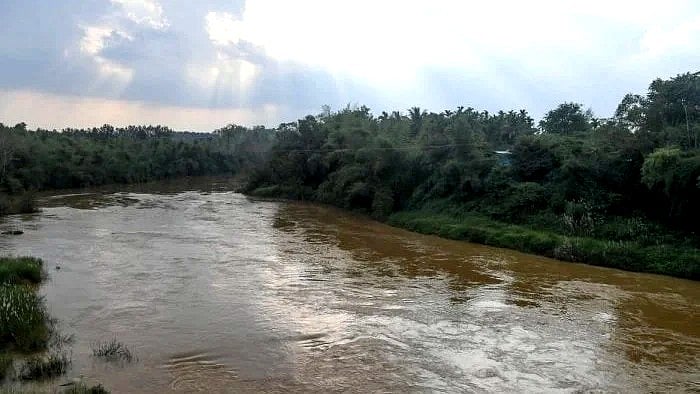
Representative image showing a river.
Credit: DH Photo
At dawn, the Kali flows almost unnoticed. Mist rises from her surface, hornbill wings cut across the canopy, and the river bends silently through some of the most intact forests of the Western Ghats. This is not a river built for spectacle. It sustains forests, wildlife, and communities precisely because it has long been allowed to remain undisturbed.
That fragile balance is now under strain. In the name of adventure tourism, the Kali is being broken into commercial segments, her quiet stretches converted into rafting routes by multiple operators. What appears to be a routine administrative step in the Ganeshgudi–Dandeli stretch is, in fact, the outcome of a specific order issued by the deputy commissioner, Uttara Kannada District — as chairperson of the River Rafting and Water Adventure Sports Management and Monitoring Committee — permitting private operators to conduct rafting on the Kali River.
This is not merely a dispute over who conducts rafting. It illustrates how a district-level decision, taken in disregard of established government policy and inter-departmental communications, allows short-term commercial interests and procedural expediency to override ecological limits, public safety, and the state’s conservation and revenue commitments.
The rafting stretch flows through the Hornbill Conservation Reserve, contiguous with the Kali Tiger Reserve. India hosts nine hornbill species, and Dandeli supports all four found in southern India — Malabar pied, Malabar grey, great, and Indian grey hornbills. The river and surrounding forests also sustain tigers, leopards, sloth bears, otters, fish eagles, marsh crocodiles, amphibians, and other riparian species dependent on quiet riverbanks and intact canopies.
Hornbills depend on large old-growth trees for nesting and are highly sensitive to disturbance. Even low-level human intrusion along river corridors can disrupt breeding, making extended rafting operations—even as Dandeli hosts the 'Hornbill Festival'—a stark contrast between conservation rhetoric and ground reality.
Allowing private rafting is also likely to trigger a surge in resorts and homestays along the river corridor. Many already operate illegally in and around Dandeli and Ganeshgudi, with little effective enforcement by the district administration. Granting private rafting permissions will only exacerbate this trend, intensifying habitat disturbance, increasing unregulated human presence, and further complicating forest management.
For over two decades, rafting in the Kali was conducted exclusively by Jungle Lodges and Resorts Ltd (JLR), a Government of Karnataka undertaking, following a clear policy decision of the Forest, Ecology and Environment Department that rafting in such landscapes must remain tightly regulated and conservation-oriented.
Under JLR, rafting was seasonal, limited in scale, and operated by trained staff under strict safety protocols. In over 22 years, no major mishaps were reported. Operations aligned with ecological sensitivities through seasonal restrictions and coordination with forest authorities. This is not an uncritical endorsement of JLR’s entire tourism portfolio — concerns exist regarding tourism within core tiger habitat at K Gudi and a few other locations — but in riverine forest landscapes such as Dandeli and Ganeshgudi, its rafting operations demonstrated how tourism can be conducted with restraint, safety, and ecological responsibility.
That model is now being dismantled. Private operators have begun rafting under permits issued by the district administration and, in some cases, illegally—contrary to long-standing government decisions and often without mandatory approvals. Despite repeated assurances to act against violations, these activities continue, eroding regulatory credibility and ecological safeguards.
Particularly troubling is the argument that the Kali River falls outside the Forest Department’s jurisdiction because it is not explicitly mentioned in the Reserve Forest notification for the Ambeli–Ilava to Moulangi stretch. This ignores ecological reality: the river’s entry points lie within forest land, both banks are forested, and the river is the lifeline of these ecosystems. The Forest Department routinely undertakes risky and pays ex gratia for wildlife incidents — especially crocodile attacks, which are common in and around Dandeli. Excluding forest approval for rafting based on a technical omission reduces governance to form over substance. It is a stark irony that the district administration expects the Forest Department to respond to such emergencies yet sidelines it when permitting private rafting, arguing that the river does not 'belong' to the department. This contradiction is nothing short of a disgrace to the Kali River.
River rafting involves fluctuating flows, submerged obstacles, and sudden dam releases. It requires trained guides, certified equipment, emergency response systems, and coordination among authorities. Fragmented, profit-driven operations pose serious safety risks, while legal and moral responsibility ultimately rests with the state.
Privatisation has also caused revenue losses. As a government undertaking, JLR reinvests its earnings into conservation, local employment, and forest protection in areas such as Dandeli. Rafting by private operators — whether legally permitted or unauthorised — diverts public revenue while increasing enforcement and ecological costs, effectively socialising losses while privatising gains.
In September 2025, the managing director of JLR formally objected to private operators, noting that JLR’s permission had been extended until June 2028 by the Forest Department. This was consistent with the Tourism Department’s 2022 communication stating that rafting in the Kali, within the Hornbill Conservation Reserve, should be conducted only by JLR. Ignoring such positions weakens governance and sets a dangerous precedent.
The Kali can either remain a living river — supporting hornbills, forests, livelihoods, and responsible ecotourism — or become another example of ecological sacrifice for short-term gains.
Restoring exclusivity of rafting operations to JLR is not about resisting tourism or competition; it recognises that certain landscapes are too ecologically sensitive to be governed purely by market logic.
If we fail to act now, the hornbills will leave quietly, the forests will thin imperceptibly, and the river will continue to flow — diminished, commodified, and poorer for it.
(The writer is a wildlife conservationist)