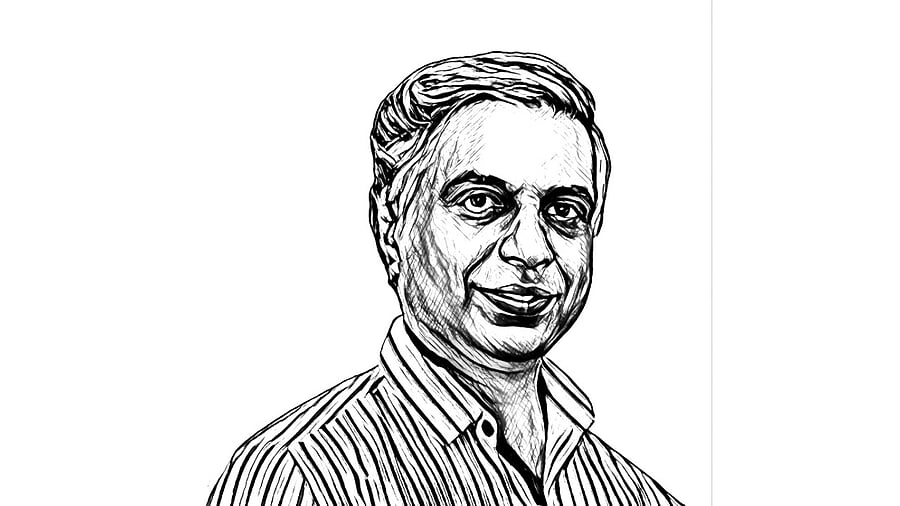
S R Ramakrishna often sees high art in kitsch and vice versa
As I wrap up my column this Saturday, I am off to the Bengaluru
International Exhibition Centre on Tumkur Road to catch
a live show to mark a milestone — 50 years of Ilaiyaraaja’s music. Many in my circle are huge fans of the film music composer; they even travel across cities to catch his concerts. I count myself as one of his most ardent fans, and I once drove from Bengaluru to Chennai to catch a show. The frenzy was such that it took two hours to reach the venue from the hotel, just 2 km away. Ilaiyaraaja’s fans are spread across the world, and the South Indian diaspora turns up in huge numbers whenever he performs abroad.
Yet, I sometimes wonder if the larger world has fully comprehended the extent of his genius. He has never been nominated for a Grammy, and Hollywood hasn’t embraced him either. Not that it matters to him, but it rankles his admirers.
Film music is group effort, and multiple authorship defines the film song. The intros and interludes are often composed by musicians other than the composer of the tune. Conventionally, composers in Indian cinema have excelled at making Indian-style melodies, getting their orchestras arranged by those familiar with Western music theory.
This collaboration between Indian and Western musicality has produced some of the most original-sounding music in the world. Before the word ‘fusion’ even came into vogue, Indian film music was fusing genres from across the world without inhibition. Ilaiyaraaja casually produces what it takes a group of musicians with specialised skills to produce. He makes the tunes and also writes the score for his full orchestra, with separate parts for each instrument. I don’t know who else can do that, and at his pace.
But that is not his primary claim to genius. It is difficult to describe the thrill that his initial scores generated among music lovers. The galaxy of composers active when he debuted had individual styles and comparable orchestral arrangements. He arrived with a sensational new approach to phrasing, harmony, and orchestral arrangement. He produced the most audaciously stylish splash of sound we had heard in Indian films. And it drew from a profusion of styles, Indian and Western.
Ilaiyaraaja has often spoken about how, with rudimentary knowledge and a phenomenal memory for tunes, he landed the job of assistant to Kannada film music composer G K Venkatesh. He eventually debuted as an independent composer with the 1976 Tamil film Annakkili. In fact, YouTube is replete with Ilaiyaraaja lore, with videos chronicling how some of his most iconic songs were made. In recent years, he has taken his listeners through the making of his scores, explaining in detail how the various sections of his orchestra come together.
The 1990s brought a challenger: A R Rahman. With Roja (1992), Rahman began exploring the new possibilities of electronic music, synthesisers, and advanced programming. It looked like Ilaiyaraaja’s analog-era flamboyance was being overtaken, but his music has stood the test of time, and he is actively composing even at 82. When interviewers ask him about technology overtaking music, he is categorical: “Without performance, there is no music.”
At his peak, Ilaiyaraaja’s popularity eclipsed the stars; films succeeded on the strength of his music alone. For those upset that he has not got his due, it is a matter of consolation that, in 2025, Ilaiyaraaja recorded and performed his Symphony No. 1, Valiant, with the London Royal Philharmonic Orchestra’s 77-piece ensemble.
The Modi dispensation made him a Rajya Sabha member in 2022, as part of the BJP’s push for a Tamil Nadu presence. Ilaiyaraaja has been relatively silent in the Upper House. Attendance is sporadic, and he has made no memorable speeches. All of which again underlines how he is a musician first and foremost, and his interest in politics will remain a matter of little consequence.
In his conversations, he can be cutting, but he never holds back when it comes to sharing his insights. At a workshop he conducted in Goa, he gave a live demonstration of his composing philosophy – a film score shouldn’t merely represent what is appearing on screen, it should add subtext. He showed what he would do to score for a scene in which a man in murderous rage is out to kill his father. He came up with a gentle lullaby, telling the audience that he is reminding the protagonist about the tender moments he has shared with his father.
The peaks Ilaiyaraaja scaled will remain hard to reach. In an era of AI algorithms and auto-tune, his organic genius reminds us why music must remain human. In him, the most distant streams of music merge to create aural magic.
The writer often sees high art in kitsch and vice versa.
Disclaimer: The views expressed above are the author's own. They do not necessarily reflect the views of DH.