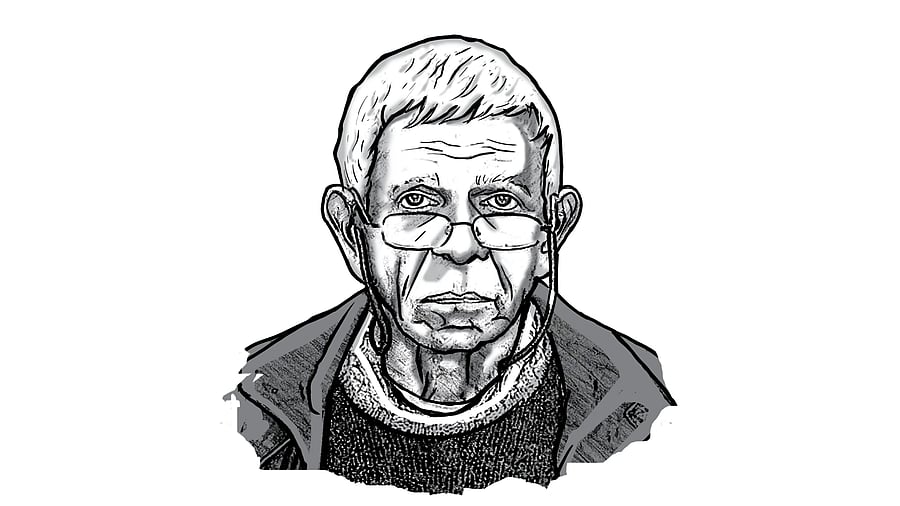
Roger Marshall is a computer scientist, a newly minted Luddite and a cynic.
Credit: DH Illustration
The time-worn adage “‘tis impossible to be sure of anything but Death and Taxes” needs to be updated to “‘tis impossible to be sure of anything but Death, Taxes, and Fees”. Fee is a generic term for all kinds of charges tacked on to the invoice with the sole purpose of gouging the customer. Few customers question the legitimacy of these extra charges.
Some fees are mandated by law, as, for example, in the beverage industry, where stores are required to charge the customer a refundable deposit on beer, soft drink, and water sold in bottles or cans using recyclable material such as metal, glass or plastic. It is all the other types of fees that I wish to comment on.
The most egregious fees are charged by companies which facilitate the movement of physical and virtual goods – airlines, railways, banks, electric utilities, telecoms, hotels and motels, restaurants, e-commerce companies, etc. Here is a non-exhaustive list of charges compiled from actual bills: cancellation fee, booking fee, restocking fee, merchant function (?), tariff surcharge, other delivery surcharges, baggage fees, preferential seat fee, no-show fee, late fee, wire transfer, incoming wire transfer, paper statement fee, bank teller visit fee, itinerary change fee, SMS notification, shipping and handling, ATM fee (own bank or some other entity), miscellaneous charges, and service charge.
While most of the above fees are self-explanatory, some of them require an explanation which is not readily available, since these days, humans have been cut out of the loop in telephone conversations. Virtual agents are practically useless in this regard.
The newest entrant to the fee game played by businesses, large and small, is the ‘convenience fee’. The fee, amounting to around 4%, is applied to every electronic payment that involves charge cards – credit as well as debit. I am puzzled as to why a company would charge a customer for using a debit card. Also, doesn’t the scheme facilitate a company to under-report income to tax authorities? Electronic payments can be tracked, but cash transactions cannot be.
In the US, no matter what store you walk into, you will always find a ‘tip’ jar or its electronic equivalent at the cash register; the electronic version is especially suggestive of how much tip you should leave – the percentage options you are presented with are usually these: 15, 18, 20, 25, 30 or ‘other’. The word ‘tip’, in this context, is really an acronym which stands for ‘to insure promptness’.
Also, the practice of asking the customer if they wish to round up their purchase amount so that the extra pennies go to supporting some charity has become quite standard. One is never really sure if customer contributions to charity end up lining the business owner’s pockets. The time-worn practice of baksheesh in India has been repurposed in the US and made more or less obligatory – shaming the customer or making them feel guilty is part of the marketing process.
About 75 years ago, credit cards were introduced to make shopping convenient, and now, we have a convenience fee. Thirty years ago, the web came into being and made searching for information a lot easier. As per Google’s own statistics, there are around six trillion Google searches per year. Just imagine an AI-enhanced Google starting to charge users a penny per search. It is bound to happen in the near future. AI chips and data centres do cost a lot of money, you know.
When the US accuses leaders of third-world nations of being corrupt and making it difficult for US businesses to operate freely in those countries, America conveniently forgets that it is also engaging in corrupt practices, albeit legalised, by allowing lobbying groups and political action committees, code-named ‘superpacs’, to facilitate various preferred legislative agenda items at the state and federal levels.
The US has a Foreign Corrupt Practices Act to prevent American companies, especially arms and aeroplane manufacturers, from offering bribes to foreign officials to obtain contracts in those countries. One man’s meat is another man’s poison, but only in certain situations. Ask Latin America or the oil-rich kingdoms of the Middle East. Qatar did give Trump a free Boeing and lucrative cryptocurrency deals for his sons. And Qatar does host the largest US Air Force base outside of the US.
The Empire is always ready to strike. And Google will be at the forefront, leading the charge.
(The writer is a computer scientist, a newly minted Luddite and a cynic.)
(Disclaimer: The views expressed above are the author's own. They do not necessarily reflect the views of DH.)