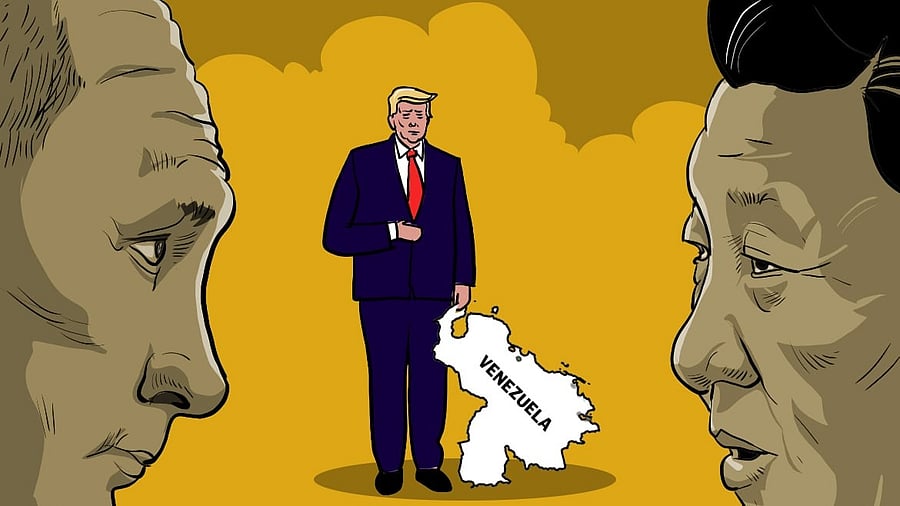
After attacking Venezuela and seizing its head of state, President Donald Trump said Saturday that the country had been “hosting foreign adversaries” and asserted that “American dominance in the Western Hemisphere will never be questioned again.”
His remarks appeared to be a broadside against Russia and China, which both built close ties to Nicolás Maduro, the captured Venezuelan leader. But in fact, there was also plenty in Trump’s words and deeds that Beijing and Moscow could get behind.
Trump’s stunning assault on Venezuela has ushered in new uncertainty around the globe, with allies and adversaries alike scrambling to reckon with a superpower ready to use force in the service of a transactional, might-makes-right foreign policy.
For the two countries long seen as America’s chief adversaries, Russia and China, that uncertainty is tinged with opportunity, foreign policy analysts said.
“If we have the right to be aggressive in our own backyard,” said Fiona Hill, a Russia expert at the Brookings Institution, “why can’t they?”
Hill was the senior director for European and Russian affairs at the White House during part of Trump’s first term. In spring 2019, she told a congressional hearing later that year, Russia quietly signalled it was ready to cut loose its ally Maduro in exchange for the United States’ stepping back from Ukraine.
“You want us out of your backyard,” the informal Russian message went, in Hill’s telling. “We, you know, we have our own version of this. You’re in our backyard
in Ukraine.”
Hill said she went to Moscow at the time to reject the idea. Russia never confirmed Hill’s account, but its RIA state news agency reported in April 2019 that her meetings in Moscow “revealed serious, deep contradictions and significant differences” regarding Venezuela.
Now, Russia could well have more luck with such a geopolitical swap, given that Trump’s rhetoric “shows that everything can be traded,” she said in an interview on Monday.
“It gives them the opportunity to try it again,” she said.
So far, China and Russia have condemned the U.S. attack on Venezuela, but they have not threatened to defend their ally.
At an emergency meeting of the United Nations Security Council on Monday, Russia and China demanded the release of Maduro and his wife, and called for a halt to any further military action by the United States.
China’s foreign minister, Wang Yi, said Sunday that no country could “act as the world’s police,” without mentioning the United States, according to Reuters. Russia’s U.N. ambassador, Vasily Nebenzya, said, “The American global gendarme is attempting to rear its head once again.”
But some in Moscow went so far as to offer hints of praise for Trump’s attack.
Dmitry Medvedev, the former Russian president, told the country’s Tass news agency that Trump “and his team have been rigidly defending his country’s national interests, both political (with Latin America being the backyard of the United States) and economic (give us your oil and other natural resources).”
The restraint was striking given the investment in Maduro’s rule by both China and Russia. Russia sent nuclear-capable bombers to Venezuela as a show of force in 2018 and ratified a “strategic partnership” with Venezuela just last October, looking to the country as a platform for projecting its influence across Latin America. China upgraded its ties to an “all-weather” friendship when Maduro visited in 2023 and lent more than $100 billion to the country over the past quarter-century, largely in a bid for access to Venezuelan oil.
But in the past year, the calculus for both Moscow and Beijing in what they stand to gain and lose in taking on the United States has been changing quickly. Both countries are aware that the consequences of antagonizing Trump can be severe, while the advantages of flattering him appear significant.
“Both Russia and China want to prioritize manipulating Trump to achieve more important interests for themselves,” said Tong Zhao, a specialist on strategic security issues at the Carnegie Endowment for International Peace in Washington.
For President Xi Jinping of China, the priorities appear to include a further relaxation of U.S. export controls and gaining more freedom of action in the South China Sea and beyond. After facing a potentially devastating trade war with the United States early last year, China secured a one-year truce with Trump in October and gained access to some advanced American computer chips in December. The Chinese leader is now expected to host Trump in Beijing in April.
Maduro’s fall comes with silver linings for Beijing, said Ryan Hass, a Brookings Institution scholar who was the China director on the National Security Council in the Obama administration. Having more U.S. military assets devoted to Latin America rather than Asia is beneficial; so is the increase in Venezuelan oil production that Trump has promised, given that China is the world’s largest importer of fossil fuels.
And then there’s the legitimizing effect for any future actions that violate international law, including against Taiwan.
America under Trump “has allowed itself to be seen as indistinguishable from China and Russia in its willingness to break rules in the service of its own narrow interests,” Hass said. “So it removes a degree of pressure on China in that regard.”
For his part, Russian President Vladimir Putin has been silent in the face of Trump’s seizure of Maduro, whom he hosted at the Kremlin just last May. The silence is especially striking because of the Russian leader’s anger in the wake of other Western interventions, such as NATO’s strikes in Libya in 2011.
But for Putin, the goal in staying in Trump’s good graces is clear: To convince the United States to deliver a Russian victory in Ukraine.
“The Russians probably think that as unhappy as they are with what happened,” said Hanna Notte, an expert on Russian foreign policy, “it is an acceptable price to pay if they come out on top in Ukraine.”
Putin achieved an end to three years of diplomatic isolation by the United States with his summit with Trump in Alaska in August. His concrete gains from humouring Trump have so far been more limited than Xi’s, with the White House still appearing unwilling to force Ukraine to capitulate to all of the Kremlin’s demands.
Notte, an analyst at the James Martin Centre for Nonproliferation Studies in Monterey, California, pointed out that Putin has sought to avoid antagonizing Trump even though the United States has become more involved in parts of the former Soviet Union, including the South Caucasus and Central Asia, that the Kremlin considers part of its post-Soviet sphere of influence. And Russian reticence to take on Trump over Venezuela might also stem from the simple fact that there was little Moscow could have done to stop him.
Even as Putin stayed out of the spotlight, Medvedev, one of Russia’s most publicly hawkish officials, gave voice to the Kremlin’s pragmatism.
“Let’s put it bluntly,” he told the Tass news agency, referring to the United States, “now they have no grounds, even formally, to reproach our country.”