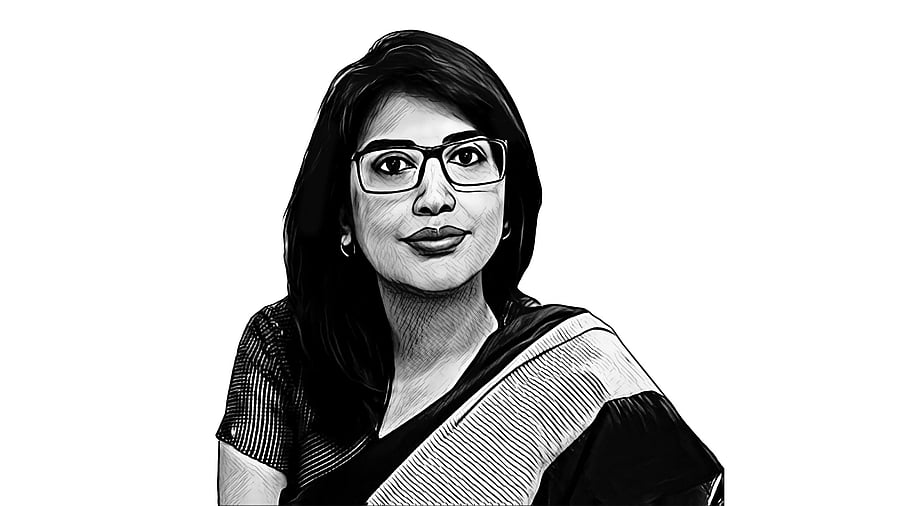
Sumana Roy is an author and poet. Her books include How I Became a Tree and Provincials.
Credit: DH Illustration
To notice is to change...’ Andy, my student, begins a poem with these words. I’m surprised that such a young person, an undergrad student, has noticed this about noticing. When students enrol for courses in creative practice, whether writing or art or theatre, I imagine that they come to acquire skills, skills that, in shorthand, can be called technique. These are not hard to acquire – soon enough, after they think they have gathered the toolkit, they begin to seek ways that are essential to creativity. That desire comes in various words: ‘seeing’, ‘writing material’, even ‘vision’ and ‘philosophy’. At some point, when discussing a punctuation mark in a poem, one of them will say it aloud in a mix of curiosity and exasperation – ‘But how does one notice these things?’ In some other location, an old school friend will say something similar: ‘We went to the same school and college and grew up in the same town. How do you notice this heart-shaped hole that’s broken from a wall, but I don’t?’
I report this not as self-praise but to summarise the obvious – what we notice and what comes to exist in the realm of our neglect gives our intelligence and spirit its personality.
Such an intuitive understanding of this lineage erupts through various words. One of them, for instance, is ‘register’. It could be something as simple as ‘She didn’t register my presence...’ Like many of this tradition of noticing, they come from a recording of some kind of permanence, such as a script. ‘Register’ is both noun and verb – what has been registered must be recorded in a register, a piece of writing stationery, something like a logbook. One of these is something that has, in places like India, been called the ‘attendance register’. It’s a ready-made category that gathers mass in our lives as soon as we enter school, and stretches till its end, stalking our work life. This bureaucratic word, which is all outside, a record of our public and institutional presence, brings two words that derive from our deeply interior lives: ‘attendance’, from ‘attend’, the same root as ‘attention’; ‘register’, an impress made on our consciousness.
How these words, coming from a mental climate that resists calibration, that is outside prediction and any kind of assurance that comes from the possibility of history repeating itself, came to grow a cell membrane and stand in for a bookkeeping world is a thing of wonder – not only of how words migrate through time but a speculation about consciousness itself. When did we begin to notice ourselves noticing? When did we think it important to preserve this act of noticing? Why did we let this internal record of noticing transmogrify into something surveillant and puritanical? For what else is the journey of ‘attention’ to ‘attendance register’?
Or the movement from ‘noticing’ to ‘notice board’? If the attendance register records footfall, the notice board is meant to be a magnet for the eye. It’s a device located at a site to catch the attention of passersby, a grazing ground for the eye to settle as it hovers everywhere, even though it intends to rest. Once it’s caught the attention of a reading person, it behaves like a germ, refusing to leave our system until sleep or a new notice board chases it out. What we notice changes us. And notice boards, do they change us too?
‘But we must notice – /we are designed for the moment.’ These are the last words Robert Lowell writes in his poem ‘Notice’. It’s a deeply moving summation of what has been given to us in the lines preceding this: ‘The resident doctor said,/“We are not deep in ideas, imagination or enthusiasm—/how can we help you?”/I asked,/“These days of only poems and depression—/what can I do with them?/Will they help me to notice/what I cannot bear to look at?” I re-read Lowell and wonder whether we notice them more, what we cannot bear to look at. I’m old enough to know that it’s not I-think-therefore-I-am that has produced what I now find myself to be. Like everyone else, I am who I have turned out to be because of what I noticed and what I didn’t. We are notice boards – an accretion of everything we have noticed. ‘We are designed’ to be.
The writer is an author and poet. Her books include How I Became a Tree and Provincials.
Disclaimer: The views expressed above are the author's own. They do not necessarily reflect the views of DH.