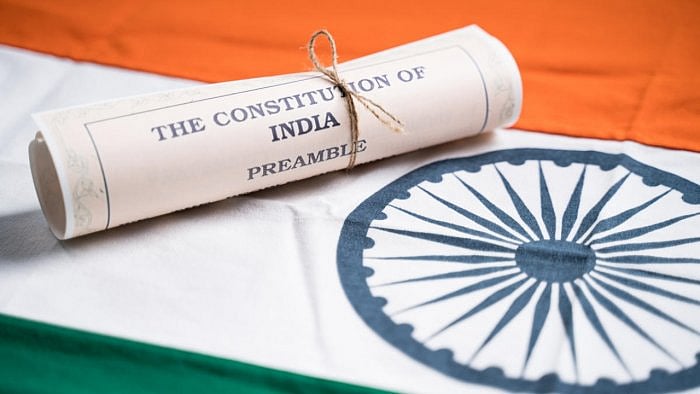
Constitution of India. (Image for representation)
Credit: iStock Photo
The conduct of governors in Kerala, Tamil Nadu and Karnataka during the special address mandated under Article 176(1) of the Constitution has resurrected a crucial debate on the role and relevance of constitutional conventions in an elected democracy. In recent times, what ought to be routine constitutional practice is increasingly turning into a democratic crisis. Notably, this pattern has emerged only in states ruled by parties outside the National Democratic Alliance. The conduct of governors in these states goes beyond political disagreements and risks eroding the foundations of constitutional democracy.
According to British academic Sir Ivory Jennings, “Constitutional conventions provide the flesh that clothes the dry bones of the law; they make the legal constitution work; they keep it in touch with the growth of ideas.”
During the Constituent Assembly Debates, B R Ambedkar stated, “If the Constitution remains in principle the same as we intend that it should be, that the Governor should be a purely constitutional Governor, with no power of interference in the administration of the province.” Article 176(1) mandates that “at the commencement of the first session after each general election to the Legislative Assembly and at the commencement of the first session of each year, the Governor shall address the Legislative Assembly or, in the case of a state having a Legislative Council, both Houses assembled together….” This provision, inherited from the British Cabinet model of parliamentary democracy, leaves little room for interpretation.
On the governor’s conduct, Karnataka Chief Minister Siddaramaiah states that it was “against the provisions of the Indian Constitution” and “clearly violates Articles 176 and 163.” He also indicated that the state government was considering approaching the Supreme Court.
The constitutional position is unambiguous. The special address under Article 176(1) is a mandatory constitutional function. Governors do not enjoy discretionary powers in this matter, unlike in areas governed by the fifth and sixth Schedules. Governors of Tamil Nadu, Kerala and Karnataka have failed to discharge this duty in accordance with the Constitution. Ironically, even as the Union government repeals colonial-era laws and has reportedly issued a circular to rename Raj Bhavans as Lok Bhavans on the premise of decolonisation, the functioning of these offices remains far removed from democratic norms. A change in nomenclature may be symbolic, but what is truly required is a change in style and substance.
The issue at hand is not the governor’s personal or political disagreement with the contents of the address, which is prepared and approved by the Council of Ministers. Constitutional convention requires the governor to address the legislature using Cabinet-approved text. Any deviation from this practice lies outside the constitutional framework and undermines the federal spirit.
Differences between the Union and state governments are a natural feature of democracy. However, once appointed, a governor’s personal and political affiliation must cease to influence their conduct—at least in theory, if not always in practice. The Supreme Court of India, in B P Singhal vs Union of India & Anr (2004), held that as the constitutional head of the state, a governor may often articulate the views of the state government, which may be neither his own nor that of the Centre. Similarly, in Shivraj Singh Chouhan & Ors. vs Speaker, Madhya Pradesh Legislative Assembly & Ors. (2020), the Court emphasised that “the Governor is expected to discharge the role of a constitutional statesman”. This spirit of constitutional statesmanship is conspicuously absent in the actions of governors in non-NDA-ruled states.
As the organic link between the Union and state governments, the governor’s role is to strengthen the federal relations, not strain them. The growing Union-state tensions emanating from Raj Bhavans point to
a troubling political bias against addresses prepared by state Cabinets. In Tamil Nadu, the Raj Bhavan issued a press note explaining the governor’s refusal to deliver the address, prompting Chief Minister M K Stalin to call for scrapping the customary governor’s address to the legislature altogether.
The Constituent Assembly retained the office of the governor to serve as a constitutional guardian of the state, not as a political actor. Viewed through the prism of constitutional governance, the conduct of governors of Tamil Nadu, Kerala and Karnataka has only deepened the democratic crisis. If the Union government is serious about dismantling colonial relics, it must reflect on whether it is prepared to reconsider the functioning and the future of Lok Bhavans, given the manner in which these offices are currently being used.
(The writer is an assistant professor at the Symbiosis Law School – Symbiosis International [Deemed University], Pune)
(Disclaimer: The views expressed above are the author's own. They do not necessarily reflect the views of DH.)