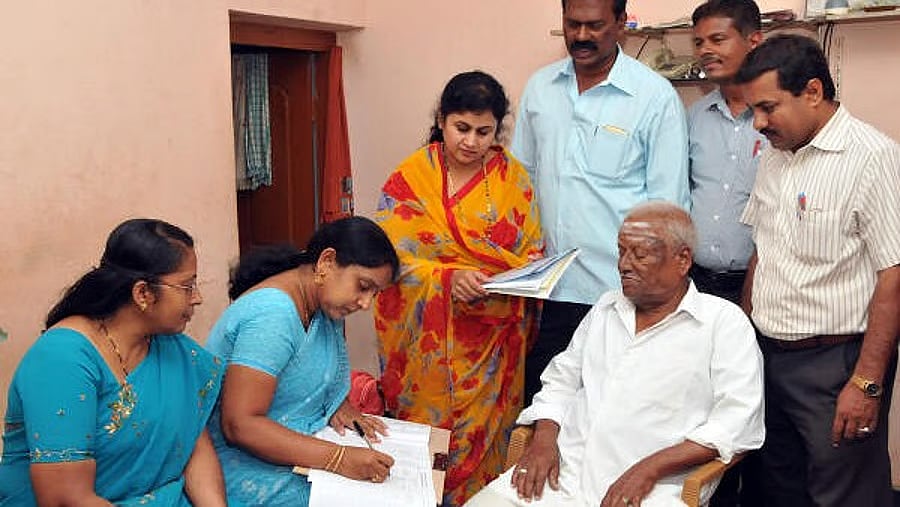
Caste survey in Karnataka. (Representative image)
Credit: DH File Photo
Karnataka’s Social and Educational Survey was conceived as an exercise in social justice. It is now revealing itself as a case study in administrative hubris. Across the state, thousands of enumerators have been trudging through villages and towns with malfunctioning devices and minimal preparation. Schools have been closed to free up teachers. In several districts, teachers have reported exhaustion, stress, and even tragedy: a 58-year-old teacher died of a heart attack reportedly while on duty. These failures reflect a deeper collapse of planning and purpose within the state. At their core lies the absence of institutional clarity about what this survey is, who is authorised to conduct it, and what purpose it serves.
The Karnataka government has tasked the Backward Classes Commission with conducting an all-caste survey – a move that, several legal experts argue, exceeds its mandate under law. Section 9(1)(i) and (ii) of the Karnataka State Commission for Backward Classes Act, 1995, empowers the Commission to study the social and educational conditions of the Backward Classes and to conduct surveys only for that purpose. It does not authorise the enumeration of Scheduled Castes, Scheduled Tribes, or the General Category. This position has also been raised in recent petitions before the Karnataka High Court, which noted that the Commission’s powers do not extend to an all-caste survey.
The irony is that the survey claims to serve the very groups it risks undermining. A government committed to social justice would strengthen institutions, not stretch their limits. The previous BJP government, through the Madhuswamy Committee, dealt with the question of internal reservations through a structured process. The present one appears to be acting without a firm legal anchor or institutional discipline. What may seem procedural in bureaucratic terms carries profound implications for justice and representation.
If the legal foundation of the survey is uncertain, its political origins are even more telling. It strains belief that Karnataka cannot locate the report of its own 2015 survey. The Kantharaj Commission’s massive survey, covering over 1.3 crore households and costing more than Rs 160 crore, was never tabled. The original report is no longer traceable. The Hegde Commission in 2023 submitted a reconstructed version using partial data. The Congress government has treated this institutional amnesia as routine -- announcing new surveys while quietly burying the old.
The decision to order a fresh survey appears to have originated not within the state cabinet or policy machinery but from the Congress high command. The announcement was made in Delhi by party general secretary Randeep Surjewala, in the presence of Chief Minister Siddaramaiah and Deputy Chief Minister D K Shivakumar. This sequence of events raises questions about where authority truly lies. Having failed to conduct a national caste census while in power at the Centre, the Congress now seeks to reclaim the social justice narrative through a state-level exercise that lacks administrative and legal clarity.
Even within the government, confusion has been apparent. Ministers have issued contradictory statements, officials have complained of shifting instructions, and the process of verification lacks clarity. The survey design itself compounds the problem. Respondents are asked to write in their caste without reference to an approved list or coding framework, producing inconsistent or non-existent identities. Reports from the field mention entries such as “Brahmin Christian” or “Lingayat Christian”, which have no recognition in law or welfare policy. Unless there is a clear process to verify and classify such data, the exercise risks producing numbers that are neither reliable nor useful. By confusing recognition with representation, the government risks turning social justice into an instrument of political convenience. Karnataka’s reservation system is built on statutory lists that define eligibility with precision.
Implementation of this survey has been equally disorderly. The government initially announced that enumeration would end by October 7, but the deadline has since been extended to October 18, with further delays expected in some districts. In Belagavi, teachers have protested the deployment of pregnant women, persons with disabilities, and those nearing retirement. Yet the government insists that the exercise is on schedule and that “minor technical issues” are being resolved.
Although the Karnataka HC has clarified that participation in the survey is voluntary and that enumerators cannot pressure anyone to respond, field reports suggest that performance targets are influencing enumerator behaviour. The questionnaire itself appears poorly designed, with intrusive and inconsistently worded questions varying across districts, raising doubts about comparability and data integrity. D K Shivakumar has also publicly advised enumerators to “avoid asking personal questions”, further indicating administrative confusion.
A survey launched without clear constitutional backing, executed without administrative capacity or clarity, and pursued without internal coherence cannot command public trust. What began as a promise of social justice now risks being seen as a politically driven exercise.
If caste enumeration is to serve equity, it must be done with credibility, legality and transparency. That calls for a national caste census, conducted transparently under the authority of the Union government, rather than fragmented state-level efforts driven by electoral or partisan considerations. The Karnataka exercise offers a cautionary tale: when data collection becomes a substitute for governance, even a cause as vital as social justice can be reduced to political theatre.
(The writer is a spokesperson for the BJP in Karnataka and a public policy professional)
Disclaimer: The views expressed above are the author's own. They do not necessarily reflect the views of DH.