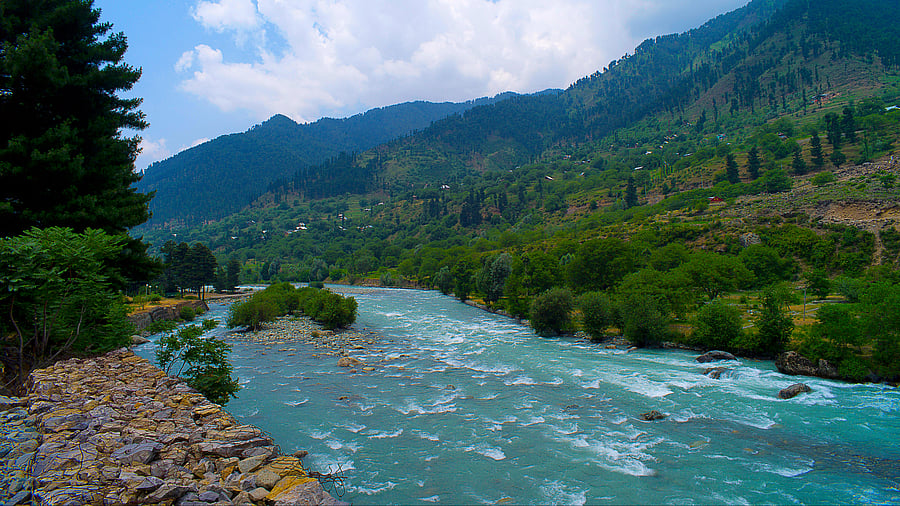
A representative image.
Credit: iStock Photo
Hazy memories of my first crossing a river on a sunny afternoon are still alive in my mind. An army man had walked me across the rocky bed of the river. It was much later that Heraclitus’ most quoted words had occurred to me: you cannot step into the same river twice. Years later, I stood again at the riverfront in Nanded without stepping into the Godavari this time, aware that Guru Gobind Singh had once lived
by its banks.
Without a cultural overdose, embedded deep in our psyche is the belief that rivers are goddesses to be revered. No one taught us this explicitly—it was absorbed in subtle and profound ways. My grandmother would postfix ‘Ganga’ to the name of any river, big or small, much to the irritation of my younger, educated sensibilities. The philosophical innocence behind such devotion is still revealing itself to me!
I could never hold rivers in ritualistic reverence, yet the sheer mention of a river has always stirred excitement. The river as a metaphor of human existence—holding answers within its flow to our foibles, loneliness, boredom, anxieties, frustration and helplessness—has remained intriguing but abstract. I often wish I had lived by a river long enough to unlock its secrets.
One such intrigue relates to Gulzar’s inimitable poetic expression–apna kinara nadiya ki dhara hai. How mainstream could anybody’s ‘destination’ be? The expression is loaded; its essence lies beneath the obvious. I have always felt that the mainstream of a river epitomises continuum; life and death are mere manifestations along its course and cannot truly be destinations.
My first lesson on karma, the core philosophy of Gita, came while travelling through the Kosi basin in north Bihar. Why would a mother be furious with her children? Perhaps it was the river’s need to correct her course or, more importantly, to perform her karma—the thankless task of land-building for human prosperity.
I knew nothing of hydrological engineering, but after that journey I sensed the worst. Just before the devastating deluge of August 2008, we prepared a report on Kosi’s growing frustration at being unable to fulfil her duties. Liberate the river from embankments, we urged, or she will find her own freedom. Our emotive outbursts were no match for prevailing hydro-hubris!
Even the Brahmaputra has honoured no boundaries in its multi-country journey. Travelling 500 kilometres along its vastness was a different experience. A colleague once asked if such a mighty river could be dissuaded from eroding its banks. My answer has always been: engage with the river and it will listen. It is a living system with a heart of its own—we must learn to listen to its heartbeat.
My many journeys along rivers have only exposed my inadequacies. Our understanding is shaped by myopic knowledge that sees a river merely as a resource for manipulation and exploitation. Such restricted vision has held us back from understanding an ecological system that is possibly the very source of life on this planet. Each river carries memories of millennia in its undercurrents.