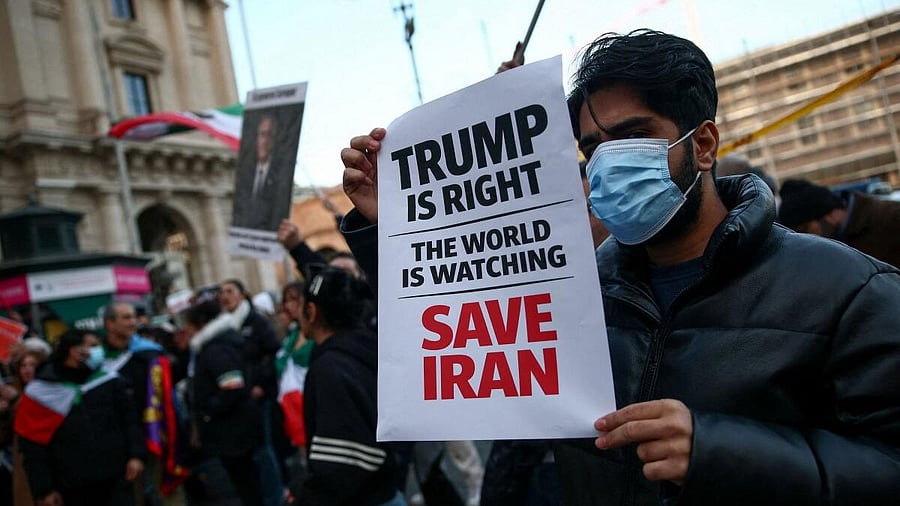
A man shows a sign mentioning US President Donald Trump during a rally in support of nationwide protests in Iran, in Rome, Italy
Credit: Reuters Photo
By James Stavridis
Even as the world focuses on the future of Greenland, the Trump administration has effectively walked away from events in Iran. Following the largest protests in the country since the 1979 revolution, President Donald Trump put the theocratic regime on notice that further killing of protesters would provoke a US response.
He later appeared to accept assurances that the executions had been halted — claims that many observers doubt. Credible human rights organizations believe that thousands, perhaps as many as 5,000 to 10,000 dissenters, have been killed in recent weeks.
Meanwhile, a US carrier strike group, centered on the massive nuclear-powered warship USS Abraham Lincoln and its embarked air wing of nearly 80 combat aircraft, is reportedly heading from the South China Sea to the North Arabian Sea. If the ayatollahs return — as they likely will — to large-scale, indiscriminate killing of protesters, what options are available to the president?
Let’s start with the carrier itself. I commanded a carrier strike group in those waters at the beginning of the Global War on Terrorism, just over two decades ago. I was a newly promoted one-star admiral, and we launched strikes against Iraq, Afghanistan and terrorist targets in the Horn of Africa during our six-month deployment.
Even a single carrier strike group is capable of considerable combat power, as the Venezuelans recently learned. And, most importantly, unlike land-based forces, no “host country” has veto authority over the six acres of sovereign US territory represented by our huge carriers.
If the president chose to use kinetic capability from the deck of the carrier, he could conduct precise strikes against Iranian air defenses using both bombs and electronic warfare.
The F/A-18 Hornets aboard the carrier could also strike high-value leadership targets (including the mullahs); command-and-control facilities of the Revolutionary Guards and the conventional military; the logistics supply chains of both the military and the civilian police — including the ironically named “morality police;” or critical elements of the Islamic Republic’s energy infrastructure such as maritime installations, refineries and port facilities.
Operating alongside the carrier and its potent air wing would be US Navy surface ships — primarily cruisers and destroyers — equipped with long-range Tomahawk land-attack missiles. These cruise missiles with a 1,500-mile range are highly precise and could be used against the same targets. They would likely be launched before manned aircraft to decimate Iranian air defenses.
These strikes would almost certainly be conducted alongside US Air Force operations from our bases in the region. Reportedly, at least one squadron of F-15 Strike Eagle aircraft has already arrived in Jordan, and additional support — aerial refuelers and cargo aircraft — could deploy to the logistics support base at Diego Garcia in the Indian Ocean.
Air strikes from Al Udeid Air Base in Doha, Qatar, are also likely, although several Gulf Arab states may be reluctant to permit strikes to launch from their soil.
In addition to US forces, we have an asset in the region that does not exist in the Caribbean against Venezuela: Israel. Israel provides the largest and best-defended set of airfields in the region.
The Israel Defense Forces would likely participate in any major mission, particularly one directed at decapitating Supreme Leader Ali Khamenei. The US and Israel, operating as an integrated joint force, have an enormous array of kinetic options to deploy against Iran.
There are also non-kinetic options the Trump administration could select. At the top of the list is offensive cyber activity, again potentially conducted in concert with Israel’s cyberwarriors.
Targets could include Iran’s energy sector, consumer supply chains, military command and control nodes, police and Revolutionary Guard facilities, telephone systems, and military production infrastructure — notably facilities that produce drones and ballistic missiles.
Information operations would likely be part of these cyber efforts. This could include taking control of Iran’s internet infrastructure — blocking all regime use while enabling the opposition to better coordinate their efforts and illuminate the atrocities that are almost certainly occurring.
Such actions would support the dissenters and help their psychological campaign to mobilize the population and further weaken the rotten theocracy that leads Iran.
While the US and most of its European allies are understandably absorbed by the drama surrounding a potential US move on Greenland, a far larger strategic game is underway in the Middle East.
Trump has a comprehensive array of options to come to the aid of Iran’s brave protesters. Acting now may be the best opportunity in decades to effect an internal regime change in Iran. The question is whether the brave opposition can once again capture the wavering attention of Washington. Let’s hope they do.
Stavridis is dean emeritus of the Fletcher School of Law and Diplomacy at Tufts University. He is on the boards of Aon, Fortinet and Ankura Consulting Group.
(Disclaimer: The views expressed above are the author's own. They do not necessarily reflect the views of DH.)