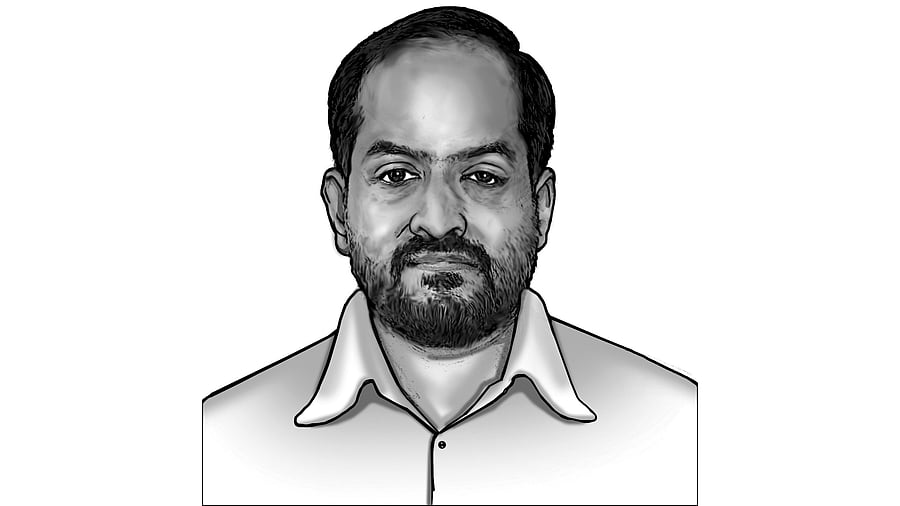
Venkatesh Nayak wakes up every morning thinking someone somewhere is hiding something.
Credit: DH Illustration
The Indian Railways (IR) ferried more than 700 crore passengers across the country in the year 2024-25. IR’s estimated earnings from passenger traffic crossed Rs 75,000 crore. According to the Parliament’s Standing Committee on Railways, the managers of the world’s fourth largest rail network are aiming at surpassing the magic figure of one billion passengers this fiscal, and earning more than Rs 92,500 crore from them.
Yet, this State-owned enterprise treats the methodology it employs for calculating passenger ticket fares as a sarkari secret. Two weeks ago, the Central Information Commission (CIC), appointed to champion the cause of transparency in governance, upheld the denial of this information for the third time.
While deciding a 1.5-year-old appeal, the CIC copy-pasted IR’s claim that the “disclosure of pricing-related information is not in the public interest” from its first appellate authority’s (FAA) decision, into its own order, without scrutinising it. Trains are the primary means of transport for a very large cross-section of our society, be it for education, work, pleasure, medical treatment or religious purposes. If the transparency of this information is not in the public interest, what else is? How much must the passengers cough up for travel tickets? In fact, this is all that IR disclosed to the woman RTI applicant, initially. Despite receiving a budgetary allocation of Rs 2.5 lakh crore, IR thinks it owes no explanation to taxpayers about its fare-calculation methodology.
The CIC accepted the FAA’s ‘rationale’ that “profit, if any, is distributed/transferred to the common man and is not retained for the benefit of personal gain as in the case of private enterprise” because it is an instrumentality of the State run as a commercial utility.
In its 2023-24 annual report, IR reported a gross profit of Rs 3,259.68 crore. It is silent about how it went about distributing this profit to the “common man”. Does investment in the expansion and upgradation of its own infrastructure, introducing high-speed trains with expensive tickets or improving waste management, etc., amount to ‘redistributing profit’? Isn’t this IR’s primary mandate? It certainly does not amount to charity as the FAA’s order makes it out to be.
Judicial recognition for the people’s fundamental right to know what the government is or is not doing, in their name, dawned 51 years ago. The joint opposition candidate, Raj Narain, sought disclosure of the ‘Blue Book’ containing detailed instructions for the Prime Minister’s security, to challenge Indira Gandhi’s election from Rae Bareli, on grounds of corrupt electoral practice. On January 24, 1975, a constitution bench of our Supreme Court directed full disclosure with this reasoning: “In a government of responsibility like ours, where all the agents of the public must be responsible for their conduct, there can but be few secrets. The people of this country have a right to know every public act, everything that is done in a public way, by their public functionaries. They are entitled to know the particulars of every public transaction in all its bearing... To cover with a veil of secrecy the common routine business is not in the interest of the public.”
Not only public authorities like IR, but many of our Information Commissions must also urgently go back to understanding these basics. IR has no competitor in the private sector. So, its claim to commercial confidence simply does not fly. Calculating passenger fares is part of its routine business. The exemption that IR claimed and whose applicability the CIC did not question is primarily designed to protect the competitive position of third parties, not a public authority, which has to decide an RTI application.
Thankfully, three days after this order by the CIC, the High Court of Orissa stepped in to correct another error committed by another Information Commission. Last year, the Odisha Information Commission disposed of a bunch of appeals, filed by an aggrieved citizen, through a common order, without directing the disclosure of any of the information sought and after describing them as ‘repetitive’ in content. Rubbing salt into the wounds, the Commission also barred him from using RTI more than 12 times a year! The court struck down this part of the order, holding that it was unjustified and directed the disclosure of all information sought by the applicant.
Most information commissions have multi-crore annual budgets. Funds must be utilised for educating them about the nitty-gritties of RTI and adjudication. Perhaps it is also time to create effective legal aid mechanisms for aggrieved RTI applicants to challenge their unreasonable orders in court.
The writer wakes up every morning thinking someone somewhere is hiding something.
Disclaimer: The views expressed above are the author's own. They do not necessarily reflect the views of DH.