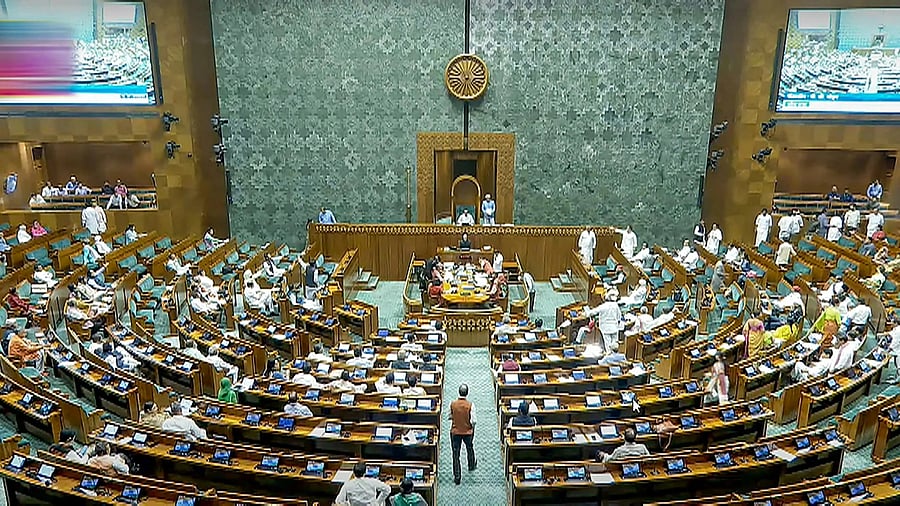
Members in the Lok Sabha, the Lower House of Parliament, in New Delhi.
Credit: PTI File Photo
Recently, a clutch of private member’s bills introduced by Shashi Tharoor, Manish Tewari, Supriya Sule, Nishikant Dubey, and Manoj Tiwari drew attention to varying contemporary issues.
Tharoor, the Congress MP from Thiruvananthapuram, sought an amendment in the existing law to criminalise marital rape, while his colleague from Chandigarh, Manish Tewari, is persisting with the idea to allow MPs to take individual positions away and free of the whip with riders. The NCP-SCP MP Sule advocated for a work-life balance and permitted employees to disconnect from office communication after work hours. BJP MP Dubey wants legislation to protect cows and establish a cow protection authority, and his party colleague Manoj Tiwari is advocating lowering the age of juveniles to 14 in the case of heinous crimes.
A private member’s bill allows any MP who is not in the Union Council of Ministers to persuade the government to write laws for the people. MPs can express their views on issues of public importance, and attempt to persuade the government to prepare policies and programmes. Rules in Parliament permit space for MPs not in the government to bring up issues by initiating legislation, which can then be discussed across the board with members across the political spectrum sharing their thoughts on it. The intention behind it is to draw the attention of the people and the government, which gets a sense of the spirit behind the intended legislation, and can come up with its decision or position on it.
Recently, a private members’ resolution sought a regulation on airfares, post the IndiGo meltdown.
Over the past 75 years, several hundred bills have been introduced in both houses of Parliament, but, to date, only 14 such Bills have been converted into laws. Parliament record shows the last such instance occurred in 1970, with the enactment of The Supreme Court (Enlargement of Criminal Appellate Jurisdiction) Bill.
Among these, the Parliamentary Proceedings (Protection of Publication) Bill, moved by then Congress MP Feroze Gandhi, strengthened freedom of the press. He discovered that while under the Constitution, MPs had immunity from court proceedings for anything said or voted in Parliament, members of the press were still at risk. While moving the Bill for consideration, he stated that inquiries from the correspondents made him realise the peril and introduced the intended legislation, which eventually led to the enactment of the law. It is another matter that the Act was repealed during the Emergency and brought back by the Morarji Desai-led Janata government, which also inserted Article 361A in the Constitution, expanding its scope to cover reportage of State legislatures in India and provide similar immunity.
The effort by individual MPs also bears fruit in another fashion. For instance, in December 2014, DMK MP Tiruchi Siva introduced a Bill in the Rajya Sabha on the Rights of Transgender Persons, which was passed by the House in the next session. This, after the Minister of Social Justice requested the member to withdraw the Bill, assuring the government’s intention to bring it. However, at the instance of the Leader of the House, the Bill was adopted. Around the time Siva’s Bill was under discussion in the Lok Sabha, the government brought a substantially identical Bill which was later enacted.
In 1953, Rajya Sabha member Seeta Parmanand introduced the Indian Suppression of Immoral Traffic and Brothels Bill. However, this could not be discussed as the recommendation of the President on it was withheld. This became a catalyst and in 1954, the government brought forward the Suppression of Immoral Traffic in Women and Girls Bill, which later on became an Act.
Rajya Sabha member K V Raghunath Reddy sought an amendment in the Companies Act to check shareholders from gifting themselves and to recover tax from companies, among other reforms. The government brought in the amendments in a separate Bill, which reflects the efficaciousness of the procedure.
In 1964, an attempt by Atal Bihari Vajpayee to ban donations by companies to political parties was rejected.
In all, the two-and-a-half hours earmarked every Friday, in the post-lunch session for private members’ bills and private members’ resolutions, are considered sacrosanct since it is the only time non-government members can push their considered views on issues of public importance.
K V Prasad is a Delhi-based senior journalist.
(Disclaimer: The views expressed above are the author's own. They do not necessarily reflect the views of DH.)