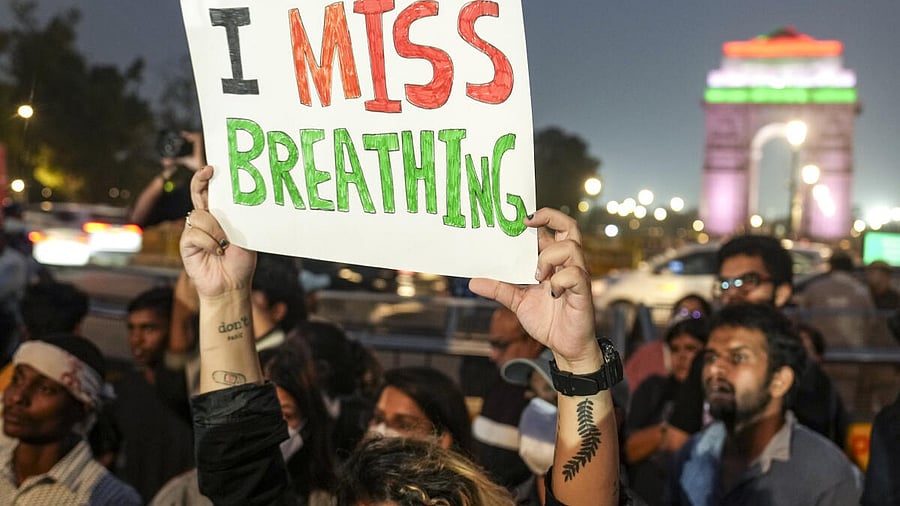
File image of a demonstrator holding a placard during a protest over the deteriorating air quality in the national capital region, in New Delhi
Credit: PTI Photo
Mihir Sharma for Bloomberg
Delhi is, once again, surrounded by a toxic, sulfurous haze, and its air quality was recorded as being just about the worst in the world last month.
If you live here, you can sometimes allow yourself to forget this. You can wake up in the morning and, even if the air doesn’t look so good, tell yourself that it’s winter — a little fog is only to be expected. But then you remember the persistent cough, and sinuses that are clogged with dust. Sometimes, your eyes are red enough to make it look like you haven’t slept a wink.
Is that just the price of living in this thriving megacity of 30 million-plus? This is, after all, where all the action is. We just learned that India grew at 8.2% last quarter. Perhaps a little bad air is the price we have pay for growth that the world envies. Indians just have to put up with it.
But it isn’t necessary for us to live this way, and we shouldn’t have to. This is a fixable problem, yet one that has never been a priority. And that tells us something unpalatable about where India is right now. Perhaps it’s growing at over 8%, but if so that’s in spite of the deficiencies of its state and not because of it.
Delhi’s world-beating pollution is only the most visible, tangible example of this. The reason it continues is because too many authorities are involved — each with their own interests, priorities and incentives. Delhi’s government may be directly responsible to the capital’s people, but those in the states that surround it are not, and it’s their farmers whose bonfires of agricultural waste make the city’s air worse. The municipal corporation is in charge of implementing anti-smog measures, but its officials don’t see eye-to-eye on the issue with the Delhi state authorities.
And then there’s the central government. It also sits in Delhi, breathing the same poisoned air as the rest of us. Yet it has been strangely unwilling to get everyone involved in a room and hammer out a sustainable solution.
For a simple co-ordination problem of this kind, solutions usually have to come from the top. Prime Minister Narendra Modi has never been shy about centralizing authority when it suits him; surely he should treat this problem the way that the leadership in Beijing treated China’s smog crisis more than a decade ago? Or Britain’s parliamentarians did after the Great Smog of December 1952?
The government can point to small improvements in air quality averages. But the reality for those of us who live here is that the air this winter remains bad enough to make us sick. And still, there is no sense of urgency; if anything, the approach is cautious and studied.
This stings — especially when compared to the “airpocalypse” of January 2013 that led the Chinese Communist Party to work out that no matter how effectively it controls the narrative, you can’t hide the fact that millions of city-dwellers are inhaling poisonous black dust all day. And so it acted to fix it. It’s almost as if Beijing’s authoritarians are more responsive than the institutions of the world’s largest democracy.
India has always moved forward, short-circuiting its fractured governance architecture, when those in charge have been willing to spend some of their political capital on a problem. By that standard, Delhi’s leaders, past and present, have been failures. And the prime minister’s popularity may give him a level of authority in the country that is the envy of his peers, but he has proved increasingly reluctant to use it in the service of anything that doesn’t have an immediate electoral payoff. Air pollution evidently doesn’t meet that standard.
Perhaps that’s a rare misjudgment. By the standard of demonstrations in India, the occasional rallies in the center of town to protest the unbreathable air are small. But they should still worry politicians, because they’re relatively spontaneous and untainted by party politics.
Issues like air pollution do not fall neatly along partisan lines, and cannot be blamed on the opposition or history. It affects all sections of society. Even those rich enough to buy air purifiers can’t cower inside all day. It’s not a divisive issue; nobody’s making pro-pollution arguments.
It’s precisely the sort of problem that can make the most apolitical of citizens lose faith in the system. China’s leaders saw that; why can’t India’s? Aspirational urban Indians are the most loyal BJP voters, and they see Modi in particular as the manifestation of competence; how long before their red eyes and dry throats cause them to start questioning that assumption?
Beijing cleaned up its skies because the alternative would threaten the regime’s legitimacy. Delhi in 2025, even if for naked political self-interest, should have a similar response. This is not an authoritarian country, but one where authority and legitimacy are increasingly concentrated, while accountability is fractured and fragmented. Modi’s ruling Bharatiya Janata Party has the power to act. Until it does, its voters discontent will only grow.