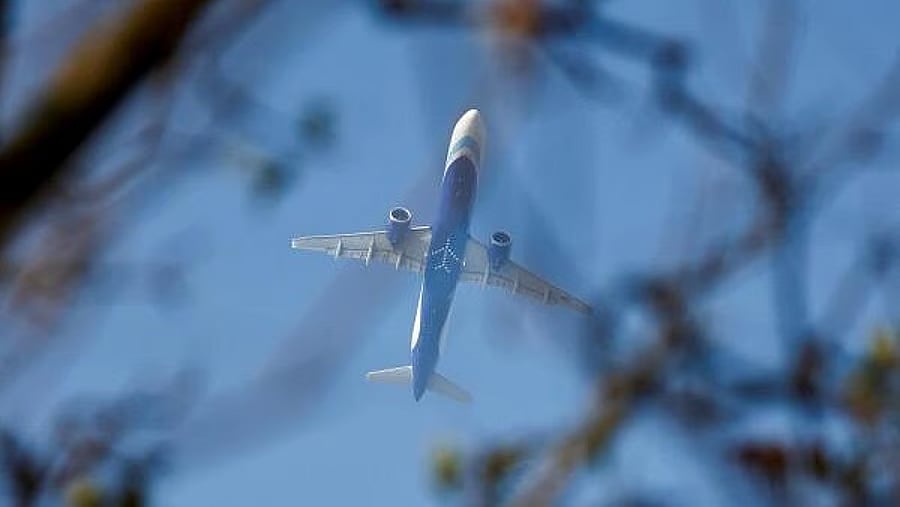
An IndiGo flight takes off.
Credit: Reuters Photo
The Indigo crisis isn’t a natural or technical disaster. It is entirely man-made.
Two parties — the airline (a supine IndiGo board and management included) and the airline regulator DGCA (policy-making government included) — are responsible for the mess, which left tens of thousands of passengers high and dry, suffering all sorts of completely avoidable pain, disappointment, and losses.
The hubris to rule India’s skies and the ‘ability’ of taking the regulator for granted, resulted in IndiGo sullying its reasonably stellar record, and its reputation getting trashed in that week of mayhem. The regulator and policy-makers proved clueless, complicating the crisis.
Will IndiGo accept its mistakes and revert to serving customers to achieve performance-based growth? Will the government and the DGCA act competently, building policy, rules, and a fit-for-purpose regulatory system? Or will India get distracted by suboptimal solutions like breaking up IndiGo’s ‘monopoly’?
IndiGo messed up
IndiGo, with extraordinary financial structuring, customer-centric commerce, and efficient operations, in a short span, captured ~65% of the domestic airline market. In the last few years, though, its model came under severe strain for various reasons.
IndiGo could not raise fares unreasonably as it was, admittedly, competing with the Indian Railways, particularly in the 500-1,500 kilometre segment.
As its profitability came under strain, it turned on its pilots and staff to save costs—this made the pilots and other staff increasingly disgruntled.
IndiGo’s operational performance suffered. This author was on a flight from Vadodara to Delhi on December 3 — it did not get a bay, then it took some time for a staircase to show up, thereafter, there was inadequate staff to operate it. This resulted in about 50 minutes being wasted!
To protect profitability, IndiGo then committed the cardinal sin of adding about 10% flights for the winter schedule, despite knowing fully well the shortage of pilots beforehand.
This gross mismanagement and hubris resulted in hundreds of cancelled flights, and massive customer pain; thus, making IndiGo an example of how not to operate an airline.
Inefficient regulator
There could not have been a worse week for IndiGo. Russian President Vladimir Putin was in the national capital. Delhi’s unbreathable air and uglier flight disruptions made the crisis an international spectacle.
That said, the whole episode demands a serious investigation.
What gave IndiGo the confidence to file a winter schedule with 10% additional flights amidst a serious pilot shortage? Why did the DGCA not disallow additional flights? What made the regulator look the other way — on its own, or at the behest of IndiGo’s star-studded Board or political masters?
The DGCA’s conduct and crisis management were horrible. Who directed it to take back the duty rules, which effectively allowed IndiGo to operate 10% additional flights, risking passengers' lives and security? Was it the civil aviation minister? What professional advice did the minister receive on this matter?
The state of utter confusion was followed by another confounding decision by the DGCA — to ‘penalise’ IndiGo by cutting the enhanced schedule by 5%. The government had to increase it to 10% as it became an embarrassment. Instead of partly taking back the FDTL rule, the regulator should have imposed a 10-15% cut on IndiGo’s schedule on December 4 itself.
All these regulatory violations and suffering caused to customers, etc. are still pending proper resolution.
Is IndiGo’s ‘monopoly’ an issue?
There is a lot of chatter, especially in circles/channels close to the government, that IndiGo has become too big to fail, and its monopoly needs to be broken.
Does Indigo’s ~65% share constitute a monopoly? Can Indigo be broken into two or more smaller airlines? Is there a better way to increase good competition in India’s aviation market?
The surest indicator of a monopoly is its ability to curtail supplies to extract off-market prices.
There is no evidence that IndiGo curtailed supplies. The accusation is that it was trying to unjustifiably increase supply. There is no evidence either that IndiGo’s airfares were too high for its costs, enabling it to earn super-normal profits.
All talks of IndiGo’s monopoly are unnecessary distractions, and do not stand scrutiny.
The solution?
What should be done to make sure that IndiGo does not remain so dominant. The solution is to bring real competition into the domestic airline market. This can be done by taking three policy decisions.
First, the domestic airline business should be opened for foreign airlines and non-resident Indians by allowing them to own more than 50% stake in domestic airline subsidiaries.
Second, the Indian Railways must be reformed on the lines of the electricity business — one or more national track operators, with passenger, freight, and station operations reorganised into smaller companies, followed by their liberal privatisation.
Third, any airline with more than 25% share in the domestic airline business should be subjected to special regulations, on the lines of other systemically important entities, like banks, for example.
These measures and reforms will introduce serious competition in the domestic airline market, and ensure that the December 2025 airport chaos never happens again. This will also make air passengers reap the benefits of an efficient and competitive Indian market.
Subhash Chandra Garg is former Finance & Economic Affairs Secretary, and author of ‘The Ten Trillion Dream Dented’, ‘Commentary on Budget 2025-2026’, and ‘We Also Make Policy’.
(Disclaimer: The views expressed above are the author's own. They do not necessarily reflect the views of DH)